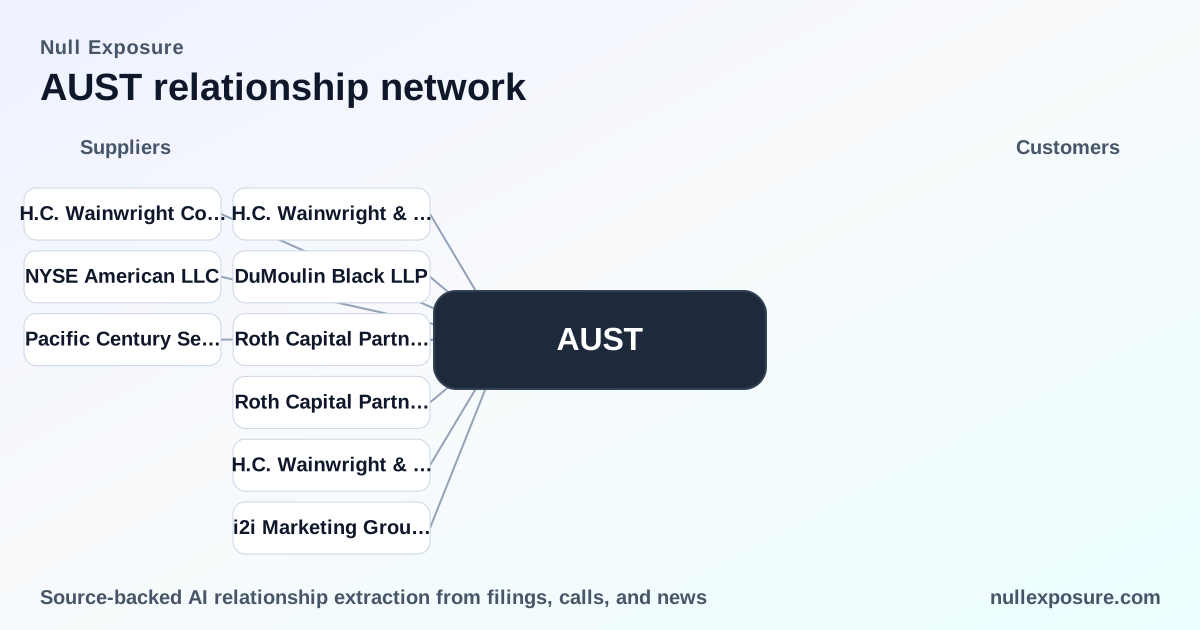
Austin Gold (AUST) — who they pay, and why it matters for funding and execution
Austin Gold is an early-stage exploration company that monetizes by advancing gold projects and selling equity to fund exploration. The company currently operates with no material revenue, a negative EBITDA, and uses capital markets relationships—most notably an At-The-Market (ATM) equity program—to raise working capital for U.S. exploration. For investors and operators, the firm’s supplier map reads as a short-term funding and service network rather than a commercial supply chain, which concentrates risk on capital access, market appetite, and select external advisors. Learn more about the platform and how we map supplier exposure at https://nullexposure.com/.
The short story: ATM financing is the operating lever
Austin Gold executed an ATM agreement that permits up to US$7.5 million of incremental equity issuance through investment banks as sales agents, a move that directly funds exploration programs without a committed term loan. That structure converts trading liquidity into working capital but dilutes shareholders when executed. The ATM is documented in a Form 6-K and associated press releases filed in February 2026 and reported by multiple outlets (see the relationship list below). For actionable supplier-intelligence and monitoring of such arrangements, visit https://nullexposure.com/.
Who Austin Gold is working with — every relationship in the public record
Below are every relationship captured in the public reporting on Austin Gold’s supplier/funding activity, each followed by a concise one‑to‑two sentence takeaway and a source reference.
-
H.C. Wainwright & Co. / H.C. Wainwright & Co., LLC / H.C. Wainwright Co., LLC
Austin Gold retained H.C. Wainwright as the lead manager under an At‑the‑Market Offering Agreement that allows the company to sell shares on the NYSE American and other U.S. markets for up to US$7.5 million in aggregate gross proceeds. This placement positions Wainwright as the primary capital markets conduit for near‑term financing. Source: Austin Gold Form 6‑K and press release as reported by StockTitan and The Globe and Mail (Feb 2026) — https://www.stocktitan.net/sec-filings/AUST/6-k-austin-gold-corp-current-report-foreign-issuer-ddedb9a1cb4d.html and https://www.theglobeandmail.com/investing/markets/stocks/AUST-A/pressreleases/182586/austin-gold-launches-us7-5-million-at-the-market-equity-program-for-exploration-funding/. -
Roth Capital Partners / Roth Capital Partners, LLC
Roth Capital is listed as co‑manager on the ATM agreement and also appears in press coverage as participating in the sales agreement, giving the firm a clear role in share placement execution and book‑running responsibilities on some transactions. This adds a second broker to diversify distribution channels for any share sales. Source: StockTitan, TradingView/Reuters summaries and Globe and Mail reporting (Feb 2026) — https://www.stocktitan.net/news/AUST/austin-gold-enters-into-atm-7wdrncnrm1de.html and https://www.tradingview.com/news/reuters.com,2026-02-11:newsml_NFCbGThZn:0-austin-gold-enters-into-atm-agreement/. -
DuMoulin Black LLP
British Columbia law firm DuMoulin Black provided a legal opinion dated February 10, 2026, confirming that the common shares issued under the ATM are properly authorized under Canadian law, and the opinion was incorporated by reference into the Form F‑3 exhibits. The law firm therefore serves as the legal gatekeeper for cross‑jurisdictional share issuance. Source: The Globe and Mail press release and Form 6‑K exhibits (Feb 2026) — https://www.theglobeandmail.com/investing/markets/stocks/AUST/pressreleases/178465/austin-gold-corp-files-form-6-k-to-support-us75-million-atm-equity-program/. -
i2i Marketing Group, LLC
Austin Gold signed a marketing agreement with i2i (Florida) on September 26, 2025, to provide various marketing services related to U.S. exploration activities, indicating the company is outsourcing investor and stakeholder communications to a third‑party marketing firm. That engagement supports market outreach rather than core technical work. Source: Company press release reported via Newsfile and StockTitan (Sept 2025) — https://www.newsfilecorp.com/release/268634/Austin-Gold-Advances-U.S.-Exploration-with-New-Geophysics-and-Drilling-Plans. -
NYSE American LLC
The ATM sales are structured to allow sales directly on the NYSE American and “other established United States trading markets,” which makes the exchange a transactional venue for share distribution and immediate liquidity execution. The exchange's role is executional: it is the market where inventory created by the ATM can be absorbed. Source: Form 6‑K and associated StockTitan coverage (Feb 2026) — https://www.stocktitan.net/sec-filings/AUST/6-k-austin-gold-corp-current-report-foreign-issuer-ddedb9a1cb4d.html. -
Pacific Century Securities
Coverage indicates Pacific Century Securities acted as a co‑manager on placements where Roth was the sole book‑running manager, adding an additional distribution desk for certain transactions and suggesting a strategy of using boutique dealers for targeted investor outreach. Its role is complementary to Roth and H.C. Wainwright in distribution. Source: StockTitan reporting (Feb 2026) — https://www.stocktitan.net/news/AUST/page-3.html.
How these relationships shape Austin Gold’s operating and funding profile
-
Funding-first operating posture. Austin Gold’s supplier network reads as a set of capital markets partners and advisers rather than a diversified operational vendor base; the ATM is the primary funding lever for near-term exploration. The relationship mix prioritizes financing and market outreach over operating contractors.
-
Concentration and criticality. The firm relies on a small number of capital markets counterparties (H.C. Wainwright, Roth, Pacific Century) and a single legal opinion provider for cross‑border issuance authorization; that concentration creates single‑point dependencies in funding execution and regulatory clearance.
-
Maturity and sophistication. Use of a Form F‑3 shelf and counsel opinion signals capital markets readiness appropriate to a mining explorer that needs flexible equity issuance, but it also highlights reliance on market conditions to convert capacity into cash.
-
Governance and ownership signal. Company metrics show high insider ownership (≈47%) and very low institutional ownership (~1.3%), which positions insiders as dominant stakeholders and suggests limited institutional liquidity supporting new share issuance.
These are company‑level signals derived from public filings and the supplier map; they are not assigned to any single relationship unless explicitly stated in the record.
Investment implications and key decision points
- Dilution vs. optionality trade‑off. The ATM provides optionality to raise up to US$7.5 million quickly, but any issuance dilutes equity; investors should model both funding scenarios and share issuance sensitivity.
- Execution risk focused on capital markets. Given no operating revenue, the company’s runway is a function of how actively the banks distribute shares; the firms named as lead/co‑managers are therefore strategic counterparties, not just vendors.
- Counterparty operational dependency. Legal clearance from DuMoulin Black and exchange execution on NYSE American are gating items for any issuance; failures or delays in these service providers would materially delay funding.
If you want ongoing monitoring of these counterparties or alerts for new agreements or filings, start tracking Austin Gold at https://nullexposure.com/.
Practical next steps for diligence
- Review the Form 6‑K and the Sales Agreement exhibit to confirm pricing mechanics, fees, and any commitment language from the placement agents. (See the Form 6‑K filing cited above.)
- Validate the marketing engagement scope with i2i to understand whether cash payments or equity‑linked compensation could amplify dilution. (See Newsfile/StockTitan release.)
- Model scenarios where the ATM is fully drawn versus partially executed to quantify dilution, runway, and required capital for the planned exploration program.
For institutional-grade supplier mapping, monitoring, and alerting on Austin Gold and its counterparties, visit https://nullexposure.com/ — our platform tracks filings, placements, and supplier shifts for active portfolio diligence.
Bold final takeaway: Austin Gold’s short‑term operational viability rests on capital markets distribution through a small set of underwriters and advisers; investor returns will depend on financing execution and exploration outcomes rather than current operating cash flow.