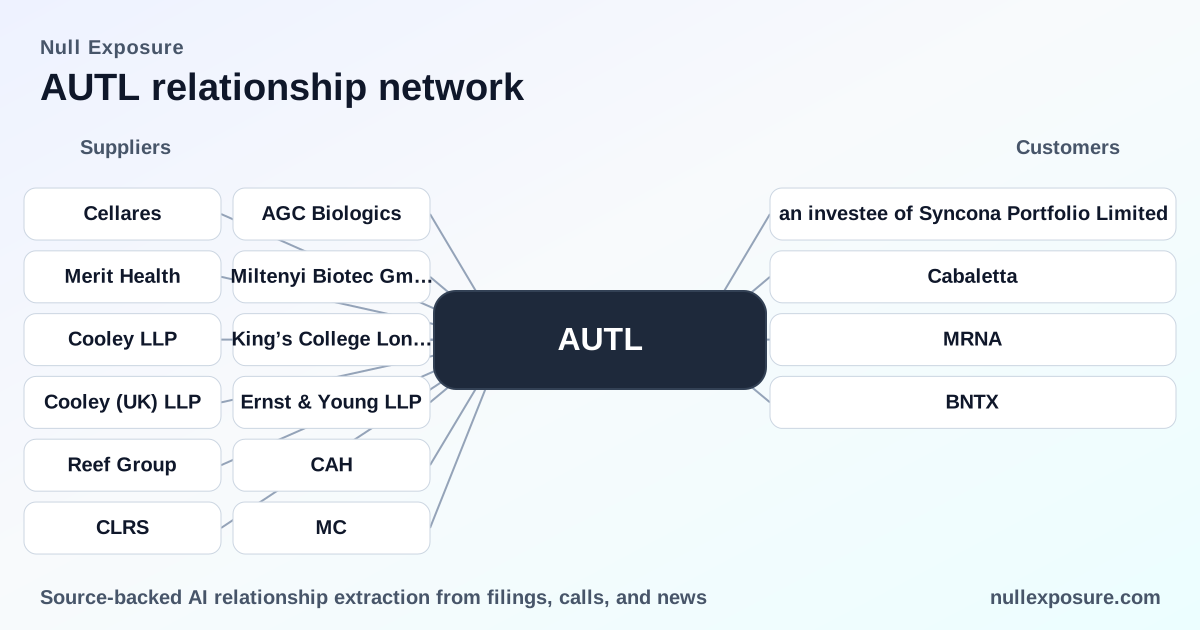
Autolus Therapeutics (AUTL): supplier map, operational constraints and why it matters to investors
Autolus builds and commercializes programmed T‑cell therapies and monetizes through product sales and commercial partnerships for AUCATZYL (obe‑cel) alongside recurring manufacturing spend to support clinical and commercial production. The company’s revenue base is nascent — Revenue TTM of $51.1m against a negative operating margin — and Autolus relies on a mix of long‑term equipment suppliers, contracted manufacturers and distribution partners to convert clinical assets into repeatable revenue. For investors evaluating supplier risk and operational scalability, the supplier roster and contracting posture drive both near‑term cost concentration and the pace at which Autolus can scale volume. Learn more and track supplier exposure at https://nullexposure.com/.
Quick read: how Autolus operates and where supplier risk concentrates
Autolus outsources critical elements of its manufacturing value chain: viral vectors, automated cell processing platforms, instruments, reagents and commercial distribution. The supplier set is a hybrid of long‑term strategic partners (instrument and platform providers) and short‑term or cancellable service contracts (CROs, site services and spot reagent orders). That mix produces three practical constraints for operators and investors:
- Contracting posture is mixed. Autolus holds at least one explicit long‑term supply agreement for manufacturing equipment and reagents, while clinical and development services remain largely cancellable and procured on short notice.
- Criticality and materiality are high. Loss of a supplier — whether for quality, regulatory or financial reasons — is explicitly flagged as capable of materially harming sales or trials.
- Maturity and automation are in transition. Autolus is exploring automation platforms to increase throughput, signaling a strategic shift to reduce per‑patient cost and manufacturing lead times.
A deeper, sourced view of each counterparty follows. If you are modeling supplier concentration or building a vendor due‑diligence checklist, this roster is a primary input — for more, visit https://nullexposure.com/.
Key operational constraints that shape capital allocation and risk
Autolus’ public filings and news releases reveal constraining signals investors should price into forecasts:
- The company disclosed a strategic, long‑term supply agreement with Miltenyi Biotec for CliniMACS Prodigy instruments, reagents and disposables supporting commercial production — a sign of durable equipment dependency and locked‑in service relationships (10‑K, FY2024).
- Clinical trial services and many CRO arrangements are cancellable with limited termination costs, implying variable near‑term operational flexibility but also potential exposure to spot pricing and vendor churn (company filing language).
- Autolus still relies on third parties for viral vector supply and early‑phase manufacturing, and flags the risk that supplier regulatory or financial problems could materially affect product availability and trials (10‑K, FY2024).
- Company‑level signals show material cost of goods for early commercial production (cost of sales recognized following FDA approval in Nov 2024), placing the spend band for manufacturing and outsourced services in a meaningful $10m–$100m range (FY2024–FY2025 disclosures).
Taken together, these constraints indicate a company operating at an inflection point: commercial launch activity increases supplier importance and incentivizes automation to scale throughput and control cost.
Vendor‑by‑vendor rundown (concise, sourced)
AGC Biologics
Autolus sources viral vector for commercial supply of AUCATZYL and late‑stage clinical trials from AGC Biologics, establishing AGC as a critical vector manufacturer in the company’s supply chain (10‑K, FY2024).
Miltenyi Biotec GmbH
Autolus has a long‑term supply agreement with Miltenyi for CliniMACS Prodigy instruments, reagents and disposables used in manufacturing programmed T‑cell therapies for commercial, preclinical and clinical use, indicating durable equipment dependency (10‑K, March 2018 reference in FY2024 filing).
King’s College London
Autolus maintains manufacturing agreements with King’s College London for early‑phase vector manufacturing, reflecting reliance on academic GMP capacity for initial development batches (10‑K, FY2024).
Ernst & Young LLP
Ernst & Young LLP was re‑appointed as Autolus’ auditors, a governance and assurance relationship noted in filings and press coverage in FY2026, confirming continuity of external audit oversight (news/SEC filing summaries, FY2026).
Cardinal Health
Cardinal Health serves as Autolus’ U.S. commercial distribution partner and will support manufacturing at the Stevenage “Nucleus” site, positioning Cardinal as the primary U.S. logistics and distribution channel for AUCATZYL (FiercePharma and TradingView coverage, FY2024–FY2025).
Moelis & Company LLC
Moelis acted as financial advisor on a strategic financing arrangement (Blackstone Life Sciences investment) noted in press release coverage from 2021, reflecting transaction advisory support during a material capital raise (GlobeNewswire, FY2021).
Cellares
Autolus has initiated evaluations and feasibility studies to run AUCATZYL manufacturing on Cellares’ Cell Shuttle automated platform, indicating a strategic push to adopt full automation to boost throughput (multiple press items, FY2025–FY2026).
Merit Health
Merit Health is implicated as a contractor to design, build and fit out the CAR‑T manufacturing facility for Autolus, with investment and bond arrangements reported to support construction activities (Business‑Live, FY2026).
Cooley LLP and Cooley (UK) LLP
Cooley and Cooley (UK) provided legal advice to Autolus in connection with the Blackstone Life Sciences investment transaction referenced in 2021 press materials, denoting external corporate legal support during strategic financings (GlobeNewswire, FY2021).
Reef Group
Reef Group is identified as a developer partner on the manufacturing facility project, working alongside Merit Health on facility development and fit‑out for Autolus’ U.S. manufacturing expansion (Business‑Live, FY2026).
What this means for investors: buy‑side checklist
- Concentration risk: Miltenyi and AGC are systemically important for commercial production; loss or disruption would force expensive requalification or slower in‑house scale‑up. Factor in lead times and qualification costs into margin models.
- Scaling path: The Cellares evaluation signals an explicit pathway to automation — successful integration would lower per‑patient cost and improve gross margin trajectory; failed integration would preserve higher variable manufacturing expense.
- Capital needs: Early commercial cost of sales and CAPEX for manufacturing facilities (Merit/Reef) suggest ongoing investment needs that could pressure cash flow until sales scale.
If you want a structured supplier impact analysis or a vendor concentration stress test for AUTL, start your diligence at https://nullexposure.com/ — our platform centralizes supplier signals and regulatory references.
Bottom line and next actions
Autolus operates a hybrid supply model: critical long‑term equipment partners and external vector and manufacturing contractors underpin near‑term product availability. Investors should treat supplier continuity and successful automation pilots as binary drivers of margin expansion and schedule risk. For portfolio teams modeling commercialization scenarios, incorporate: 1) contingency cost to re‑qualify suppliers, 2) automation adoption success probabilities, and 3) phased capital deployment for facility buildouts.
Explore supplier risk profiles and indexed references for AUTL at https://nullexposure.com/ to convert these qualitative signals into measurable scenario inputs and make faster, evidence‑based investment decisions.