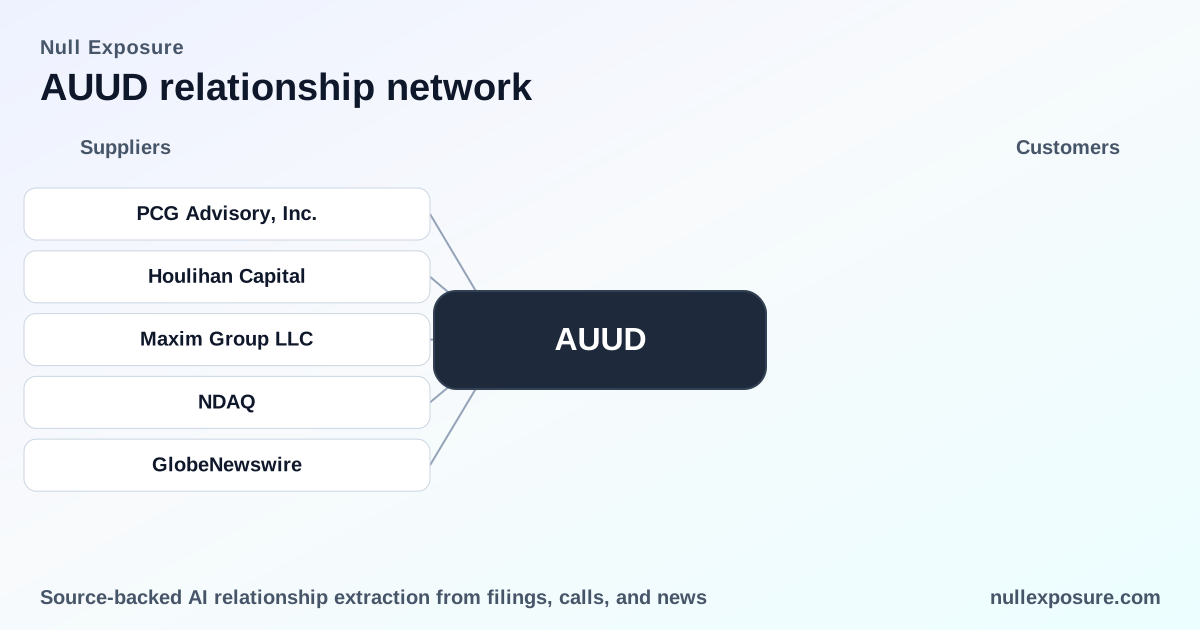
Auddia Inc (AUUD) — supplier relationships that shape a microcap audio software player
Auddia develops software for audio and podcast markets and monetizes through licensed audio services, subscription and ad-enabled product placements, and capital raises tied to strategic transactions; the company leverages third‑party licensing and cloud infrastructure while maintaining a small public equity footprint. For investors and operators, supplier relationships—licensing partners, financial advisers, and listing venues—are material to execution risk and deal optionality. Explore the supplier snapshot and source documents at NullExposure.
What the relationships tell you about AUUD’s go-to-market and capital posture
Auddia’s supplier map is compact and transaction-oriented. The company relies on external advisors for capital markets work and fairness opinions, uses investor‑relations firms to manage market communications, and depends on industry infrastructure (licensing regimes, cloud providers, and an exchange listing) to operate. This is a small-cap, high-leverage operating model: external counterparties provide credibility and access while also concentrating execution risk. For a fast read on the company’s supplier footprint, visit NullExposure.
Relationship roll call — every partner found in the public items
Below are every relationship referenced in the public news and filing excerpts available in our collection, with a concise plain-English summary and source note.
-
PCG Advisory, Inc.
Auddia repeatedly lists PCG Advisory (Kirin Smith, President) as its investor relations contact across press releases and SEC filing communications in 2024–2026, indicating outsized reliance on a single IR provider to manage market messaging and investor outreach. (Source: StockTitan SEC filing excerpt and related press releases, March 2026.) -
Houlihan Capital
Houlihan Capital provided a fairness opinion to Auddia’s special committee and board in connection with a definitive merger agreement, signaling the use of an external investment bank to validate the transaction terms for governance purposes. (Source: StockTitan news item announcing the merger agreement, March 9, 2026.) -
Maxim Group LLC
Maxim Group acted as sole book‑running manager for Auddia’s upsized offering in FY2021, showing that the company has used boutique capital markets firms to execute equity financings. (Source: StockTitan release on the $16.5 million upsized initial public offering, 2021.) -
Nasdaq Capital Market (Nasdaq listing reference)
Auddia’s common stock and public warrants were approved for listing on the Nasdaq Capital Market under AUUD/AUUDW, the listing event that established the company’s public trading venue and created ongoing exchange obligations. (Source: StockTitan release referencing Nasdaq Capital Market listing approval, February 2021.) -
Nasdaq (exchange statement referenced separately)
Nasdaq commentary reported in coverage of a 2026 press release confirms that the expiration of publicly traded warrants does not affect the company’s ongoing common‑stock listing, reinforcing continuity of the public market presence even as derivative instruments roll off. (Source: Manila Times distribution of GlobeNewswire item, February 20, 2026.) -
GlobeNewswire
GlobeNewswire is the distribution channel used for official press releases (including announcements of warrants expiration and merger activity); one item distributed via GlobeNewswire was flagged with an AI‑summary disclaimer in aggregators, so investors should prefer the issuer’s original release for exact language. (Source: QuiverQuant/GlobeNewswire distribution flagged March 2026.)
Constraints and what they imply about supplier posture and business model
Auddia’s constraint signals read as a company-level operating profile rather than as attributes tied to a particular named supplier.
-
Licensing orientation: The company filed a Notice of Use of Sound Recordings under statutory license (37 CFR § 370.2), confirming that licensing is core to Auddia’s product model and that the company operates within established copyright frameworks for noninteractive audio transmissions. This imposes ongoing royalty and compliance obligations.
-
Long-term occupancy commitment: Auddia executed a 37‑month operating lease with renewal options, indicating a modest but explicit fixed-cost commitment to physical operations and a contracting posture that accepts multi-year obligations (monthly rent stepping from $2,456 up to $3,684). The lease figures also align with the company’s disclosed operating lease commitments (office lease $81,493), which places supplier spend in a sub‑$100k band for near-term commitments.
-
Buyer and licensee roles: The documentation shows Auddia acting as both a licensee and buyer—it purchases office occupancy and obtains content/performance licenses from PROs—so supplier relationships include rights‑acquisition counterparties and typical buyer obligations.
-
Service provider dependency: Auddia depends on third‑party cloud infrastructure and related security measures for operations, establishing a critical dependency on cloud and managed service providers for uptime and data protection.
-
Maturity and concentration: With a microcap market capitalization (~$2.99M) and negative EBITDA (approximately -$7.15M), the company is early-stage with concentrated supplier exposure—a small IR firm, boutique bankers and a limited set of licensing arrangements perform outsized operational roles.
These constraints point to a contracting posture that is active and concentrated, with several low-dollar but mission‑critical relationships (licensors, cloud providers, IR advisors). The combination of statutory licensing obligations and external advisory dependence elevates legal/compliance and execution risk more than raw supplier spend would suggest.
Risk and opportunity through the supplier lens
-
Risk — governance and deal execution: The use of external fairness opinions and boutique banks reduces internal deal risk but transfers execution dependency to advisers; divergence between adviser incentives and shareholder outcomes is a live governance consideration. (See Houlihan Capital and Maxim Group references above.)
-
Risk — licensing and content cost: Statutory licensing and the process of obtaining PRO licenses create recurring obligations that are essential to the product’s operation and non‑negotiable in the audio market.
-
Opportunity — low fixed spend, high leverage: Small operating commitments and targeted use of external advisers give management flexibility to pursue strategic transactions quickly; the upcoming merger activity and warrant expiration process are examples of active capital structure management.
What investors and operators should watch next
- Monitor any changes in licensing status with PROs and royalty terms, because these directly affect product economics.
- Track advisory relationships (e.g., Houlihan Capital, Maxim) around announced transactions for insight into deal valuation and process.
- Verify primary source press releases on issuer channels rather than aggregator summaries when assessing transaction terms. For ongoing supplier intelligence, see NullExposure.
Bottom line: compact supplier map, outsized dependency
Auddia operates a strategically compact supplier ecosystem: a small set of investor relations and capital markets advisers, regulatory‑driven licensors, and cloud/service providers. That configuration supports rapid transactions but concentrates operational and governance risk. Investors evaluating AUUD should value the credibility advisers bring while also accounting for licensing cost structure and the company’s limited balance‑sheet buffer.
For more supplier intelligence on AUUD and related microcap counterparties, visit NullExposure.