Aveanna Healthcare (AVAH): CHAP certification sharpens the service moat — what investors and operators need to know
Aveanna Healthcare runs a diversified home-care platform that monetizes through fee-for-service and managed-care contracts across private duty nursing, pediatric therapy, adult home health, hospice and enteral nutrition delivered in patients’ homes. Revenue scales with patient volume and payer mix, while margin expansion depends on utilization, payer contracting, and clinical operating efficiency — not one-off technology plays. For investors, Aveanna is a healthcare services operator with meaningful scale (roughly $2.29B revenue TTM) and an EBITDA base (~$266M) that earns returns by managing complex care outside the hospital. Learn more at https://nullexposure.com/.
Why the CHAP Heart Failure certification matters to the business
Aveanna Home Health and Hospice’s recent Disease Program Certification for Heart Failure from Community Health Accreditation Partner (CHAP) is a quality credential that converts into competitive differentiation in value-based and referral-driven channels. Certification signals that Aveanna has instituted standardized clinical pathways, clinician education and quality reporting for heart failure — all of which strengthen payor negotiations and reduce clinical variability that drives costs and readmissions.
- Commercial implication: Certification strengthens the company’s position when negotiating with managed care organizations and hospital discharge planners who prioritize accredited providers for higher-acuity home care.
- Operational implication: Standardized protocols tied to certification reduce variability in delivery and support scale of higher-margin chronic-condition management programs.
If you want a concise supplier-risk and relationship assessment for AVAH, visit https://nullexposure.com/ for a structured briefing.
All disclosed supplier relationships (complete coverage)
The dataset returned two news items, both referencing the same external accreditor. Both items are reported here; no relationships are omitted.
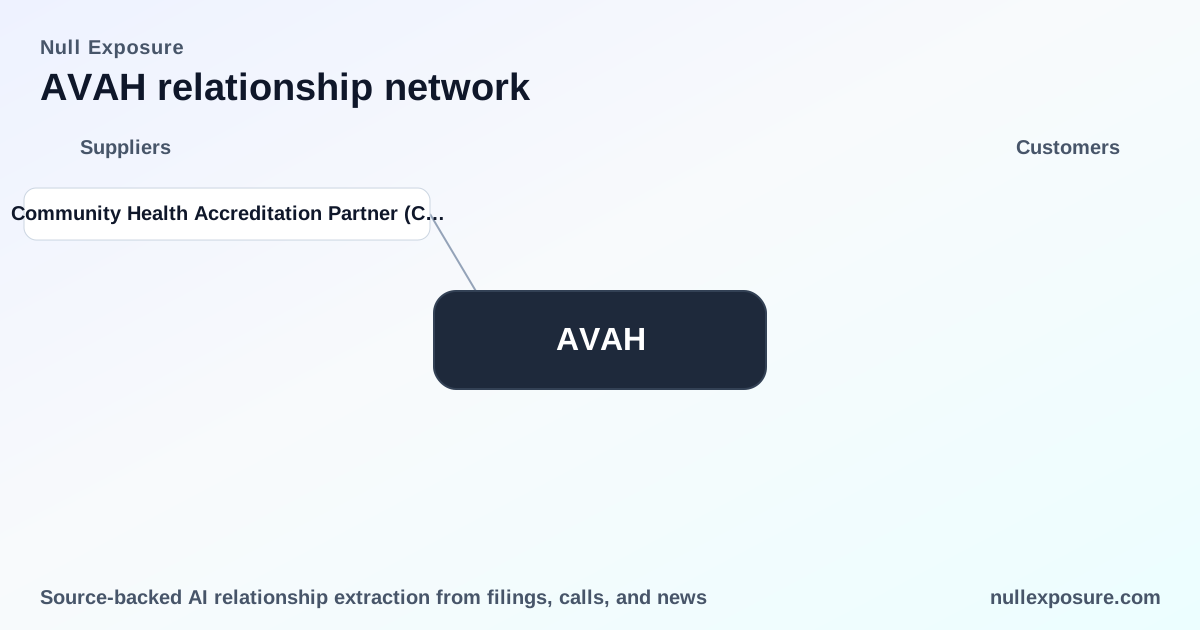
Community Health Accreditation Partner (CHAP) — GlobeNewswire press release (Feb 11, 2026)
CHAP awarded Aveanna Home Health and Hospice a Disease Program Certification for Heart Failure under the CHAP Disease Program Standards, recognizing compliance with nationally accepted quality metrics and clinician education standards. The certification is a formal external validation of Aveanna’s Heartways program and its clinical protocols. (Source: GlobeNewswire press release, February 11, 2026.)
Community Health Accreditation Partner (CHAP) — SAHM Capital investor commentary (Feb 12, 2026)
An investor note from SAHM Capital reiterated the CHAP award and analyzed its significance for shareholders, framing the certification as evidence of improved clinical governance and potential margin upside via higher-acuity referrals and stronger payor placement. The note emphasized operational execution of the Heartways program as the near-term value unlock. (Source: SAHM Capital investor commentary, February 12, 2026.)
Contracting posture and supplier model — what constraints reveal
Company-level disclosures signal a service-oriented supplier footprint with reliance on third-party licensed software and external service providers. These disclosures read as operational realities rather than isolated vendor anecdotes:
- Licensed software: Aveanna uses third-party licensed software to support its business and information systems. That means licensing expense and vendor SLAs are part of the cost base and operational risk profile.
- Third-party service providers: The company relies on external providers for maintenance, enhancements and security of protected data, indicating an outsourced posture for some IT and operational support functions.
- Software segment exposure: References to licensed software classify part of the supplier ecosystem under the software segment — not a vendor concentration call, but a signal that software suppliers are material to operations.
From these signals, infer the following business-model characteristics: moderate contracting concentration with a reliance on service providers for non-core IT and security; contracts that are operationally critical for patient-facing services; and supplier maturity consistent with established enterprise software and managed services arrangements. These are company-level signals and do not tie any single constraint to a named third party.
Investment implications and the risk/reward posture
Aveanna’s financial profile positions it as a scaled home-care operator with high institutional ownership (~93.7%) and a market capitalization around $1.435B. Key metrics to anchor valuation and risk analysis:
- Revenue TTM: ~$2.29B; EBITDA: ~$266M; Operating margin (TTM): ~11%.
- Valuation: trailing P/E ~18.6 and forward P/E ~11.7, EV/EBITDA ~10.1 — multiples that reflect both growth and operational leverage expectations.
- Volatility & governance: Beta ~2.08 indicates above-market volatility; insiders hold ~5.9%.
Strategic takeaways:
- Quality accreditations such as CHAP are value-accretive because they increase access to higher-acuity referrals and strengthen payor negotiation leverage.
- Supplier and software reliance creates an operational dependency: any significant disruption to licensed systems or third-party service providers would directly affect scheduling, billing and clinical documentation.
- Upside drivers: improved payer mix from accredited programs, execution on clinical pathways, and operating leverage in higher-utilization segments.
- Downside risks: payor reimbursement pressure, labor intensity of home care, and vendor-related downtime or cybersecurity incidents that affect protected health information.
For a focused supplier-risk report and comparative benchmarking, visit https://nullexposure.com/ to request a tailored briefing.
What operators and investors should watch next
- Track CHAP program expansion beyond Heart Failure to other chronic-condition certifications; every additional accreditation increases program stickiness with payors and referral sources.
- Monitor operational KPIs: referral-to-admission conversion, readmission rates for heart-failure cases, and payer mix within certified programs.
- Review vendor contracting terms for licensed software and third-party providers: SLAs, breach liability, and business-continuity provisions will determine operational resilience.
Bottom line and recommended actions
Aveanna’s CHAP Heart Failure certification is an active improvement in its clinical credibility that strengthens both referral flows and payer negotiation posture. Combine that quality credential with the company’s scale and margin profile, and Aveanna presents a compelling operational story for investors focused on post-acute care exposure — with supplier and vendor risk that requires active monitoring.
- If you are evaluating supplier risk or partnership exposure for AVAH, start with the CHAP certification as a positive signal and then assess contractual terms for licensed software and service providers.
- To commission a detailed supplier and accreditation briefing for Aveanna, go to https://nullexposure.com/ and request the AVAH supplier dossier.
Key sources for this note include the CHAP press coverage and contemporaneous investor commentary in February 2026, along with the company’s public financial profile and latest quarter disclosures through 2025-09-30.