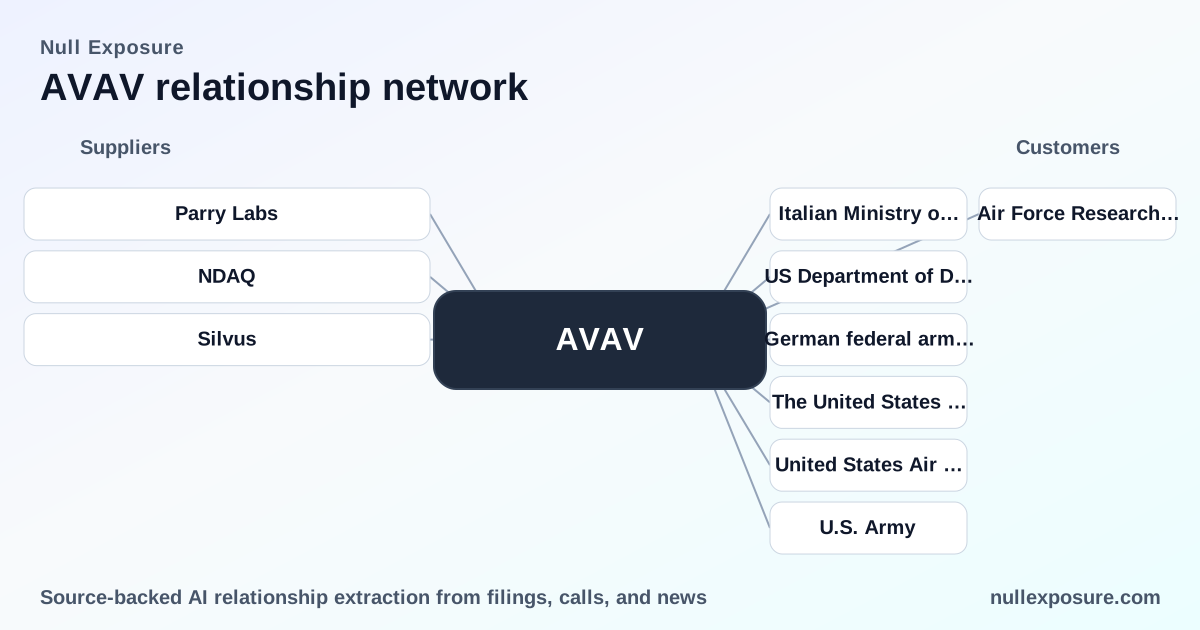
AeroVironment (AVAV) — supplier relationships that shape product delivery and program risk
AeroVironment designs, manufactures and supports unmanned aircraft systems (UAS) and related mission electronics for government and commercial customers, monetizing through product sales, follow-on service and defense delivery orders tied to program awards and delivery schedules. Supplier relationships drive AeroVironment’s ability to meet contract timetables, control component pricing and deliver mission-ready systems—making supplier posture a direct input to revenue realization and program risk. For a quick look at how supplier exposure is mapped and monitored, visit https://nullexposure.com/.
How AeroVironment makes money and why suppliers matter
AeroVironment’s revenue mix is concentrated in defense and government procurement cycles, with product sales (including Next-Generation Switchblade, P550 class UAS and other systems) supported by recurring follow-on orders and sustainment contracts. The company’s operating model depends on stable access to specialized components, resilient communications subsystems, and increasingly software-intense mission systems—so suppliers that provide hardware, radios, software integration and data services are functionally critical to program delivery.
Company-level disclosures and observed reporting signal three structural procurement characteristics:
- Long-term supplier arrangements are part of the procurement posture; AeroVironment states it manages materials risk through long-term, non-binding agreements to stabilize pricing and lead times.
- Geographic concentration in East Asia for electronics components is a material supply-chain fact, exposing the company to regional manufacturing and environmental regulation differentials.
- Service-provider relationships carry compliance demands; subcontractors and vendors must align with cybersecurity certifications (CMMC) for defense work.
These are company-level signals drawn from AeroVironment’s public commentary on suppliers and procurement practices in FY2026. Together they describe a supplier ecosystem that is semi-structured (long-term agreements but non-binding), regionally concentrated for key components, and reliant on compliance-capable service providers.
What the record shows about specific supplier relationships
Parry Labs — mission systems and MOSA integration
Parry Labs is partnering with AeroVironment to architect, develop and integrate Modular Open Systems Approach (MOSA)-aligned digital engineering, software and mission hardware for the P550 UAS being pitched into the U.S. Army’s Long Range Reconnaissance (LRR) program. According to UASWeekly (Jan 26, 2026), this collaboration positions Parry Labs as an integration partner on the P550 footprint for MOSA-aligned mission systems: https://uasweekly.com/2026/01/26/parry-labs-integrates-modular-mission-systems-into-aerovironment-p550-for-army-lrr-program/.
Nasdaq — market data and liquidity provisioning
Nasdaq provides real-time trade data and company updates that AVAV uses as a liquidity and market-information source for order execution and monitoring. A market commentary piece on Feb 2, 2026 referenced Nasdaq’s role in providing trade and quote data for AVAV trading and investor monitoring: https://meyka.com/blog/avav-aerovironment-nasdaq-738-after-hours-02-feb-2026-ai-stock-outlook-0202/.
Silvus — resilient communications for fielded systems
Silvus MANET radios are cited in defense reporting as part of the integrated resilient communications suite supporting distributed operations and extended handoff ranges on AV platforms, enhancing GPS-challenged navigation and mission resilience. Defense coverage of a $186 million U.S. Army delivery order referenced resilient communications including Silvus radios as enablers for extended range and mission continuity: https://www.asdnews.com/news/defense/2026/02/26/av-receives-186m-us-army-delivery-order-nextgen-switchblade-systems and similar coverage at StockTitan (Feb 2026): https://www.stocktitan.net/news/AVAV/av-receives-186-million-u-s-army-delivery-order-for-next-generation-ybbo3ztlee4p.html.
What these relationships imply for investors
The disclosed supplier ties are consistent with a company operating at the intersection of hardware, software and defense program delivery. Key implications:
- Integration partners like Parry Labs raise the company’s software and digital-engineering capability, increasing product differentiation on MOSA-compliant platforms and supporting long-lead program awards. That makes program wins more defensible on technical grounds, and increases the importance of close supplier coordination on schedules and interfaces.
- Communications suppliers such as Silvus are operationally critical; resilient radio solutions are not commodity inputs but mission enablers. Their availability, certification status and performance under contested conditions directly affect product qualification and fielding schedules.
- Market-data providers like Nasdaq are non-operational but functionally important for investor liquidity and price discovery; they do not affect flight-readiness but do affect how investors access AVAV stock and monitor company developments.
These relationships, combined with AeroVironment’s procurement signals, produce a profile of moderate supplier concentration, strategic reliance on specialized service providers, and heightened regulatory/compliance demands driven by defense contracting. For investors focusing on operational risk, supplier continuity and certification timelines are primary variables to monitor.
If you want to map these linkages against contract schedules and supplier criticality, explore supplier exposure tools at https://nullexposure.com/ to see how risk concentrations translate to program delivery timelines.
Constraints and how they shape valuation risk
AeroVironment’s public supplier commentary highlights three company-level constraints that should be factored into credit and operational risk assessments:
- Contracting posture: long-term, non-binding supplier agreements. This reduces spot-market volatility in pricing and lead times but leaves some negotiation and renewal risk—useful for smoothing but not fully eliminating disruption risk.
- Geographic concentration: reliance on East Asian electronics sources. This exposes procurement to regional supply shocks, shipping disruptions, and differing environmental/regulatory regimes—important for scenario analysis around component scarcity and lead-time inflation.
- Service-provider role: subcontractors must meet cybersecurity and compliance standards (CMMC). This increases the operational dependency on third-party certification and raises substitution costs if a vendor fails to comply.
These constraints are company-level signals; they inform how agile AeroVironment can be in the face of component shortages, regulatory shifts, or supplier non-compliance, and therefore feed directly into scenario-adjusted cash flow and delivery-risk modeling.
What to watch next (and how to act)
For investors and operators, focus on three near-term indicators:
- Program delivery milestones on the Next-Gen Switchblade and P550 LRR efforts—supplier integration notes (Parry Labs, Silvus) signal where delays or performance gains will surface.
- Supplier certification and continuity announcements, especially around CMMC and MOSA compliance, which materially affect program eligibility.
- Component sourcing disclosures and lead-time commentary in quarterly filings, given the East Asia concentration noted for electronics components.
Strong calls-to-action: review AeroVironment’s supplier exposure and program timelines at https://nullexposure.com/; if your investment or procurement thesis depends on delivery certainty, cross-reference program award notices with supplier integration disclosures at https://nullexposure.com/; and set alerts for supplier-certification and delivery-order announcements to capture signal changes that alter delivery risk.
AeroVironment’s supplier map shows a company that is growing both its systems integration sophistication and reliance on specialized partners—this raises upside through differentiated platforms but also concentrates operational risk in supplier availability and compliance. Monitor supplier certifications, delivery orders and long-term agreement renewals closely to adjust position sizing and operational contingencies.