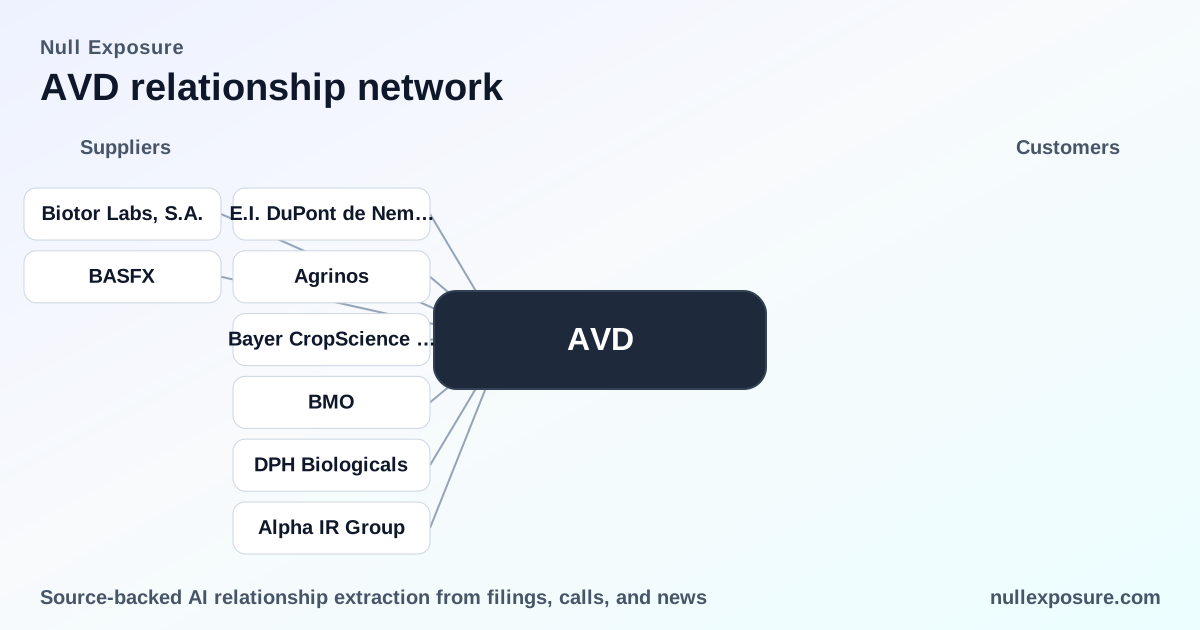
American Vanguard (AVD): supplier relationships that shape downside protection and operating risk
American Vanguard Corporation develops, manufactures and sells specialty agricultural chemicals and biologicals, monetizing through direct product sales across crop protection, specialty markets and third‑party distribution channels. The company combines in‑house manufacturing with strategic acquisitions and regional distribution partners to scale patented and off‑patent chemistries; revenue derives from product volume and geographic channel coverage supported by manufacturing assets and long‑term supplier and distributor agreements. Investors should view AVD as a manufacturing‑centric agricultural inputs firm with exposure to raw material supply concentration and the credit profile of its commercial lending group. For deeper supplier relationship analytics, visit https://nullexposure.com/.
Why supplier relationships matter for AVD’s valuation
AVD’s operating model balances controlled manufacturing with external partnerships: the company owns multiple manufacturing sites acquired from global chemical majors and supplements capability through acquisitions and distribution deals. That structure reduces unit cost risk but increases the importance of long‑lead sourcing and counterparty continuity. The 10‑K language confirms a preference for long‑term contracts when single‑source suppliers exist, indicating a contracting posture oriented toward supply assurance rather than spot buying. At the same time, AVD uses outside service providers for audit, IT governance and seasonal labor, suggesting moderate third‑party operational criticality but clear reliance on external professional services.
Key company‑level signals:
- Long‑term contracting posture for single‑source inputs is an explicit corporate policy and a mitigating strategy against input shocks.
- Service provider reliance (audit, IT, temporary labor) is material to operations and financial reporting; disclosed audit fees are in the $1m–$10m band, indicating meaningful spend with a major firm.
- Acquisition and distribution strategy increases geographic reach but also creates integration and counterparty risk that is visible in historical asset purchases.
Explore a supplier‑level map and supplier risk scoring at https://nullexposure.com/ to see how these relationships feed into credit and operational models.
Relationship roll‑call: what filings and press coverage record
Below are every supplier/relationship mention surfaced in AVD’s supplier scope results, presented with concise summaries and source citations.
E.I. DuPont de Nemours and Company
AVD reports that AMVAC purchased the Axis manufacturing facility from DuPont in 2001, reflecting an early strategy of acquiring legacy pesticide manufacturing capacity from major chemical firms. Source: AVD FY2024 Form 10‑K (avd‑2024‑12‑31).
Agrinos
AVD completed the purchase of all outstanding shares of Agrinos on October 2, 2020, bringing a fully integrated biologicals supplier with proprietary tech and global distribution into AVD’s fold. Source: AVD FY2024 Form 10‑K (avd‑2024‑12‑31).
Bayer CropScience Limited Partnership (BCS LP)
AVD acquired the Marsing, Idaho manufacturing facility from Bayer CropScience in 2008, adding legacy crop protection production capability to AMVAC’s asset base. Source: AVD FY2024 Form 10‑K (avd‑2024‑12‑31).
BMO (press release reported on The Globe and Mail)
AVD announced an amendment and extension to its senior credit facility led by a group of commercial lenders underwritten by BMO, signaling active management of its corporate liquidity and bank relationships. Source: Press release reported on The Globe and Mail (FY2025 press release).
DPH Biologicals
AMVAC entered a regional distribution agreement with DPH Biologicals to expand biological solutions across U.S. specialty crops, demonstrating AVD’s use of third‑party distributors to scale biological product reach. Source: Potato News Today, January 30, 2025.
BMO (stocktitan.net report)
A second press report reiterated that BMO led the amendment of AVD’s senior credit facility, underlining the lender’s role in AVD’s working capital and credit structure. Source: StockTitan press coverage of AVD press release (FY2025).
Alpha IR Group (investor relations contact)
Alpha IR Group is listed as AVD’s investor relations representative in recent press materials, indicating the company’s external communications and investor outreach are outsourced to a dedicated IR firm. Source: StockTitan press release / investor contact listing (FY2025).
Biotor Labs, S.A.
AMVAC/AgriCenter markets Biotor’s portfolio (Trichomax, Klamic, Cronox Plus, Atropos) in Latin America, and extended a development/marketing contract with Biotor, reflecting AVD’s reliance on regional partners to commercialize biological control products. Source: Agribusiness Global coverage of AMVAC‑Biotor collaboration (FY2022).
BASF
AVD purchased manufacturing assets for Thimet and Counter from BASF’s Hannibal, Missouri facility in 2007, further evidencing AVD’s strategy of acquiring existing crop protection manufacturing assets from global incumbents. Source: AVD FY2024 Form 10‑K (avd‑2024‑12‑31).
What this network means for risk and upside
AVD’s supplier and partner network is a blend of owned manufacturing assets (acquired from DuPont, Bayer, BASF) and distributed biological products (Agrinos, Biotor, DPH Biologicals). That mix creates a dual risk profile: manufacturing ownership reduces margin volatility on production but concentrates operational risk in legacy sites and in the availability of specific intermediates; distribution and acquisition of biologicals amplify revenue optionality but increase integration and channel execution risk.
Operational characteristics investors should price:
- Concentration & criticality: Acquisitions of legacy facilities make certain sites critical to product lines, elevating the importance of plant uptime and long‑lead procurement. The company’s explicit preference for long‑term supply arrangements is a targeted consequence of that concentration.
- Spend and service dependence: The company engages major service providers (notably Deloitte for audit) with disclosed aggregate fees in the $1m–$10m band, indicating material ongoing professional services spend that is integral to compliance and reporting.
- Liquidity & covenant management: The BMO‑led credit facility amendment signals active management of liquidity and potentially covenant renegotiation, which investors should watch as a near‑term balance sheet catalyst.
For practitioners mapping counterparty risk: prioritize vendor continuity for single‑source inputs and monitor integration outcomes for acquired biologicals—those are the two levers that will move operating leverage most materially.
If you want a modeled supplier risk profile or a counterparty‑concentration heat map for AVD’s counterparties, see the supplier tools at https://nullexposure.com/.
Actionable conclusions and next steps
- Short term: Track covenant language and maturity profile of the BMO‑led senior credit facility; bank amendments change liquidity optionality and can re‑price risk.
- Medium term: Assess integration success of Agrinos and revenue contribution from DPH/Biotor distribution agreements; positive traction de‑risks the biologicals growth narrative.
- Operational vigilance: Identify single‑source raw materials tied to legacy plants and validate long‑term supply contracts to quantify outage and substitution risk.
For a detailed supplier concentration report, counterparty scoring and to subscribe to ongoing monitoring of AVD’s supplier signals, visit https://nullexposure.com/. For professional inquiries and tailored diligence support, return to https://nullexposure.com/ and engage our supplier intelligence workflow.