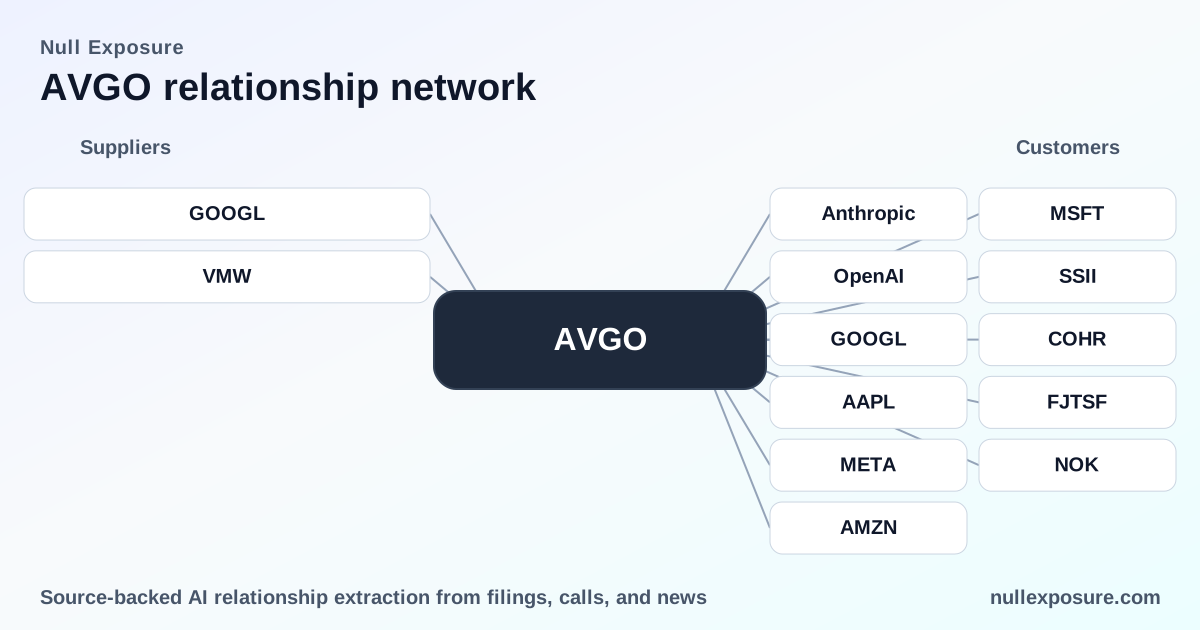
Broadcom (AVGO) and Its Supplier Web: what investors should price in
Broadcom monetizes by selling high-margin semiconductor products (ASICs, networking switches, RF components) and infrastructure software and subscriptions to enterprises and hyperscalers. The company combines proprietary silicon design and targeted software acquisitions with outsourced wafer fabrication and contract manufacturing to scale volume deliveries to cloud customers and communications OEMs. For investors, revenue growth is driven by Broadcom’s ASIC wins with hyperscalers and its ability to convert those design wins into multi-year, multi-gigawatt production streams while managing outsourced manufacturing capacity. More supplier intelligence is available at https://nullexposure.com/.
Why the supplier map matters for AVGO's earnings cadence
Broadcom’s economics are a function of design leverage and manufacturing execution. The company outsources wafer fabrication and a significant share of assembly/test to third-party contract manufacturers, while keeping high-value design, software integration and customer relationships in-house. This operating posture creates three practical characteristics investors must price:
- Concentration risk in fabrication. Broadcom relies on leading foundries for wafers, leaving the company exposed to external capacity constraints and pricing dynamics in the foundry market. A Reuters-sourced report cited by InsiderMonkey on March 24, 2026 confirms Broadcom’s manufacturing partner TSMC is operating near full capacity as AI demand rises.
- Critical co-development ties with hyperscalers. Broadcom’s roadmap accelerates when cloud customers commit to ASIC pipelines and multi-gigawatt purchases; wins translate into highly visible, recurring revenue streams.
- Mature supplier network for assembly/test and services. The company uses established CMs and external auditors, reflecting a large-scale, standardized supply model rather than captive fabrication at scale.
The company-level constraint signals mirror these traits: a manufacturer relationship signal highlights reliance on third-party wafer fabricators and contract manufacturers, and a service_provider signal reflects external audit and control relationships. These are company-level operating signals, not claims about any single counterparty beyond those explicitly named by Broadcom.
All identified supplier and partner relationships (concise investor summaries)
GlobalFoundries (GFS)
GlobalFoundries reported that Broadcom selected GFS’s CBIC platform for a low-noise amplifier, marking the company as a second major customer for that product (GlobalFoundries Q4 2025 earnings call, reported March 7, 2026). This is a design win tied to RF performance and signals product-level adoption outside Broadcom’s core digital ASICs.
Cadence Design Systems (CDNS)
Cadence said it deepened a long-standing partnership with Broadcom through a strategic collaboration to develop Agentic AI workflows to help design Broadcom’s next-generation products (Cadence Q4 2025 earnings call, March 8, 2026). This is a co-development relationship that accelerates Broadcom’s internal design cadence.
Semtech (SMTC)
Semtech described demonstrations of extended‑reach connectivity and a 1.0T Ethernet switch running traffic over Broadcom Tomahawk platforms and noted a prospective customer requested a configuration tied to Broadcom switches (Semtech Q1 2026 earnings call and company commentary, March 2026 / May 2026). The linkage highlights ecosystem interoperability between Semtech silicon and Broadcom switching platforms.
Taiwan Semiconductor Manufacturing Co. (TSM)
A Reuters report cited by InsiderMonkey (March 24, 2026) quoted a Broadcom executive saying TSMC is operating near full capacity as AI chip demand surges. TSMC is therefore a critical fabrication partner whose capacity profile directly affects Broadcom’s ability to scale AI ASIC shipments.
Keysight Technologies (KEYS)
Keysight reported collaboration with Broadcom to validate next‑generation 1.6 terabit networking silicon and custom AI accelerators in Q4 (Keysight Q4 2025 earnings call, March 7, 2026). This is a validation and testing relationship that supports Broadcom’s customer qualification and time-to-market.
Google / Alphabet (GOOGL)
News outlets covering Broadcom management guidance noted Broadcom as a key partner developing Google’s TPU and securing contracts with OpenAI, Meta, and Anthropic (reported March 9, 2026). This positions Broadcom as a strategic ASIC supplier to major cloud AI platforms, a core revenue growth driver.
OpenAI
Market commentary and analyst notes (May 2026) list OpenAI as a contracted customer in Broadcom’s expanded ASIC pipeline, reflecting direct hyperscaler adoption of Broadcom ASICs for large-scale AI deployments (industry coverage, May 2026).
VMware (VMW)
Coverage of Broadcom’s acquisition activity and product strategy referenced legal counsel during the VMware transaction and Broadcom’s release of the VMware Telco Cloud Platform 9, built on VMware Cloud Foundation 9 (Bloomberg Law / Yahoo Finance, filings and coverage 2022–2026). VMware is both an acquisition target and a product integration point, making it an important enterprise-software relationship for Broadcom’s infrastructure business.
Anthropic
Analyst commentary (Mizuho coverage reported in May 2026) included Anthropic in the list of customers underpinning Broadcom’s multi-gigawatt ASIC pipeline; Anthropic’s 3.5‑gigawatt commitment starting in 2027 is presented as part of Broadcom’s demand outlook. Anthropic is therefore a large-scale cloud AI user influencing Broadcom’s long-term capacity needs.
MTIA
Research coverage in May 2026 referenced MTIA alongside other cloud players in Broadcom’s ASIC expansion notes. MTIA is listed among end‑users or partners in the ASIC pipeline and therefore forms part of the hyperscaler-driven demand profile supporting Broadcom’s next-generation silicon.
Investment implications: where the next upside and downdrafts come from
- Upside: Continued multi-gigawatt ASIC commitments from Google, OpenAI, Anthropic and similar customers convert design wins into predictable, high-margin product revenue; co-development relationships with Cadence and Keysight shorten time‑to‑revenue.
- Downside: Supply-side concentration at TSMC and reliance on third-party assembly/test create operational exposure — if foundry capacity remains tight, Broadcom’s ramp cadence could be constrained and push pricing or delivery risks into earnings.
- Operational maturity: Broadcom runs a mature supplier network (third‑party CMs and audited internal controls) that supports large-scale production runs, reducing idiosyncratic execution risk while increasing dependence on external capacity.
Risk checklist for your model
- Track gross bookings and public statements from hyperscalers for multi‑gigawatt commitments (near-term revenue visibility).
- Monitor TSMC and other foundry capacity reports and spot pricing for wafers (manufacturing bottleneck risk).
- Watch co-development milestones (Cadence, Keysight) as leading indicators of time to production qualification.
- Review legal and integration updates tied to VMware as they affect software margin and cross-sell potential.
If you want supplier-level mapping tied to portfolio exposures, see the company overview and supplier breakdown at https://nullexposure.com/ for a consolidated view.
Bottom line
Broadcom’s value hinges on converting strategic design partnerships into sustained production at scale. The company’s outsourced manufacturing model concentrates execution risk at major foundries but preserves design leverage and margins; the hyperscaler relationships (Google, OpenAI, Anthropic) are the single largest directional driver of revenue growth. For investors, the imperative is to watch capacity signals from TSMC and new publicized ASIC commitments — those two vectors will determine whether Broadcom’s robust guidance converts into repeatable earnings.