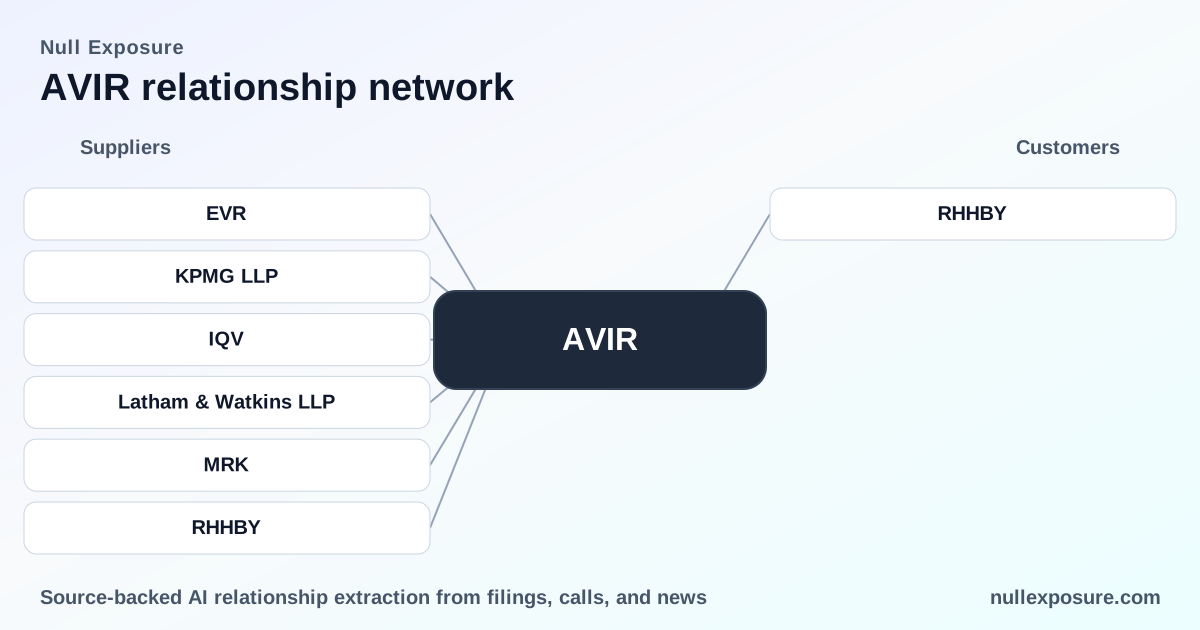
Atea Pharmaceuticals (AVIR): Supplier and advisor map for investors
Atea Pharmaceuticals is a clinical-stage antiviral developer that monetizes through licensing, milestone-triggered payments and eventual royalties on commercialized therapies while funding operations with equity and partner-sourced support. The company advances its HCV and antiviral programs through outsourced manufacturing, contract research, and strategic advisory relationships that convert clinical progress into deal activity and licensing economics. For investors evaluating supplier relationships, Atea’s model is a classic asset-light biotech: product development is internally led while critical manufacturing, market research and deal-making are outsourced — concentrating execution risk outside the corporate firewall.
If you want a consolidated supplier-risk brief for diligence, see more at https://nullexposure.com/ — practical supplier intelligence for investors.
What to know up front: how Atea runs and funds programs
Atea does not operate its own manufacturing capacity; it runs clinical development programs in partnership with third-party manufacturers (CMOs), market research providers, and financial and legal advisors. Revenue potential is driven by successful Phase 3 outcomes and subsequent partnership/licensing agreements that trigger milestone payments and downstream royalties. In the interim, operating cash flows rely on equity capital, partner milestone recognition and controlled external spend on clinical trials.
Supplier and advisor relationships that matter (clearly explained)
Below I list every relationship reflected in press releases and filings tied to Atea in the provided results, with short plain-English summaries and source citations.
Evercore (EVR) — financial advisor and previously engaged deal broker
Atea engaged Evercore as its financial advisor to explore strategic partnerships tied to its Phase 3 HCV program, and later concluded the formal engagement as the company prioritized clinical readouts to catalyze business development. Source: FierceBiotech reporting on Atea’s Q4 results and GlobeNewswire company announcements (2025–2026).
https://www.fiercebiotech.com/biotech/atea-offloads-quarter-its-workforce-while-gearing-phase-3-hcv-trials
KPMG LLP — external auditor ratification
KPMG LLP was re-appointed as Atea’s auditor with shareholder ratification reported in the company’s FY2025/2026 proxy/filing summary, indicating continuity in external financial controls and audit oversight. Source: SEC filing summary published via StockTitan (FY2026).
https://www.stocktitan.net/sec-filings/AVIR/page-3.html
IQVIA — independent market research and KOL survey provider
Atea contracted IQVIA to conduct independent quantitative market research and provider surveys; the IQVIA work underpins Atea’s commercial assumptions for the BEM/RZR HCV regimen and informed KOL feedback used in investor materials. Source: GlobeNewswire (Nov 12, 2025) and subsequent conference materials (J.P. Morgan 2026).
https://www.globenewswire.com/news-release/2025/11/12/3186782/0/en/Atea-Pharmaceuticals-Reports-Third-Quarter-2025-Financial-Results-and-Provides-Business-Update.html
Merck / MSD International GmbH — in‑license and milestone/royalty counterparty
Atea has an in‑license for ruzasvir from MSD/Merck (listed as MSD International GmbH / MRK), under which Atea is responsible for milestone payments and royalties upon commercialization; recent financial disclosures note milestone-related expense tied to the Merck license in Phase 3 development. Source: company earnings materials and Q4 2025 filing (StockTitan / GlobeNewswire, FY2026).
https://www.stocktitan.net/news/AVIR/atea-pharmaceuticals-reports-fourth-quarter-and-full-year-2025-w1542gob5mnz.html
Roche (RHHBY) — historic license for AT‑527 (program asset)
Atea’s earlier lead program AT‑527 is a nucleotide prodrug licensed from Roche; filings and earnings commentary reference the Roche license as the origin for that program and as part of the company’s prior R&D footprint. Source: MarketBeat coverage of earnings releases (FY2026) and prior statements.
https://www.marketbeat.com/instant-alerts/atea-pharmaceuticals-nasdaqavir-posts-earnings-results-misses-expectations-by-008-eps-2026-03-05/
Latham & Watkins LLP — legal counsel on governance and activist engagement
Latham & Watkins acted as Atea’s legal counsel in transactions tied to shareholder activism and agreements (for example, advising on the agreement with the Radoff‑JEC Group), demonstrating high‑caliber outside legal support for strategic and governance work. Source: Latham & Watkins announcement and company disclosures (FY2025).
https://www.lw.com/en/news/2025/04/latham-watkins-advises-atea-pharmaceuticals-in-agreement-with-radoff-jec-group
Notes on duplicates and symbol mappings: several items in the record duplicate these relationships under different feeds (e.g., EVR / Evercore, MRK / MSD International GmbH) but the underlying counterparties and roles are the same as summarized above across the FY2025–FY2026 reporting window.
Operational constraints and what they signal for investors
The company filings and press materials reveal several structural constraints that shape supplier risk and execution timelines:
- Manufacturing and service concentration. Atea lacks owned manufacturing and relies on a small number of CMOs for active pharmaceutical ingredients and clinical supply; this is a high‑criticality, concentrated supplier posture that elevates supply chain execution risk and regulatory dependency. (Company-level signal from filings describing reliance on CMOs and limited supplier count.)
- Geographic single-sourcing for key inputs. For ruzasvir, Atea disclosed a sole supplier for the active pharmaceutical ingredient and that regulatory starting materials for both ruzasvir and bemnifosbuvir are located in China — a single-country concentration that increases geopolitical and logistics risk for these programs. (Company-level signal from supply-location disclosure.)
- Outsourced professional services for dealmaking and commercialization readiness. The company’s use of Evercore for business development and Latham for legal counsel indicates a deliberate externalized approach to M&A/partnering and governance—benefit: high-expertise external support; risk: dependence on third-party execution for transformative transactions.
- Fixed real estate commitment through 2026. A long-term lease for the corporate offices at 225 Franklin Street runs through December 31, 2026, reflecting a modest fixed-cost commitment amid a variable outsourced spend profile. This lease is a tangible operating leverage line in the near term. (Company-level lease disclosure.)
Collectively, these constraints depict an asset-light, partnership-dependent operating model with concentrated supplier geography and externalized commercialization capabilities — a configuration that amplifies the importance of vendor selection, contract terms and contingency planning.
Investment implications: what investors should watch
- Catalyst-centric upside: Clinical readouts (Phase 3 HCV results) and subsequent business-development activity are the primary value drivers; Evercore engagement was timed to capture that upside.
- Execution risk centered off‑balance-sheet: Manufacturing failures, regulatory inspection issues at CMOs, or supply interruptions in China would have outsized impact because Atea does not internalize production. Monitor CMO disclosures, inspection histories and redundancy plans.
- Partner economics: License obligations to Merck/MSD (milestones and royalties) will affect net margins on any eventual product revenue; understand the royalty stack and milestone schedule in future filings.
- Governance and audit continuity: KPMG re‑appointment reduces audit transition risk; Latham’s role in activist negotiations indicates active shareholder engagement dynamics.
If you want an integrated supplier-risk dossier and ongoing monitoring for Atea, NullExposure compiles these signals into investor-facing supplier risk dashboards — see https://nullexposure.com/.
How to monitor the next 12 months
Prioritize:
- Phase 3 enrollment and data milestones for the BEM/RZR regimen.
- Vendor announcements on secondary sourcing or relocation of API/regulatory starting materials outside China.
- Disclosure of milestone payments and royalty schedules tied to Merck/MSD licensing.
- Any new strategic advisory or banker engagements that presage a transaction.
Bottom line: Atea’s value rests on clinical success and expert external execution. Supplier concentration (manufacturing and single-country inputs) and outsourced commercialization obligations create clear pathways to both upside (partnering/licensing) and downside (supply disruption), so active monitoring of the counterparties listed above is essential for investors evaluating exposure to AVIR.