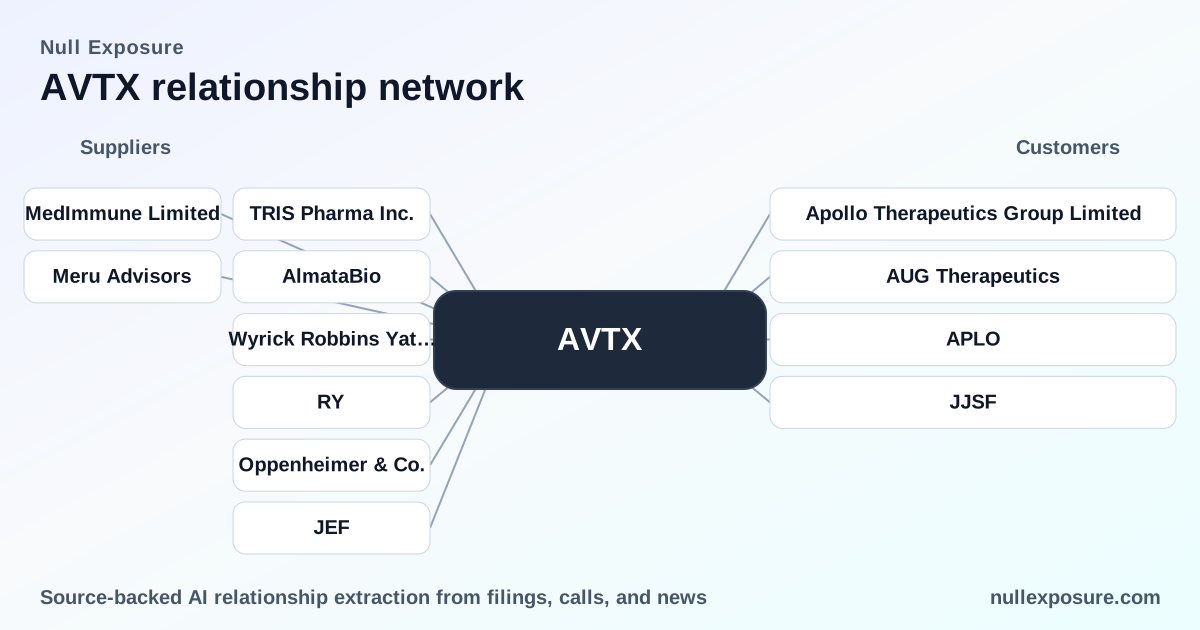
Avalo Therapeutics (AVTX): Supplier relationships and what they signal for investors
Avalo Therapeutics operates as a clinical-stage biotechnology company that monetizes primarily by licensing and developing partnered drug assets and by securing capital markets transactions to fund clinical programs. The company acquires and in-licenses therapeutic candidates, advances them through trials using contract research and manufacturing partners, and finances development through equity placements and private placement financing while retaining commercialization rights for core programs. For investors, the commercial runway is driven by licensing economics, milestone liabilities and the robustness of third‑party supplier and advisor relationships.
Explore Avalo’s supplier profile and related risk signals at https://nullexposure.com/.
Overview: how Avalo runs the supplier playbook Avalo’s operating model is license- and acquisition-driven: the firm acquires programs (for example through mergers such as the AlmataBio transaction) and steps into existing license frameworks that include material milestone and sales-based obligations. Avalo does not operate its own manufacturing facilities and therefore relies heavily on contract manufacturers, clinical CROs and external commercial partners to execute trials and supply product for the market. Cash flow to support these activities is episodic and dependent on capital markets execution and placement agents. That combination creates a profile of high contractual leverage, concentrated third‑party dependency, and asymmetric downside if counterparties or CMOs underperform.
Supplier and counterparty relationships — what the filings and press releases show Below are the supplier, advisor and capital-market counterparties that appear in Avalo’s public materials, with concise, sourced descriptions.
TRIS Pharma Inc.
TRIS is referenced in Avalo’s 2024 Form 10‑K in connection with an agreement described as the Karbinal Agreement, which tied TRIS obligations to Aytu under a supply and distribution arrangement. This is recorded as a legacy commercial supply arrangement tied to transferred product rights. (Avalo 2024 10‑K, FY2024)
AlmataBio
Avalo acquired AVTX‑009 through a merger with AlmataBio, and recorded $27.6 million of in‑process R&D as part of the transaction, indicating AlmataBio was the vehicle used to obtain rights to that program. The acquisition is a direct source of Avalo’s program inventory. (Avalo 2024 10‑K, FY2024)
Wyrick Robbins Yates & Ponton LLP
Wyrick Robbins served as legal counsel to Avalo on a March 27, 2024 financing and acquisition press release, establishing a named external law firm relationship for transactional work. (GlobeNewswire press release, March 27, 2024)
RBC Capital Markets
RBC Capital Markets is cited in market reports summarizing a historical underwriting agreement alongside Jefferies for a prior public offering. The mention documents RBC’s role as an underwriter in at least one capital markets transaction involving Avalo. (StockTitan summary of underwriting agreement, referencing prior offering)
Oppenheimer & Co.
Oppenheimer served as sole placement agent in the March 27, 2024 private placement announcement, positioning the firm as a primary capital markets intermediary for Avalo’s 2024 financing activity. (GlobeNewswire press release, March 27, 2024)
Jefferies LLC
Jefferies joined an underwriting agreement reported in press summaries for a prior offering, demonstrating that Avalo has engaged multiple global investment banks for equity financings. (StockTitan summary of historical underwriting agreement)
MedImmune Limited (AstraZeneca subsidiary)
MedImmune originally licensed AVTX‑007 to Avalo and that license was transferred into a subsequent transaction to Apollo Therapeutics, documenting Avalo’s role as a middle actor in in‑licensing and out‑licensing flows for antibody programs. (GlobeNewswire release, August 1, 2022)
Meru Advisors
Meru Advisors appears as an investor relations/media contact on recent announcements, indicating an active outsourced IR relationship that handles communications and investor engagement. (StockTitan press posting with IR contact details)
Constraints and what they reveal about Avalo’s contracting posture The public record establishes several persistent attributes of Avalo’s operating model:
-
License‑centric growth: Avalo’s pipeline is the product of multiple exclusive license agreements and acquisitions. The 10‑K lists explicit license arrangements with established institutions (OSI/Astellas, CHOP, Kyowa Kirin, Sanford Burnham Prebys, Eli Lilly via AlmataBio), demonstrating a strategy that substitutes licensing for in‑house discovery. (Avalo 2024 10‑K)
-
Material milestone and sales obligations: Avalo recorded contractual obligations that include large contingent payments, including up to $70 million in development/regulatory milestones and sales‑based milestones aggregating to up to $650 million payable to Lilly plus additional commitments referenced in the filing — a meaningful future cash outflow contingent on program success. This creates a pronounced leverage on future approvals and commercial performance. (Avalo 2024 10‑K)
-
No internal manufacturing; dependency on CMOs and service providers: Avalo discloses it lacks manufacturing facilities and relies on contract manufacturing organizations and third‑party clinical vendors. This increases operational risk tied to supplier performance and regulatory compliance at third parties. (Avalo 2024 10‑K)
-
Third‑party services extend beyond lab work: Avalo uses external legal counsel, placement agents, IR firms and managed security service providers, reflecting an operational model that outsources non‑core functions and relies on financial and advisory intermediaries to execute transactions and manage cyber and compliance risk. (GlobeNewswire; 10‑K excerpts)
-
Contract termination and legacy product flows: The Millipred® license and supply agreement expired as planned on September 30, 2023, illustrating that Avalo transitions legacy product obligations through contractual end dates rather than maintaining long-term commercial sales operations. (Avalo 2024 10‑K)
Implications for investors and operators
- Concentration of execution risk: Avalo’s reliance on external manufacturers and CROs makes supplier performance a primary determinant of timelines and value realization. Investors should treat supplier diligence with equal weight to clinical data.
- Balance sheet sensitivity to capital markets: The company’s historical use of underwriters (Jefferies, RBC) and placement agents (Oppenheimer) underscores dependence on equity financings to fund operations; underwriting access directly affects runway.
- P&L skewed to binary events: Minimal current revenue (reported revenue TTM of $192k) and large contingent liabilities imply return profiles are binary — success unlocks milestone payments but also triggers large outflows to licensors. Valuation and risk must be modeled as milestone-driven and partner‑dependent.
Mid‑report action: for a concise supplier and counterparty risk scorecard, visit https://nullexposure.com/ to compare Avalo’s supplier posture across peers.
Final takeaway and recommended next steps Avalo is a license-and-acquisition focused biotech with pronounced third‑party reliance and sizable contingent milestone obligations. For investors, the key lenses are (1) counterparty quality of CMOs and CROs, (2) covenant and milestone structure in license agreements, and (3) the company’s ability to access capital through placement agents and underwriters when clinical inflection points demand cash. Operators evaluating supplier relationships should prioritize contractual clarity on delivery SLAs, regulatory compliance duties, and termination protections.
If you want a deeper, line‑by‑line supplier exposure review or a comparative peer analysis, start with the Avalo supplier profile at https://nullexposure.com/ and request a tailored report for diligence and portfolio risk management.