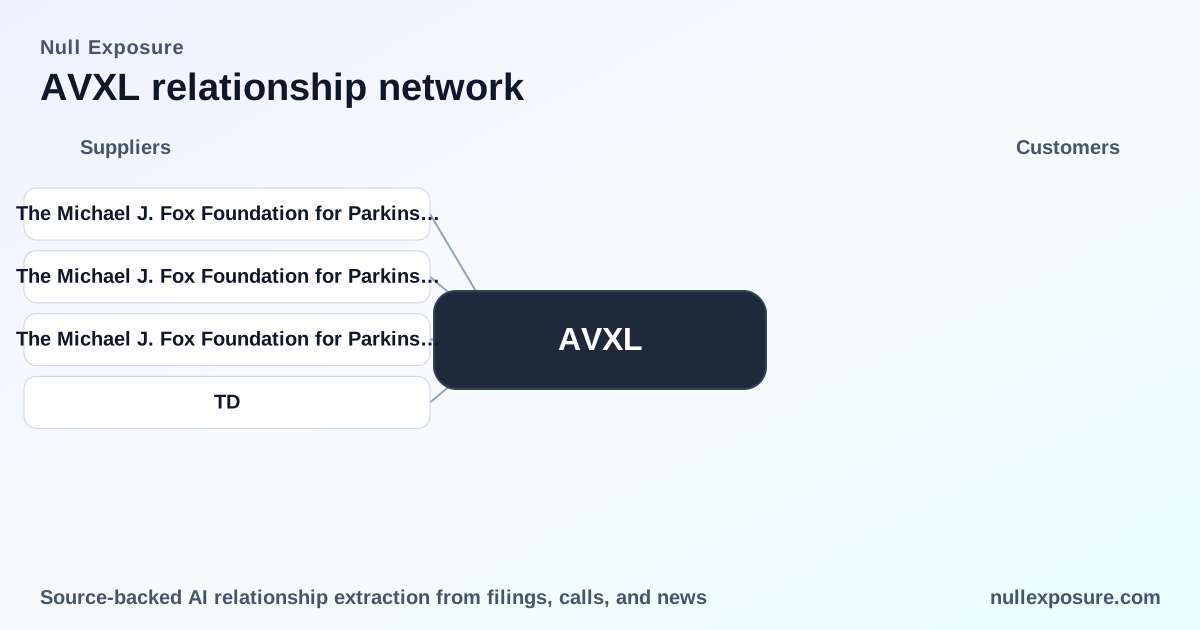
Anavex Life Sciences (AVXL): Supplier relationships and operational constraints investors need to price in
Anavex is a clinical-stage biotechnology company that develops small-molecule therapeutics (notably ANAVEX®2-73) and finances operations through a combination of grant funding, research collaborations, and equity markets rather than product sales. The company's monetization profile today is driven by R&D financing and capital markets access—grants de-risk specific programs and an at-the-market (ATM) sales agreement with an investment bank provides immediate funding capacity when needed. For a consolidated supplier-risk and counterparty view, visit https://nullexposure.com/.
Why supplier relationships matter for a clinical-stage biotech investor
Anavex operates with a small internal footprint (approximately 34 full-time employees) and outsources core functions: non-clinical studies, clinical trial management, and drug manufacturing. That outsourcing creates operational leverage—good for variable cost control, risky for execution and regulatory timelines. Grants and incentive programs reduce near-term financing pressure for targeted programs; conversely, the ATM facility is a structural equity financing channel that dilutes shareholders when used but guarantees access to capital. Investors should treat supplier relationships as both enablers of progress and potential single-point failures for trial and filing timelines.
For a granular supplier mapping and third-party exposure profile, see https://nullexposure.com/.
Michael J. Fox Foundation — strategic non-profit backer
Anavex received funding from The Michael J. Fox Foundation that funded preclinical work and a clinical-trial–directed award for ANAVEX®2-73 related to Parkinson’s disease. The grant reduced the program’s near-term cash burden and underwrote specific development activities tied to the Parkinson’s indication. (According to Anavex press materials and SEC filings across FY2025–FY2026, the Foundation awarded a research grant, with a $1.0 million award noted in the company’s FY2025 disclosures.)
TD Securities — a framework sales agent for equity raises
On July 25, 2025, Anavex entered a Sales Agreement with TD Securities (USA) LLC under which the company can offer and sell up to $150 million in common stock through an at-the-market (ATM) facility; TD Securities will act as sales agent under commercially reasonable efforts. This agreement creates a standing capital-raising channel that management can activate to finance development programs or corporate needs. (Source: 2025 Sales Agreement disclosures and the company’s FY2025 filings.)
How these two relationships interact with the business model
- Grant funding (non-profit): The Michael J. Fox Foundation grant is a targeted, non-dilutive funding source that lowers program-specific cash requirements and improves the visibility of trial funding for the Parkinson’s program. Grants are time-limited and program-specific, so they reduce but do not eliminate financing needs across the company’s pipeline.
- ATM framework (financial intermediary): The TD Securities sales agreement is a liquidity mechanism that converts investor demand into cash quickly; it is a framework contract that trades dilution for optionality. The presence of an active ATM reduces the urgency of bridge financings but increases shareholder dilution risk if heavily used.
- Outsourced execution (CROs/CDMOs, distributors, service providers): The company’s strategy of contracting universities, CROs and CMOs means execution is dependent on a distributed supplier base; progress on registrational studies and CMC deliverables is contingent on these third parties.
Mid-read action: understand supplier concentration and contractual terms in advance — more detail at https://nullexposure.com/.
Constraints and what they say about Anavex’s operating model
The company-level constraint signals in filings and disclosures produce a clear, investor-relevant profile:
- Contracting posture — framework agreement present: The July 25, 2025 Sales Agreement with TD Securities is an explicit framework contract that institutionalizes capital access. This is a structural feature of the company’s financing strategy and changes the capital-risk equation for investors.
- Counterparty mix — government, non-profit, individual advisors: Anavex reports eligibility for Australian R&D tax incentives (government counterparty exposure), a $1.0M research grant from a non-profit (Michael J. Fox Foundation), and reliance on scientific advisors who are individual clinicians and researchers. These counterparty types diversify funding and expertise, but introduce audit and compliance vectors (government audits) and dependence on expert networks for trial design and investigator relationships.
- Supplier roles — manufacturer, distributor, service provider: The company explicitly uses contract manufacturers, contract research organizations, and distributors for numerous functions. This is consistent with a lean internal model that leverages external capacity but elevates operational and supply-chain criticality—any disruption at a CDMO or CRO can delay timelines materially.
- Relationship stage — active: Filings describe ongoing reliance on third parties and active agreements, indicating these supplier relationships are operationally mature and currently relied upon for execution.
None of these constraints are hypothetical: they are embedded in the corporate disclosures and directly inform capital allocation and execution risk.
Practical investor implications — risk and upside
- Funding runway and dilution: The ATM with TD Securities is a high-conviction funding mechanism; investors must price potential dilution if management draws on the facility repeatedly. The ATM reduces the probability of emergency financings but increases the likelihood that equity issuance will be used to fund development.
- Program de-risking through grants: The Michael J. Fox Foundation grant is positive for the Parkinson’s program: it reduces the incremental cash needed to advance that program and provides an independent signal of external scientific validation.
- Execution and regulatory risk anchored to suppliers: Clinical progress and CMC readiness are dependent on third-party providers and government incentive programs that can be audited. Supply-chain continuity, vendor quality, and audit exposure are primary operational risks for Anavex.
- Concentration of expertise: With a small headcount, Anavex is highly dependent on external scientific advisors and contracted teams for trial design and execution; this increases governance and counterparty-selection importance.
Final takeaways for commercial relationships and investor action
- Anavex’s funding model is hybrid: non-dilutive, program-specific grants sit alongside a ready-to-deploy ATM equity facility; both materially affect valuation dynamics.
- Operational model is outsourced and therefore supplier-risk sensitive: investors must monitor CRO/CDMO performance, grant milestones, and any government audit activity tied to R&D credits.
- Two relationships to watch closely: the Michael J. Fox Foundation (program funding and validation) and TD Securities (capital access and potential dilution) are active levers that will shape execution and financing outcomes in the near term.
For a full supplier-risk assessment and to monitor these counterparties as filings and press releases update, visit https://nullexposure.com/.
If you want an investor-tailored supplier risk brief on AVXL or comparable clinical-stage peers, review our coverage hub at https://nullexposure.com/ and request a custom report.