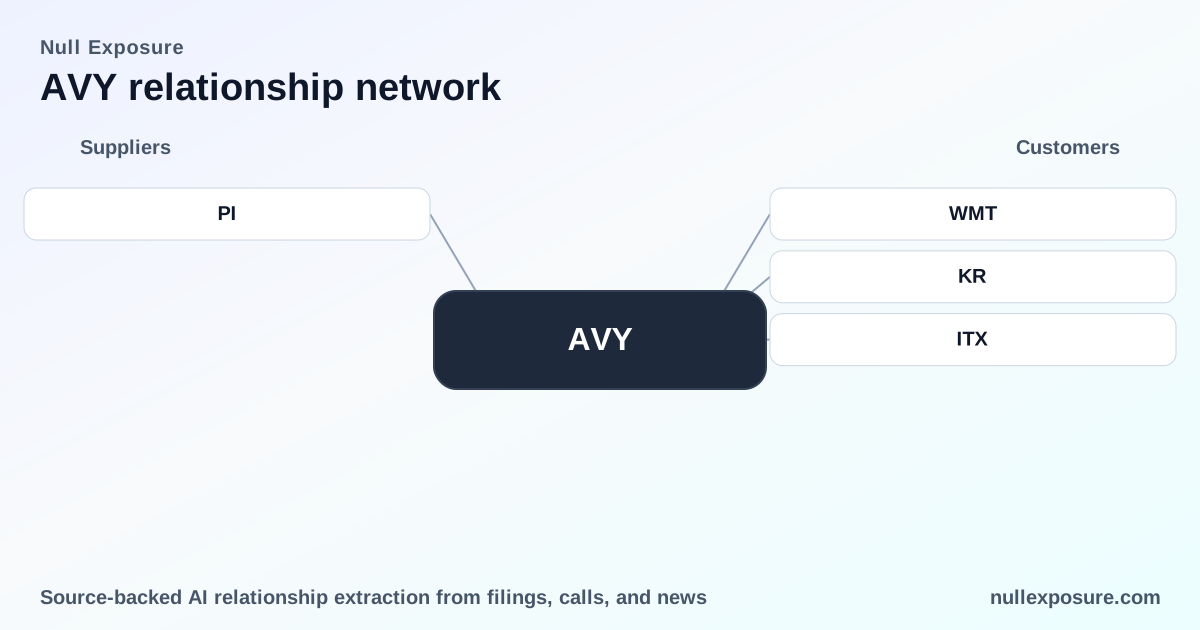
Avery Dennison (AVY) — Supplier Relationships and Strategic Signals for Investors
Avery Dennison operates as a global manufacturer and distributor of pressure‑sensitive adhesive materials, apparel branding, RFID inlays and specialty products, monetizing through product sales to consumer brands, retailers and industrial customers, plus value capture via design, packaging services and technology-enabled label solutions. The company combines durable manufacturing margins with recurring commercial relationships in retail tagging and supply‑chain services, generating revenue from both materials and higher‑margin technology solutions such as RFID. Explore the full supplier mapping at https://nullexposure.com/ for deeper counterparty context.
What investors need to know up front
Avery Dennison’s business model blends commodity input exposure with a technology-enabled product stack. The core revenue engine is high-volume materials (paper, films, resins) sold to packaging and apparel customers, while RFID and labeling solutions provide differentiated margins and stickiness. Key financial anchors include an approx. $13.2B market capitalization, ~8% return on assets and a 12.7% operating margin (TTM), which underpin supplier bargaining power and capacity to invest in technology partnerships.
- Contracting posture: AVY operates primarily as a buyer in commodities and manufacturing inputs, running hedging programs to stabilize input costs.
- Concentration: The company’s product breadth diffuses supplier concentration in many inputs, but specialized partners for RFID and tech components increase supplier criticality.
- Criticality: RFID and brand-identifying label suppliers are strategically important because they underpin customer switching costs and service differentiation.
- Maturity: Avery Dennison’s supplier relationships span long-standing raw-material contracts and evolving technology partnerships that are becoming more central to revenue growth.
Explore supplier signals and relationship analytics at https://nullexposure.com/ to assess counterparty concentration and operational risk.
Supplier relationships identified in public coverage
Impinj Inc. — technology supplier for RFID-enabled fresh-food labels
A consumer-market report notes that Avery Dennison’s AD IdentiFresh Co series advances readability and speed by leveraging technology from Impinj Inc., indicating a product-level integration of Impinj’s RFID read/write or tag silicon to improve traceability and throughput in the fresh‑food category. This relationship signals AVY’s strategy to combine materials with third‑party RFID technology to expand into higher-value retail applications. (MassMarketRetailers, Mar 9, 2026: https://massmarketretailers.com/avery-dennison-advances-rfid-tech-in-fresh-food-categories/)
How these relationships fit into Avery Dennison’s operating model
The Impinj collaboration illustrates AVY’s dual approach: retain control of high-volume manufacturing while partnering for specialized components that accelerate product capability. Avery Dennison leverages supplier technology where it cannot economically internalize capability, enabling faster go‑to‑market for new label products and preserving capital for production scale.
- Supplier selection follows a pragmatist playbook: maintain vertical control on commodity inputs, partner externally for semiconductor and reader technologies.
- Strategic partnerships like the Impinj tie into customer solutions that increase switching costs for retail customers, turning transactional sales into service relationships.
Constraints and what they reveal about AVY’s procurement posture
Company disclosures and excerpts show Avery Dennison executes hedging strategies and relies on volatile raw materials: the firm discloses entering natural gas futures contracts to reduce risks for anticipated manufacturing consumption, and it sources raw materials—primarily paper, plastic films, resins and specialty chemicals—that are subject to price fluctuations. These are company‑level signals that translate into operational constraints:
- Hedging and procurement sophistication: The use of futures contracts for natural gas indicates a mature procurement function that actively manages commodity price risk.
- Input cost sensitivity: Dependence on paper, films and resins enforces a buyer posture for raw materials and creates ongoing margin exposure to feedstock inflation.
- Supplier criticality varies by input: Commodity suppliers are replaceable in the medium term, while specialized technology suppliers (RFID silicon, inlay manufacturers) are higher‑criticality relationships requiring tighter integration and longer-term coordination.
These constraints support an investor view that Avery Dennison balances operational stability via hedging and scale with selective external partnerships for technology acceleration.
Investment implications — risks and upside tied to suppliers
- Upside: Partnerships that embed third‑party RFID technology into AVY product lines increase average selling price and customer stickiness; revenue growth in RFID and brand solutions will command higher multiples than commodity packaging. The Impinj tie is an example of revenue mix uplift potential.
- Risk: Persistent raw‑material inflation or disruptions in chemical and resin supply chains compress margins absent effective hedging, and reliance on specialized suppliers for RFID components introduces vendor concentration and technology dependency risk.
Major takeaway: Avery Dennison’s supplier strategy is deliberate—procure commoditized inputs at scale while integrating select external technologies to extend product value. Investors should track supplier innovation partnerships and raw‑material hedging disclosures as primary drivers of margin trajectory.
If you want a comprehensive view of AVY’s supplier map and counterparty risk scores, visit https://nullexposure.com/ for full relationship analytics and sourcing intelligence.
Final assessment and investor actions
Avery Dennison combines predictable manufacturing economics with an active pivot into technology-enabled labeling that lifts unit economics. Monitor supplier-related signals—RFID partnerships, hedging disclosures and input price trends—to anticipate margin inflection points. For investors and operators evaluating AVY counterparty exposure, a focused review of specialized technology suppliers alongside traditional paper and film vendors is essential.
For deeper, transaction-level supplier intelligence and to map concentration risk across AVY’s vendor base, consult the repository at https://nullexposure.com/ and integrate those signals into your operational diligence and investment model.