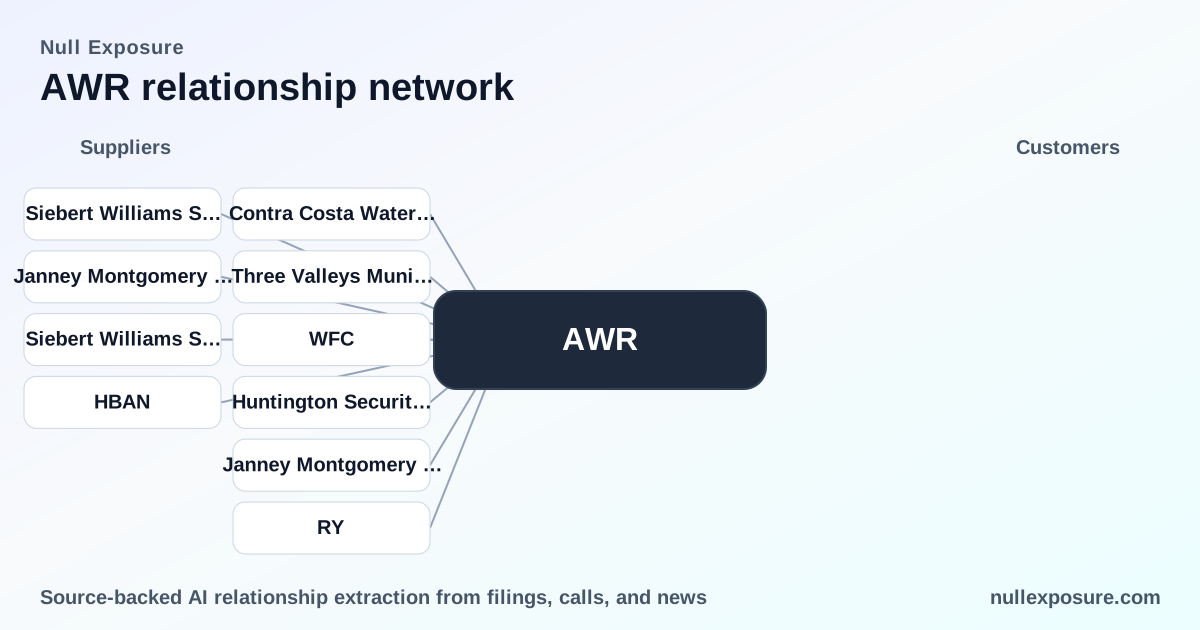
American States Water (AWR): Supplier relationships and what they tell investors
American States Water (AWR) operates regulated water and electric utilities in California and adjacent markets, monetizing through utility rate bases, regulated returns on capital, and occasional non-regulated activities supported by corporate financing. The company funds capital spending through cash flow and credit facilities, and it preserves optionality with an active at‑the‑market (ATM) equity program that uses institutional sales agents; management uses these levers to manage working capital and growth in a capital‑intensive business. For investors evaluating counterparty and supplier exposure, the mix of long‑term contracted supply, spot purchases for peak demand, and bank financing relationships drives both stability and conditional funding risk. Learn more about how supplier intelligence feeds investment decision‑making at https://nullexposure.com/.
How AWR’s supplier posture translates into investment signals
AWR’s operating model shows both structural stability and operational contingency. The company relies on long‑dated, CPUC‑approved and other long‑term contracts for core inputs (renewable credits, purchased power, reservoir and treatment capacity), while also using the spot market to meet peaks and timing mismatches. The constraints extracted from filings convey several firm‑level signals:
- Contracting mix: Evidence supports a predominance of long‑term contracts for critical inputs (high confidence) complemented by spot purchases for peak demand (moderate confidence). This combination preserves reliability while exposing the company to short‑term price volatility during peak events.
- Counterparty profile: AWR transacts with government entities and regional water suppliers for wholesale water and diversion rights, which raises the criticality of some counterparties and typically reduces commercial counterparty risk given regulatory frameworks.
- Spending scale: Capital and purchase commitments are material — references show capital expenditures and purchase commitments in the $10–100 million band, consistent with the capital intensity of regulated utilities.
- Financing posture: AWR maintains syndicated credit facilities and an active ATM equity program supported by major investment banks and regional sales agents, creating funding optionality but also potential dilution if equity issuance is used.
Those company‑level constraints are central to assessing counterparty concentration and liquidity risk for investors.
Quick relationships map — who AWR contracts with and why
Below I summarize every counterparty mentioned in the supplier results and the context investors need.
Contra Costa Water District
GSWC (a water utility unit within AWR) holds an exclusive capacity right to use 4.4 million gallons per day from a treatment plant owned by Contra Costa Water District, a direct operational supply arrangement referenced in AWR’s FY2024 Form 10‑K. This is a reliability‑oriented relationship that underpins water delivery capacity. (Source: AWR FY2024 10‑K)
Three Valleys Municipal Water District
GSWC also holds exclusive rights to reservoir capacity and half of a treatment plant capacity owned by Three Valleys Municipal Water District, giving the company dedicated storage and treatment capacity to manage demand cycles. (Source: AWR FY2024 10‑K)
Wells Fargo Securities / Wells Fargo and affiliates
Wells Fargo appears as a joint lead arranger, lender and administrative agent for AWR’s credit facilities and is one of the sales agents for the company’s ATM program, linking AWR’s liquidity and capital markets execution to a major bank. This multi‑role relationship supports both lending capacity and distribution capability. (Source: AWR 8‑K / news coverage, Feb 2026)
RBC Capital Markets / RBC affiliate
RBC is identified both as a sales agent for the ATM program and as an affiliate lender on AWR’s credit facilities, providing both capital markets distribution and bank lending support to the company. (Source: AWR 8‑K / news coverage, Feb–Mar 2026)
Siebert Williams Shank & Co., LLC
Siebert Williams Shank is listed among the sales agents for AWR’s ATM equity distribution agreement, serving a distribution role in any at‑the‑market issuance. This amplifies the company’s access to equity investors when the program is used. (Source: AWR 8‑K / related news, Feb 2026)
Janney Montgomery Scott (Janney)
Janney was an original sales agent under AWR’s Equity Distribution Agreement but was replaced by Huntington Securities as documented in the February 2026 amendment; the change reflects a tactical update in distribution partners for the ATM program. (Source: AWR 8‑K and contemporaneous market reports, Feb 2026)
Huntington Securities / Huntington Securities, Inc.
Huntington Securities was added as a sales agent in the February 2026 amendment to the Equity Distribution Agreement, replacing Janney and joining Wells Fargo, RBC and Siebert as active distributors of ATM placements. This signals a shift toward a new mix of regional and national distribution partners. (Source: AWR 8‑K; market coverage Feb–Mar 2026)
What these relationships imply for valuation and risk
- Revenue and operational stability: The long‑term rights to treatment and reservoir capacity with municipal and regional water districts are highly critical to operations and support predictable service delivery under regulated returns — a positive for valuation multiples assigned to utility cash flows.
- Capital intensity and contractual scale: Spend commitments in the $10–100M band indicate ongoing capital expenditure and purchase obligations that constrain near‑term free cash flow and require active liquidity management.
- Funding flexibility vs dilution risk: The ATM program, supported by multiple sales agents and backed by syndicate lenders, gives management flexible access to capital, but increases potential shareholder dilution if equity is issued under stress; the February 2026 amendment to the Equity Distribution Agreement demonstrates active management of distribution partners.
- Counterparty concentration and counterparty type: Government and regional suppliers provide stable counterparties for core water supply, reducing commercial credit risk; bank syndicates (Wells Fargo, RBC) reduce refinancing risk but create exposure to broader credit‑market conditions.
For investors, the combination of regulated cash flow, material capital commitments, and active credit/equity arrangements produces a mixed risk/return profile: stable core revenues with conditional funding and execution risks.
If you want deeper supplier and counterparty mapping for portfolio stress testing, start a review at https://nullexposure.com/.
Bottom line and action items for investors
American States Water’s supplier universe is a blend of mission‑critical municipal supply arrangements and market‑facing financing partners. That mix underpins durable utility operations but requires monitoring of capital commitments, ATM usage, and bank facility terms. Key investor actions:
- Monitor any ATM issuance activity and sales agent usage as a signal of funding needs and dilution trajectory.
- Track credit facility covenants and lender composition for refinancing risk.
- Consider the operational criticality of municipal supply contracts when stress‑testing outage or drought scenarios.
For analysts building exposure models or diligence memoranda, the supplier footprints and financing relationships documented above are essential inputs — discover more supplier intelligence and supplier‑driven risk analytics at https://nullexposure.com/.
Bold takeaways: AWR’s regulated supply contracts secure operational continuity; its financing relationships provide optionality but create dilution and refinancing considerations that must be priced into near‑term valuation.