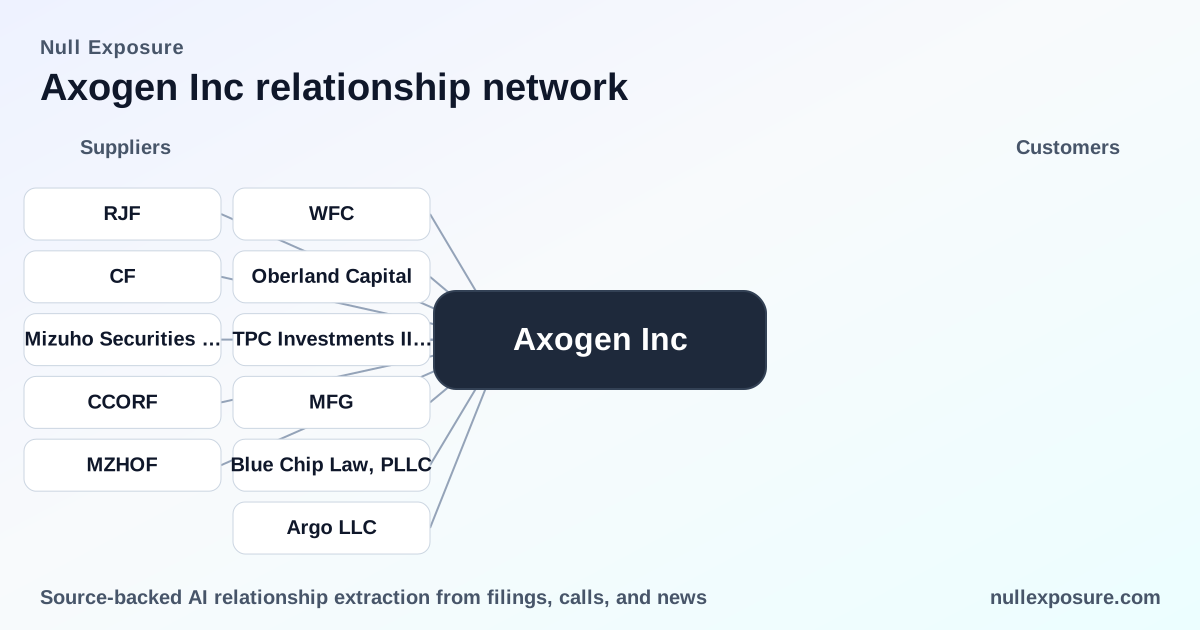
Axogen Inc (AXGN): Capital markets relationships and supplier posture investors should price in
Axogen is a medical‑device company that monetizes through the sale of surgical products for peripheral nerve repair, supported by contract manufacturing and third‑party services. In early 2026 the company executed an underwritten equity offering and is using proceeds to pay down a term loan and strengthen the balance sheet, while continuing to operate with multi‑year supply relationships for critical components and sterilization services. This briefing consolidates every named counterparty identified in public releases and explains how each relationship affects operating leverage, counterparty concentration, and execution risk. For more supplier and counterparty visibility visit https://nullexposure.com/.
Quick investment thesis — capital and operations aligned
Axogen is pursuing a classic life‑cycle capital strategy: raise equity to reduce leverage and preserve operational flexibility, while keeping manufacturing and critical services outsourced under long‑dated contracts. That posture reduces fixed manufacturing capital but concentrates execution risk in a small set of third parties; investors should value near‑term de‑risking of the balance sheet against medium‑term operational concentration.
What the January 2026 capital raise means in plain English
Axogen launched a public offering and entered into an underwriting agreement in January 2026. Wells Fargo Securities and Mizuho acted as lead book‑runners; Raymond James and Canaccord Genuity served as co‑managers. The company disclosed that net proceeds will be used for an early payoff and termination of its term loan with Oberland Capital and for general corporate purposes—an explicit deleveraging use of proceeds. These details are drawn from Axogen’s press releases and an 8‑K filed in January 2026 (GlobeNewswire; StockTitan; TradingView reporting January 21–22, 2026).
- For continuing coverage and supplier intelligence, see https://nullexposure.com/.
How to read the supply and service constraints
Axogen’s public disclosures include long‑term supply commitments for certain tissue products—contracts that run through 2030—alongside explicit reliance on third parties for sterilization, storage, distribution and related services. This indicates a deliberate outsourcing model with the following implications:
- Contracting posture: Multi‑year agreements provide predictability for pricing and availability but lock the company into a small supplier set for critical inputs.
- Concentration risk: Exclusive contract manufacturing for flagship products concentrates operational risk and makes supplier performance a critical variable for revenue continuity.
- Criticality and maturity: Agreements that extend through 2030 are medium‑term; they are mature enough to be tested by demand swings or supplier disruption but not so long as to be permanent fixtures. These constraint signals are present in Axogen filings and amendment language that reference multi‑year supply agreements and service arrangements (see company filings summarizing supply agreements and facility licensing).
Counterparty roll call: every named relationship and what it means
Wells Fargo Securities (WFC)
Wells Fargo served as one of the lead underwriters and book‑running managers on Axogen’s January 2026 offering and is party to the underwriting agreement that gives the underwriters a 30‑day option to purchase additional shares. This positions Wells Fargo as a primary distribution partner for equity capital markets execution. (Source: Axogen 8‑K and GlobeNewswire release, January 21–22, 2026; TradingView report)
Mizuho Securities USA / Mizuho
Mizuho acted alongside Wells Fargo as a lead book‑running manager and representative of the underwriters for the offering, sharing responsibility for pricing and distribution. The underwriting agreement naming Mizuho formalizes the bank’s placement role. (Source: Axogen 8‑K and GlobeNewswire release, January 21–22, 2026; TradingView report)
Raymond James (RJF)
Raymond James was disclosed as a co‑manager on the offering, providing distribution support and syndicate coverage for institutional and retail channels. Their role is supportive rather than lead but adds distribution breadth. (Source: GlobeNewswire and StockTitan press notices, January 2026)
Canaccord Genuity
Canaccord Genuity participated as a co‑manager alongside Raymond James, contributing to syndicate distribution and investor outreach for the public offering. (Source: GlobeNewswire and StockTitan press notices, January 2026)
Oberland Capital
Oberland Capital is the term‑loan lender under a credit facility dated June 30, 2020 (as amended). Axogen stated it will use offering proceeds for early payoff and termination of the term loan with Oberland—an indication the firm prioritized reducing secured debt exposure. (Source: Axogen 8‑K and GlobeNewswire, January 2026)
TPC Investments II LP
Named as an affiliate party to the credit facility, TPC Investments II LP is identified as part of the lender group supporting Axogen’s term loan facility. Its inclusion underscores that the company’s debt is held by a small set of related credit investors. (Source: Axogen 8‑K filing, cited January 2026)
Argo LLC
Argo LLC is listed with Oberland and TPC as an affiliate lender under the credit facility, forming part of the collective lender group whose loan Axogen intends to repay with offering proceeds. (Source: Axogen 8‑K filing, January 2026)
Blue Chip Law, PLLC
Blue Chip Law provided a special counsel opinion on the legality of the issuance and sale of common stock in the offering, fulfilling standard legal prerequisites for a registered public offering. (Source: Axogen 8‑K filing, January 2026)
Operational implications for investors
Axogen runs a capital‑light manufacturing model: outsourcing exclusive manufacturing and routine sterilization/distribution to third parties under multi‑year contracts. That reduces fixed asset intensity and supports margins once scale is reached, but it also creates single‑point failure risk if a contract manufacturer or service provider suffers a disruption.
- Positive: The January 2026 equity raise and planned early loan repayment reduce financial leverage and interest burden, which improves cash flow optionality and reduces refinancing risk.
- Negative: The operational concentration—exclusive manufacturing and vendor‑provided sterilization—creates execution risk that could impact revenue if a supplier relationship deteriorates.
For detailed counterparty tracking and supplier concentration analytics visit https://nullexposure.com/.
Bottom line and investor action items
Axogen’s recent financing and public disclosures show a company that is actively deleveraging while deliberately outsourcing manufacturing and service functions under long‑dated agreements. Investors should price reduced financial risk post‑offering against persistent operational concentration with a handful of critical suppliers.
- Review syndicate coverage and lockup details from the underwriting documents to assess dilution and secondary demand (Wells Fargo, Mizuho, Raymond James, Canaccord).
- Monitor confirmation of term‑loan payoff and any amendments to supply agreements with the named contract manufacturers and service providers.
- For deeper supplier profiles and counterparty risk scoring, see https://nullexposure.com/ for the latest updates and supplier intelligence.
Make these relationships part of your model: the capital move changes solvency dynamics, the supply agreements determine execution risk, and both should be incorporated into valuation and operational due diligence.