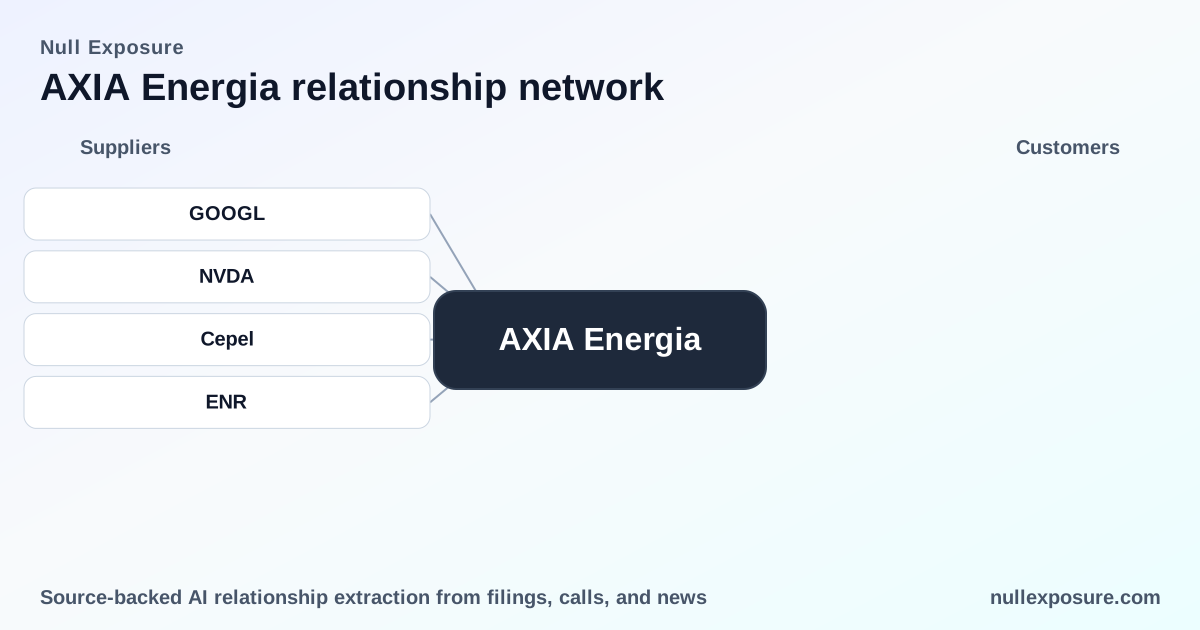
AXIA Energia: supplier relationships that steer a grid- and data-driven transformation
Thesis — AXIA Energia monetizes a hybrid utility model by operating generation and transmission assets while aggressively monetizing digital services and operational efficiency gains. The company drives cash flow from regulated and commercial power operations, and it is reinvesting privatization proceeds into cloud-enabled analytics, high-performance compute, and grid modernization projects that lower operating costs and create new products (digital renewable certificates, forecasting services) that expand revenue per megawatt.
If you are reviewing AXIA as a counterparty or investment target, focus on how these supplier relationships shift risk from capital equipment to software/cloud and specialized compute; you should also evaluate continuity plans for critical partners. Learn more or validate coverage at https://nullexposure.com/.
Supplier map: who powers AXIA's digital and grid transformation
AXIA’s recent disclosures and vendor references cluster around four strategic partners: Google Cloud, Nvidia, Cepel and Siemens Energy. Each plays a distinct role in the company’s operational modernization and productization of data-driven services.
Google Cloud — AXIA's primary cloud partner
AXIA accelerated migration to the cloud following privatization and selected Google Cloud as its main partner to host platforms and scale data services. According to a BNamericas feature (March 9, 2026), Google Cloud is the principal cloud provider supporting AXIA’s digital strategy and AI initiatives. Source: BNamericas, “From energy to AI: AXIA’s digital strategy in Brazil” (2026-03-09) — https://www.bnamericas.com/en/features/from-energy-to-ai-axias-digital-strategy-in-brazil
Nvidia — GPU hardware enabling forecasting and deep learning
AXIA uses GPU-based supercomputers and Nvidia technologies to run deep-learning climate forecasting and other compute-intensive models that support operations and product development. The same BNamericas story notes AXIA’s reliance on Nvidia GPUs for climate forecasting systems and AI workloads. Source: BNamericas, “From energy to AI: AXIA’s digital strategy in Brazil” (2026-03-09) — https://www.bnamericas.com/en/features/from-energy-to-ai-axias-digital-strategy-in-brazil
Cepel — research compute and energy-model execution partner
AXIA carries out AI model training and execution of energy-system models on both its proprietary supercomputers and on Cepel’s servers, integrating national lab compute capacity into its workflow. BNamericas reports Cepel’s role as a compute host and collaborator for energy-model execution. Source: BNamericas, “From energy to AI: AXIA’s digital strategy in Brazil” (2026-03-09) — https://www.bnamericas.com/en/features/from-energy-to-ai-axias-digital-strategy-in-brazil
Siemens Energy — grid modernization and heavy equipment supplier
Siemens Energy completed a significant grid modernization project covering 40 substations, replacing hundreds of breakers and disconnectors as part of AXIA’s hardware refresh and reliability upgrades. Siemens Energy’s reference material documents the project scope and equipment delivered in FY2025. Source: Siemens Energy reference page (FY2025) — https://www.siemens-energy.com/global/en/home/references/axia-energia-brazil-power-grid-modernization.html
What this supplier set signals about AXIA’s operating model and business constraints
AXIA’s supplier profile shows a deliberate pivot from pure infrastructure to a mixed model where digital services are operationally critical. Several company-level signals arise:
-
Contracting posture: AXIA is negotiating long-term strategic relationships rather than one-off purchases. A cloud anchor (Google Cloud) plus specialized compute partners (Nvidia, Cepel) indicate multi-year commercial commitments and technical integration that go beyond spot procurements.
-
Concentration and vendor mix: The mix is balanced between platform/cloud (Google Cloud), hardware/GPU (Nvidia), national research infrastructure (Cepel), and heavy electrical equipment (Siemens Energy). This mitigates single-vendor concentration risk but introduces cross-domain dependency—cloud and GPU uptime are as material to operations as physical substation hardware.
-
Criticality of relationships: Google Cloud and Nvidia occupy high criticality roles for AXIA’s AI-enabled forecasting and digital product roadmaps; Siemens Energy is critical to physical grid reliability. Cepel’s involvement signals reliance on external research-grade compute when in-house capacity is insufficient, which is important for seasonal planning and model validation.
-
Maturity and integration: The Siemens Energy engagement demonstrates mature, capital-intensive contracting and long asset lifecycles, while Google Cloud and Nvidia relationships reflect a more modern OPEX-driven approach to scaling analytics. The coexistence of CAPEX-heavy grid upgrades and OPEX-heavy cloud/compute arrangements suggests AXIA is evolving contract management capabilities across different procurement models.
No explicit constraints were provided for specific vendor agreements, so treat these operating characteristics as company-level signals to guide diligence on contract length, SLAs, and exit provisions.
Risk and opportunity implications for counterparties and investors
-
Operational risk: Dependence on cloud and GPU infrastructure makes continuity planning essential; outages or supply squeezes (GPU availability) would directly affect AXIA’s forecasting and trading operations. Investors should review SLAs, redundancy across cloud zones, and contractual remedies with Google Cloud and Nvidia.
-
Commercial upside: Cloud-enabled analytics and digital renewable certificates (RECFY) create new revenue lines with low incremental marginal cost once platforms scale. The BNamericas coverage highlights AXIA’s use of blockchain for certificate issuance, indicating a productization focus.
-
Capital and lifecycle risk: Siemens Energy’s substation work reduces near-term reliability risk but commits capital to long-lived assets; monitoring capex schedules and maintenance provisions is necessary to understand free-cash-flow timing.
Practical actions for investors and counterparties
- Request copies or summaries of key contracts with Google Cloud and Nvidia, focusing on term length, termination rights, and performance SLAs.
- Validate redundancy for compute workloads: multi-cloud or hybrid-cloud fallbacks, and access arrangements with Cepel for overflow compute.
- Monitor Siemens Energy project handover documentation and warranty terms tied to the 40-substation modernization work.
For a detailed vendor-risk briefing or to map these relationships against AXIA’s counterparty exposure, visit https://nullexposure.com/ to request a tailored analysis.
Final read: the strategic balance between wires and software
AXIA is executing a credible, two-track strategy: modernize the physical grid with established engineering partners while simultaneously building digital capabilities that convert operational data into commercial products. The dual reliance on cloud/GPU compute and heavy electrical equipment creates a diversified, but interdependent, supplier matrix that raises both resilience and complexity.
For decision-makers, the priority is clear: validate contractual guarantees and redundancy where compute is critical, and ensure that capital investments into substations remain on budget and schedule. If you want a concise crosswalk of AXIA’s supplier contracts and a one-page vendor risk scorecard, go to https://nullexposure.com/ and request the supplier brief.