AXINR — What investors should know about the warrant, its underwriters, and commercial posture
Axiom Intelligence Acquisition Corp 1 Right (AXINR) is a NASDAQ-listed warrant tied to a London-headquartered SPAC that targets European infrastructure deals. The security’s economic value is realized through secondary-market trading and through potential exercise into equity if a qualifying business combination completes; the sponsor and underwriters monetize value primarily through the SPAC process rather than operating cash flow. For investors evaluating supplier and counterparty relationships, the key questions are underwriting quality, contract and disclosure posture, and the inherent maturity and liquidity limitations of a warrant instrument. Visit https://nullexposure.com/ for deeper supplier relationship analytics.
How AXINR operates in plain terms
Axiom Intelligence Acquisition Corp 1 is a blank‑check vehicle focused on European infrastructure and is headquartered in London while listed on NASDAQ. AXINR itself is a warrant — a derivative right tied to the SPAC that converts into equity upon exercise — not an operating company with revenue or EBITDA. The company overview shows effectively zero operating metrics: no reported revenue, no earnings, and a negative book value entry (-0.256), with quoted 52‑week trading bounds of $0.105 to $0.25. The issuer’s public profile is consistent with a pre‑combination SPAC structure: value is created or destroyed by deal execution, sponsor economics, and market liquidity rather than by recurring operating cash flow.
What the operating model implies for relationship risk
Treat AXINR as a financial instrument whose performance depends on transaction execution and market liquidity rather than supplier service delivery. That leads to a few direct operating-model characteristics investors should internalize as constraints:
- Contracting posture: SPACs adopt short, event-driven contracts (underwriting agreements, trust account rules, merger agreements). These arrangements prioritize speed and conditionality; counterparties are typically paid on completion events rather than ongoing service fees.
- Concentration of critical relationships: A small set of underwriters and sponsors determine access to capital and distribution. Underwriting relationships are therefore strategically critical — the quality and commitment of the banks running the book materially affect execution and pricing.
- Maturity and disclosure posture: The entity reports minimal standard corporate metrics (no revenue, earnings, or shares outstanding reported in the summary), signaling an immature operating lifecycle focused on a single strategic event rather than sustained operations.
- Liquidity and market risk: As a warrant, AXINR is inherently more sensitive to liquidity and volatility than ordinary shares; price discovery is driven by investor expectations for a deal and the value of the redemption trust.
No supplier constraints or contract-specific limitations were included in the available records, which itself is a company-level signal: there are no reported vendor or supplier restrictions disclosed in the analyzed materials.
Who ran the offering — relationships that matter to investors
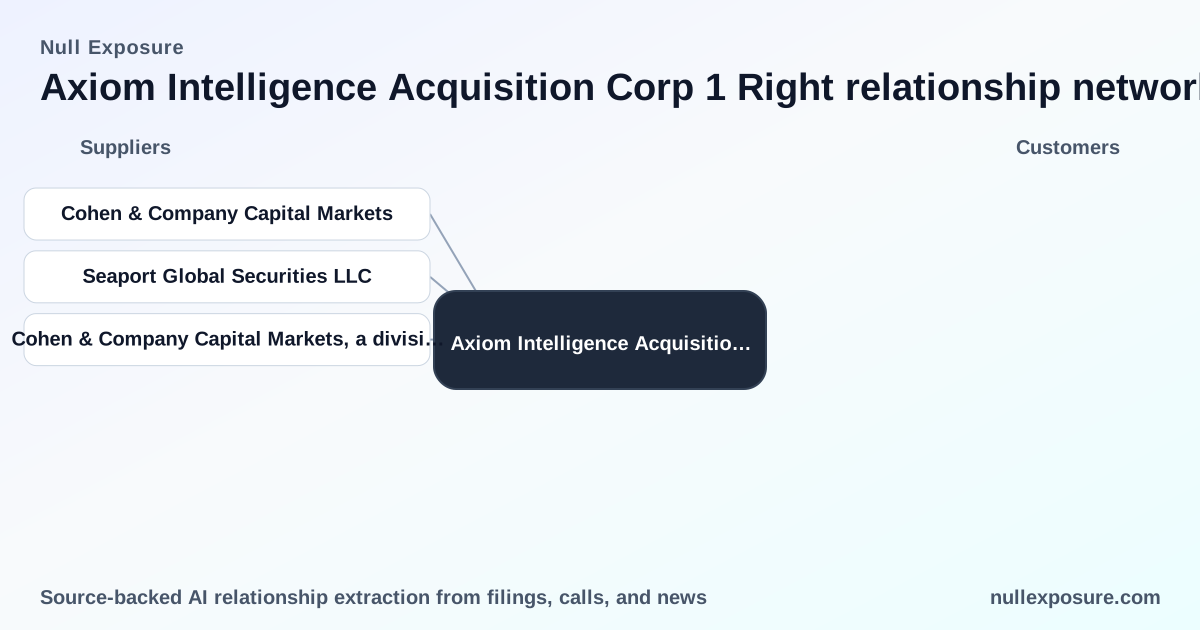
Below are the underwriting counterparties named in the public communications around the offering; each relationship is summarized with source context.
Cohen & Company Capital Markets, a division of J.V.B. Financial Group, LLC
Cohen & Company served as the lead book‑running manager on the offering, positioning it as the principal distribution and placement agent for the transaction and anchoring the capital raise. According to a March 9, 2026 news release reported on Yahoo Finance and mirrored on StockTitan, Cohen & Company acted as lead book‑running manager for the offering (Yahoo Finance, Mar 9, 2026; StockTitan, Mar 9, 2026).
Seaport Global Securities LLC
Seaport Global Securities acted as joint book‑runner, sharing placement and underwriting responsibilities alongside the lead manager, which broadens distribution channels for the instrument. The same March 9, 2026 release identifies Seaport Global Securities LLC as a joint book‑runner (Yahoo Finance, Mar 9, 2026; StockTitan, Mar 9, 2026).
What these relationships mean for investors
Underwriting pedigree matters for a SPAC‑linked warrant. Having recognized firms — a lead book‑running manager and a named joint book‑runner — improves distribution and gives the transaction a conventional capital markets structure. That reduces execution risk relative to an unanchored or dealerless offering, and it increases the probability that market makers will provide liquidity. However, underwriting quality does not change the fundamental mechanics: value realization for warrant holders requires either a successful business combination or active secondary trading.
A few practical implications:
- If you trade this warrant, prioritize liquidity checks because exercise economics and tight spreads determine real investor outcomes; underwriting names make liquidity more probable but do not guarantee it.
- If you assess counterparty risk, the lead manager and joint book‑runner roles are central — their reputations and balance-sheet willingness to support distribution affect initial pricing and aftermarket depth.
- If you are evaluating exposure to the sponsor’s deal pipeline, consider that the SPAC model concentrates risk around a single M&A outcome rather than diversified operating earnings.
If you want a deeper read on counterparty exposures and underwriting concentration for SPAC‑linked securities, see more at https://nullexposure.com/.
Practical next steps for operators and investors
- Validate secondary market liquidity before establishing a position; underwriters reduce but do not eliminate liquidity risk.
- Monitor filings and press releases from the SPAC for underwriting fees, sponsor promote, and redemption results, as those disclosures determine post‑deal dilution and warrant leverage.
- Track the relationship continuity between the sponsor and named underwriters: repeated partnerships signal strategic alignment and smoother execution.
For a full view of supplier relationships and underwriting concentration across similar instruments, visit https://nullexposure.com/ to access our relationship intelligence.
Bottom line and recommended action
AXINR is a financial exposure tied to a SPAC process: its value is driven by transaction execution and market liquidity, not operating performance. The presence of Cohen & Company as lead book‑runner and Seaport Global Securities as joint book‑runner is a positive signal for distribution and initial market support (Yahoo Finance, Mar 9, 2026; StockTitan, Mar 9, 2026). Investors should treat underwriter relationships as primary risk levers and confirm liquidity before committing capital.
Explore supplier and underwriting relationship maps if you intend to take a position: https://nullexposure.com/ provides the connective context investors need to move from information to action.