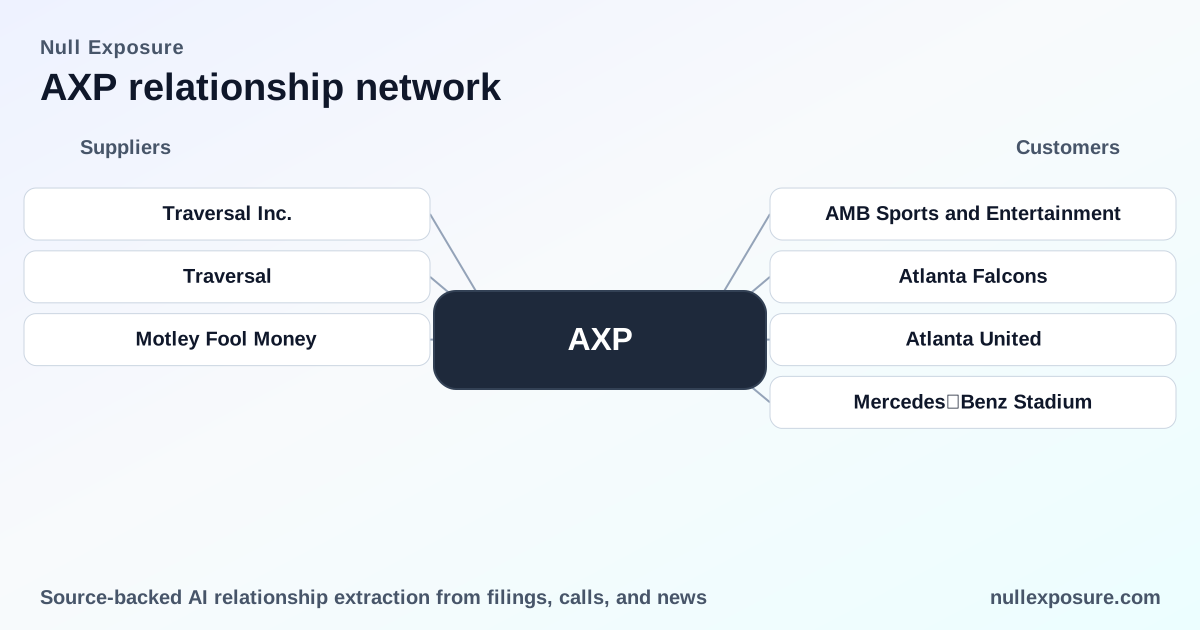
American Express (AXP) — supplier relationships investors should track
American Express operates a high-margin payments and financial services franchise that monetizes through cardholder fees, merchant discount revenue, lending interest and fee-based services, while actively deploying venture and technology partnerships to protect platform reliability and customer experience. Recent supplier activity shows a deliberate mix of strategic technology investments and marketing partnerships that support growth and operational resilience; these supplier moves are material to uptime, brand and long-term productivity. For a consolidated view of counterparty exposures and supplier intelligence, visit https://nullexposure.com/.
Why the latest supplier news matters to investors
AmEx is increasingly treating suppliers as extensions of its product and operational stack rather than commodity vendors. That shift changes how investors should evaluate counterparty risk: strategic minority investments through AmEx Ventures, plus live deployments of specialized infrastructure software, increase both upside (faster innovation, lower operating cost) and operational concentration (reliance on third-party reliability tools).
- Strategic supply relationships now touch core technology and brand lines — not just card processing or merchant networks.
- Operational risk is concentrated where uptime and SRE tooling intersect with customer-facing systems.
If you want a deeper supplier-level view tied to AXP’s corporate filings and newsflow, see https://nullexposure.com/.
Traversal Inc. — AmEx is investing in AI-driven site reliability
American Express has made a strategic investment through AmEx Ventures in Traversal Inc. and is rolling out Traversal’s AI-driven site reliability engineering (SRE) platform across its global technology infrastructure to improve availability and incident response. The move is positioned as an operations productivity play and part of a broader technology initiative tied to AmEx’s long-term productivity improvements.
Source: SiliconANGLE, March 4, 2026 (https://siliconangle.com/2026/03/04/exclusive-american-express-partners-invests-ai-operations-startup-traversal/); MarketBeat filing commentary, March 8, 2026 (https://www.marketbeat.com/instant-alerts/filing-korea-investment-corp-sells-369134-shares-of-american-express-company-axp-2026-03-08/).
Motley Fool Money — advertising and distribution partner
American Express is an advertising partner of Motley Fool Money, using the show for brand distribution and customer acquisition rather than operational services. This relationship is a marketing-channel partnership that supports AmEx’s member acquisition and brand messaging.
Source: The Globe and Mail press release (Motley Fool Money reference), March 2026 (https://www.theglobeandmail.com/investing/markets/stocks/KO/pressreleases/489313/use-this-etf-to-earn-dividends-from-berkshire-hathaway/).
What the supplier list reveals about AmEx’s operating model
The supplier activity and the company-level excerpts point to several concrete operating characteristics:
- Contracting posture: strategic and active. AmEx uses AmEx Ventures to invest in vendor technology, converting vendors into strategic partners rather than one-off suppliers. This signals proactive supplier development and a preference for outcome-oriented contracts tied to operational metrics.
- Concentration and criticality: increased for technology suppliers. Deploying a third-party AI SRE platform across global infrastructure creates high criticality for that supplier’s performance; uptime and incident remediation are core to cardholder experience and transaction flow.
- Maturity and stage: active and evolving. The relationships in the coverage set are in active stages, reflecting live deployments and ongoing commercial or marketing engagement rather than exploratory pilots.
- Company-level materiality nuance: corporate disclosures show both limited counterparty exposure in certain financial instruments (for example, derivatives were not in a material net liability position as of December 31, 2025) and recognition that third-party failures or controversies can materially affect revenue, reputation and profitability. These are company-level signals, not tied to any single named supplier in the excerpts.
Risk profile and investor implications
- Operational risk has shifted from in-house stacks to vendor ecosystems. The Traversal deployment increases a single-vendor dependency around SRE tooling; investors should treat that as an operational concentration risk.
- Reputational risk remains a discrete but significant exposure. AmEx’s filings explicitly state that shortcomings or controversies at third-party providers can be attributed to AmEx and can materially damage brand and business volumes.
- Counterparty financial exposure looks limited in trading/derivatives contexts. The company’s December 31, 2025 disclosure on derivatives suggests no material net liability to individual derivative counterparties, reducing certain counterparty-financial risks while operational and brand risks persist.
- Regulatory and systemic considerations. AmEx’s reliance on large enterprise tech and cloud vendors maps to systemic dependencies noted in governance excerpts — disruptions to widely used vendors can have broad consequences.
For investors tracking supply-chain and third-party risk, cataloging both strategic investments and marketing deals is essential; consider vendor concentration metrics alongside traditional balance-sheet measures. For ongoing monitoring and supplier scoring tied to AXP filings and public news, visit https://nullexposure.com/.
Practical due-diligence steps for investors
- Map revenue and customer-impact flows to supplier functions: which vendors touch authorization, settlement, member account services, and customer notifications. Prioritize suppliers that intersect with authorization and customer data.
- Track AmEx Ventures disclosures and press mentions for new minority investments that convert vendors into strategic partners.
- Monitor SRE and uptime metrics in quarterly commentary and operational disclosures; increased spending or capitalized integrations with SRE vendors indicate deeper reliance.
- Watch brand and marketing partnerships (like Motley Fool Money) for shifts in acquisition strategy and marginal cost of member growth.
Bottom line: treat suppliers as strategic assets and risks
American Express is transitioning supplier relationships from transactional inputs to strategic, operational building blocks—especially in technology and reliability. Traversal’s AI SRE engagement represents both a productivity lever and a concentration risk, while advertising partners support customer acquisition with lower operational criticality. Investors should evaluate AXP through this dual lens of innovation upside and operational concentration risk, and monitor vendor disclosures and AmEx Ventures activity closely. Learn more about supplier exposures and research tools at https://nullexposure.com/.