AMREP (AXR): Supplier relationships and operating constraints that matter to investors
AMREP Corporation (AXR) operates as a small-cap real estate development company that monetizes through the development, sale and management of real property, with recurring results driven by land sales and project development margins. The company reported trailing revenue of $53.0M and EBITDA of $14.1M, supporting a profit margin of 24.4% and a compact balance sheet relative to market capitalization of $149.9M; cash-flow flexibility is supplemented by subsidiary-level credit arrangements. For investors evaluating supplier exposure, the most material signals are AMREP’s reliance on independent construction subcontractors, third-party service providers for IT and risk functions, and active banking relationships used to extend working capital to operating subsidiaries. Learn more about how we track supplier risk at https://nullexposure.com/.
Why supplier relationships matter for a development-led real estate operator
Real estate development companies translate capital and services into finished lots and projects. Contracting posture matters more than vendor count: AMREP’s model uses external subcontractors for construction scope and third-party providers for IT and cybersecurity, which concentrates operational execution risk into a network of suppliers rather than internal headcount. That posture produces predictable cost structure benefits (lower fixed payroll) and countervailing dependencies: delivery timing, contractor quality, and vendor continuity are critical to revenue recognition and margins.
Capital relationships are equally consequential. AMREP’s subsidiaries use bank facilities to manage working capital and land acquisition timing; modifications to those facilities directly change liquidity and flexibility in the development cycle. The relationships summarized below reflect the supplier and service counterparties disclosed in AMREP’s FY2026 filings. If you want a structured supplier risk profile for portfolio analysis, start here: https://nullexposure.com/.
Catalog of reported relationships (complete list from filings)
This section records every relationship called out in the provided FY2026 filing excerpts.
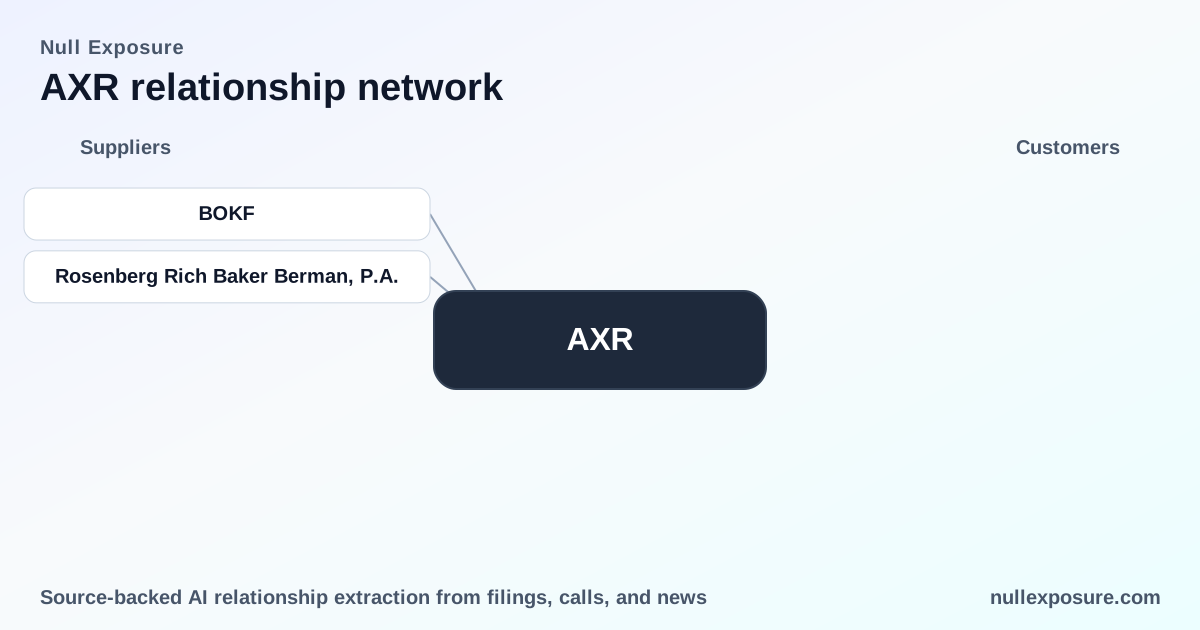
BOKF, NA dba Bank of Albuquerque — lending counterparty
AMREP Southwest Inc., a subsidiary of AMREP, modified a revolving line of credit with BOKF, NA dba Bank of Albuquerque that extended the loan’s maturity date and increased the maximum borrowing amount for general corporate purposes, evidencing an active bank financing relationship that supports subsidiary liquidity and corporate operations. This modification is disclosed in AMREP’s FY2026 filings on StockTitan (SEC filing excerpts filed March 2026).
Rosenberg Rich Baker Berman, P.A. — independent registered public accounting firm
Shareholders ratified Rosenberg Rich Baker Berman, P.A. as the independent registered public accounting firm for the year ended April 30, 2026, with votes recorded in the FY2026 meeting results, establishing the auditor relationship that underpins financial reporting and controls. This appointment is documented in the FY2026 proxy/SEC filing excerpts posted on StockTitan (March 2026).
Operating-model constraints that shape supplier risk and execution
The filings provide two clear company-level signals about how AMREP contracts and runs operations. Treat these as structural features impacting any supplier relationship analysis.
-
Contracting posture: third-party execution and subcontracting. Filings state that "most construction work is performed by independent subcontractors under contracts that establish a specific scope of work at an agreed-upon price." That indicates AMREP intentionally outsources construction execution and transfers execution risk to contracted vendors, which reduces fixed labor cost but increases counterparty performance risk and the importance of contract terms and enforcement.
-
Dependence on services for infrastructure and risk management. The company relies on third-party service providers to operate, maintain and monitor its IT infrastructure and to "assess, identify and manage material risks from cybersecurity threats." Outsourced IT and cyber risk functions create an operational dependency where vendor selection and oversight determine the maturity of AMREP’s operational resilience.
These are company-level constraints, not relationship-specific claims; they set the context for how material any individual supplier or bank facility will be to cash flow and project delivery.
What investors should attack first in diligence
Focus diligence on three practical vectors where these supplier signals translate into quantifiable risk:
-
Balance-sheet flexibility and bank counterparties. The BOKF facility increase is a direct liquidity lever; examine covenants, pricing, and maturity profiles at the subsidiary level to understand refinancing and project-timing risk. The recent modification signals available borrowing capacity but also an operational reliance on external credit. (Source: FY2026 filing excerpts, StockTitan.)
-
Contractor concentration and procurement governance. Because construction is outsourced, evaluate the concentration of spend among major subcontractors, contract terms (liquidated damages, performance bonds), and dispute history. The filings explicitly describe subcontracting as the predominant construction model.
-
Vendor controls for IT and cyber. Verify SLAs, third-party audits, and incident response arrangements for IT service providers; the filing emphasizes outsourced monitoring and cybersecurity risk management as a critical business function.
Valuation and ownership context that amplify supplier impact
AMREP’s public metrics frame supplier risk within corporate scale. The company trades at a trailing P/E of 11.7 and EV/EBITDA of 7.4, with a price-to-book near parity (0.95), indicating the market prices AMREP as a modestly valued developer with tangible asset backing. Ownership is concentrated: insiders hold ~45.6% and institutions ~45.0%, which creates a compact governance profile where management and large holders can influence counterparty choices and financing approaches quickly. Use these data points to assess whether supplier disruptions are manageable within the company’s governance and capital structure.
Practical takeaways for investors and operators
- Bank lines are operational levers. The BOKF amendment increases runway for subsidiary operations and grounds short-term liquidity assumptions in your model. (Source: FY2026 filings, StockTitan.)
- Outsourcing equals vendor governance risk. Heavy reliance on subcontractors and third-party IT providers requires rigorous vendor governance and contingency planning; evaluate procurement concentration and contractual protections.
- Auditor continuity matters for transparency. Ratification of Rosenberg Rich Baker Berman, P.A. preserves continuity in financial oversight for FY2026. (Source: FY2026 proxy/SEC filing, StockTitan.)
If you want comparative supplier visibility across small-cap real estate operators or need a tailored exposure report, start your analysis at https://nullexposure.com/.
Final assessment and recommended next steps
AMREP runs a development-focused model that intentionally pushes execution risk to subcontractors and relies on targeted bank facilities to smooth project timing. That combination drives operating leverage but also concentrates dependency on external contractors and lenders. For investors the core questions are: how diversified and contractually protected are construction suppliers, and how robust are the subsidiary-level credit covenants? Address those and you resolve the most material supplier risks reflected in the FY2026 disclosures.
For a deeper supplier risk profile and benchmarking against peers, visit https://nullexposure.com/ to request a tailored report.