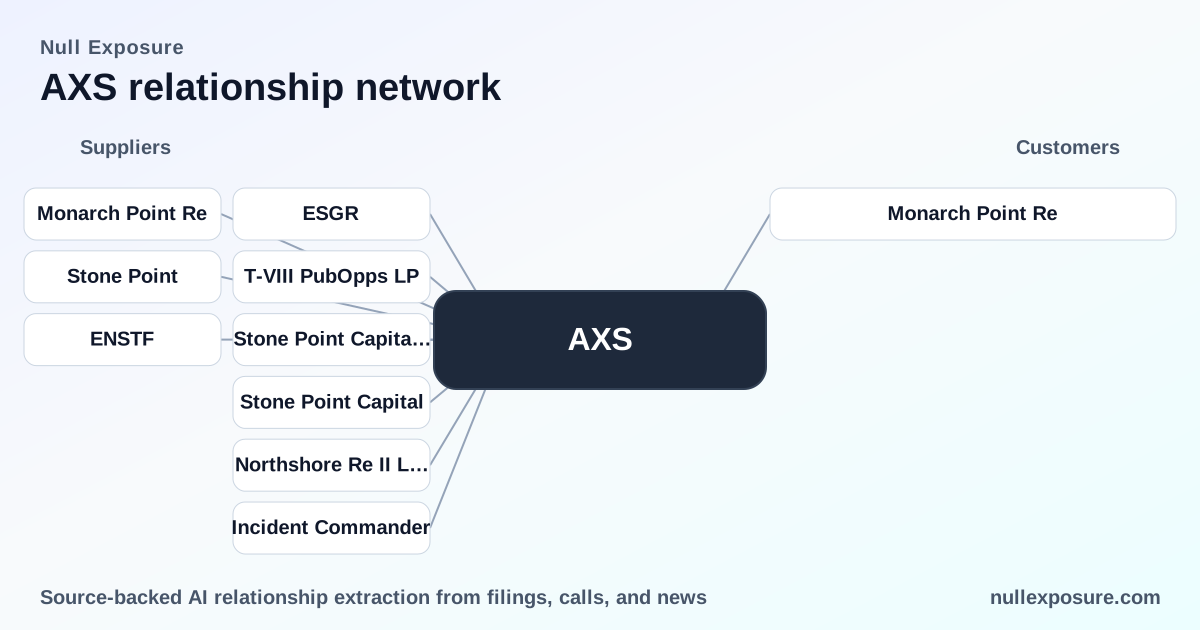
AXIS Capital (AXS): how supplier, retrocession, and capital relationships shape underwriting leverage
AXIS Capital is a Bermuda-headquartered specialty insurer and reinsurer that earns through underwriting margin, investment income, and structured capital transactions. The company transfers risk through facultative and treaty reinsurance, leverages collateralized reinsurance and ILS-like vehicles to manage peak exposures, and executes active capital-management (including targeted buybacks) to optimize returns on equity. For investors, the commercial network around AXIS is as important as loss trends—third‑party reinsurers, alternative capital partners, and technology/service providers directly affect AXIS’s loss transfer capacity, capital efficiency, and operational resilience. Learn more about how these supplier relationships influence counterparty and operational risk at https://nullexposure.com/.
What the supplier network reveals about AXIS’s operating posture
AXIS operates as a large buyer of reinsurance and as an originator of collateralized risk transfer, rather than a pure closed-book carrier. The company routinely retrocedes legacy reserves and cedes segments of catastrophe and casualty risk to third parties and investor-backed structures, converting balance-sheet volatility into funded protection. Outsourcing is explicit in the company disclosures: investment selection, trade execution and several technology and business process functions use third-party managers and vendors.
Investor-relevant characteristics:
- Contracting posture: AXIS uses a mix of standard reinsurance treaties, retrocession agreements, and sponsored collateralized entities—contracts are typically multi-year and fully collateralized when sold to capital providers.
- Concentration: Institutional and alternative-capital partners (notably Stone Point and specialist retrocessionaires) are recurring counterparties; that concentration increases counterparty credit and reputational dependencies.
- Criticality: Reinsurance, retrocession, and collateralized programs are critical to AXIS’s capacity to underwrite catastrophe and casualty risk; failure or underperformance of these suppliers translates directly to capital and earnings volatility.
- Maturity: The mix of loss portfolio transactions, sidecars/ILS-style vehicles, and sponsored retrocessional issuances signals a mature, market-savvy capital-management model rather than ad hoc hedging.
These signals are company-level and derive from AXIS’s own disclosures on outsourcing, reinsurance purchasing, and third‑party investment management.
Detailed supplier and partner relationships investors should track
Enstar
AXIS retroceded approximately $2.3 billion of reinsurance-segment reserves to Enstar, in a loss portfolio transaction that shifts legacy casualty and prior-year exposure off AXIS’s balance sheet. According to Reinsurance News (March 9, 2026), the transaction covered predominantly 2021 and earlier underwriting years (https://www.reinsurancene.ws/axis-repurchases-200m-of-stock-from-stone-point-vehicle/). Bermuda Reinsurance Magazine also reported the transaction in April, noting the larger $3.1 billion LPT closure with $2.3 billion retroceded to Enstar (Bermuda Reinsurance Magazine, 2026).
T‑VIII PubOpps LP
AXIS entered into a share repurchase agreement with the investment vehicle T‑VIII PubOpps LP as part of its capital-management program. Reinsurance News documented the buyback announcement related to the Stone Point–managed vehicle on March 9, 2026 (https://www.reinsurancene.ws/axis-repurchases-200m-of-stock-from-stone-point-vehicle/).
Stone Point Capital LLC / Stone Point Capital
AXIS repurchased roughly 2,234,636 shares for approximately $200 million from an investment vehicle managed by Stone Point Capital, and also agreed broader repurchase arrangements reported in the press. Reinsurance News detailed the $200 million block purchase (March 9, 2026), and SahmCapital noted a related agreement that referenced about $238 million in repurchases tied to a Stone Point–managed vehicle (December 25, 2025 report, https://www.sahmcapital.com/news/content/does-axiss-q3-beat-and-targeted-buyback-shift-the-bull-case-for-axis-capital-axs-2025-12-25).
Northshore Re II Ltd.
AXIS will receive multi‑year, fully‑collateralized retrocessional protection backed by proceeds from a Northshore Re II Ltd. issuance (Series 2025‑1 Class A notes), with coverage targeted at U.S. named storms and North American earthquake risks. Artemis covered the issuance and the role of the notes as collateral for a retrocessional agreement involving AXIS (Artemis, 2025 issuance note, https://www.artemis.bm/news/axis-seeks-150m-northshore-re-ii-2025-1-named-storm-quake-cat-bond/).
Incident Commander
AXIS’s new cyber insurance product (ACTM) integrates third‑party incident response and triage services delivered through the Incident Commander platform, embedding service provisioning into the policy offering to improve breach response outcomes for insureds. Insurance Business Magazine reported the product launch and the Incident Commander partnership (Insurance Business, March 2026, https://www.insurancebusinessmag.com/ca/news/cyber/axis-capital-launches-new-cyber-insurance-policy-534072.aspx).
Monarch Point Re
Monarch Point Re is a collateralized reinsurer capitalized with more than $400 million, functioning as a third‑party capitalized casualty reinsurance sidecar for AXIS and investors—an example of AXIS shifting underwriting capacity to external capital vehicles. Artemis profiled Monarch Point Re and its role as investor-backed capacity that AXIS cedes business to (Artemis, coverage of 2023-2024 collateralized reinsurance activity, https://www.artemis.bm/news/axis-reinsurance-premiums-ceded-to-investors-rises-17-in-2023/).
(Note: Artemis and other sources also reference Stone Point’s involvement in launching Monarch Point Re in 2023, underscoring the overlap between Stone Point as a capital partner and multiple AXIS-sponsored vehicles.)
What investors should price into valuation: risks and operational signals
AXIS’s supplier map creates discrete pricing implications for investors. Counterparty credit and collateral performance are direct drivers of loss-bearing capacity; when AXIS retrocedes reserves or cedes premiums to collateralized vehicles, investors are effectively substituting balance-sheet flexibility for counterparty or investor capital reliance.
Key investor takeaways:
- Credit/collateral risk: Collateralized retrocessional agreements and third‑party capital structures transfer default and margin-call risk to investors and special-purpose issuers; monitor collateral quality and trigger mechanics.
- Concentration risk: Recurrent reliance on a small set of alternative-capital managers (e.g., Stone Point–linked vehicles) increases exposure to counterparties that are also active market participants.
- Operational and cyber vendor risk: AXIS discloses that it outsources technology and investment functions and performs cybersecurity diligence on key service providers, yet retains limited control over those suppliers’ security; third‑party vendor failures constitute operational and data-exposure risk.
- Capital-management linkage: Share buybacks executed with investor vehicles signal a willingness to use bespoke capital transactions for EPS and ROE optimization; such transactions alter free float and investor alignment.
For deeper operational diligence and counterparty scoring, review the supplier evidence and consolidated counterparty positions at https://nullexposure.com/.
Bottom line and recommended investor actions
AXIS runs a sophisticated hybrid: underwriting income combined with active use of retrocession, collateralized reinsurance, and alternative capital. That model supports scalable underwriting but replaces some balance-sheet certainty with counterparty, collateral, and operational vendor dependencies. Investors should incorporate exposures to Stone Point–linked vehicles, Enstar retrocession outcomes, and the performance of Monarch Point and Northshore collateral structures into stress scenarios and credit-adjusted capital models.
For a practical next step, download AXIS supplier mappings and counterparty risk notes at https://nullexposure.com/ and subscribe for alerts that track material changes in retrocession collateral and buyback transactions.