Aytu BioScience (AYTU): supplier relationships that shape commercialization and risk
Aytu BioScience monetizes by acquiring or licensing specialty-branded pharmaceuticals and moving them to U.S. commercialization—typically through licensing deals, outsourced manufacturing, and targeted commercial partnerships—while funding growth through periodic equity placements and placement-agent-supported financings. Revenue comes from marketed prescription products and licensed rights (U.S. commercialization), while cost and execution risk concentrate in long-term supply and contract-manufacturing relationships. For a concise risk map and supplier scorecard, visit https://nullexposure.com/.
How to read these supplier links as an investor
Aytu’s supplier footprint is a mix of commercial partners (licensees and distributors), capital markets intermediaries, and legal/service advisors. Several constraints in company disclosures give a clear operating posture: Aytu relies on long-term supplier and manufacturing agreements, uses licensing for new product rights (notably EXXUA), and outsources manufacturing and certain services to third parties. Those characteristics translate into predictable cost profiles and concentrated counterparty risk: interrupted supply or a failed commercialization partner would have outsized impact on product revenue.
- Contracting posture: The company operates with multi-year supply and manufacturing contracts that carry renewal options, which favors cash-flow visibility but creates lock-in and vendor concentration.
- Commercial model: Licensing and exclusive U.S. commercialization deals are a primary growth lever—evidence shows Aytu records contingent payments as part of intangible asset capitalization for such agreements.
- Operational dependency: Manufacturing and quality responsibilities are handled by CMOs and third parties, making supplier selection and oversight critical to margin and launch timing.
- Geographic focus: Key commercialization deals for new assets (EXXUA) are U.S.-centric, indicating domestic revenue focus even as Aytu retains international partnerships elsewhere.
If you want a succinct supplier risk score tailored for investment committees, see our platform: https://nullexposure.com/.
The relationships that matter (what the record shows)
Below are every supplier-relationship mention surfaced in public sources included in this review, presented as short plain-English descriptions with their cited origin.
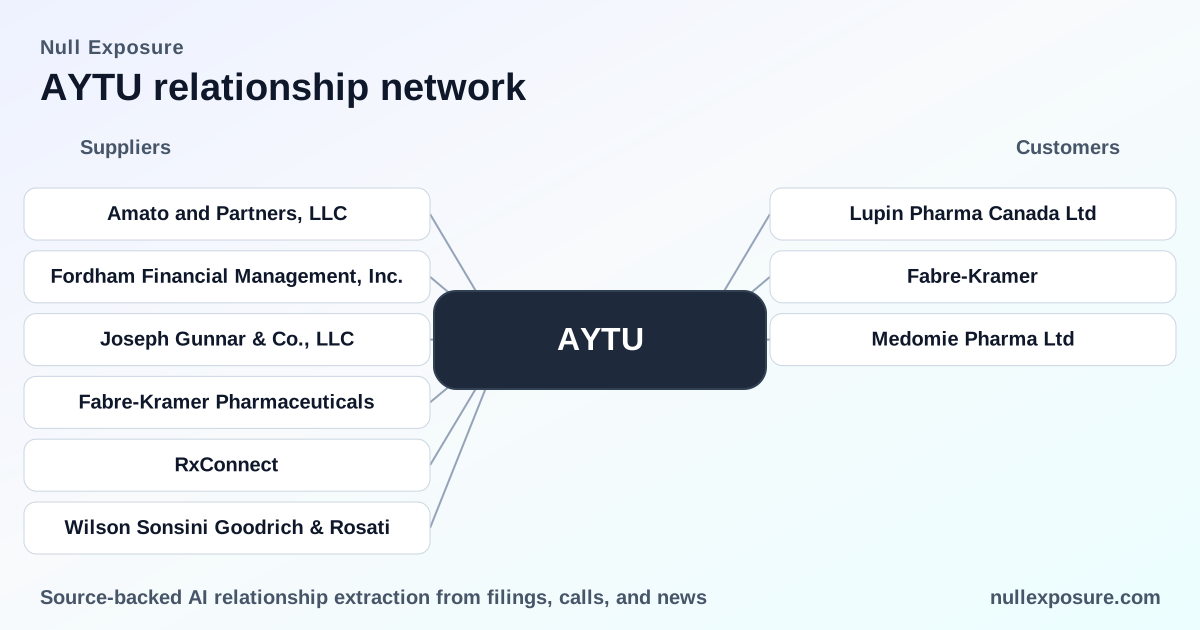
Amato and Partners, LLC
Aytu lists Amato and Partners as its investor relations counsel and a contact point tied to a private placement announcement, implying a retained IR/communications role supporting financings. According to a Biospace press release detailing the closing of an $11.8 million private placement (FY2017), Amato and Partners served as investor contact for the transaction.
Fordham Financial Management, Inc.
Fordham Financial Management acted as a co-placement agent on at least one Aytu financing, which signals use of boutique placement intermediaries to access capital markets. The Biospace release on the private placement notes Fordham as Co‑Placement Agent (FY2017).
Joseph Gunnar & Co., LLC
Joseph Gunnar & Co. served as lead placement agent on the same private placement, underscoring Aytu’s reliance on organized placement desks to secure equity capital for operations and launches. This detail is also recorded in the Biospace announcement closing the $11.8 million private placement (FY2017).
Fabre‑Kramer Pharmaceuticals
Fabre‑Kramer is a commercialization counterparty for EXXUA in the United States; the transaction is a licensing/commercialization arrangement that transferred certain U.S. rights and obligations to Aytu and underpins a targeted psychiatry launch strategy. Coverage from a company investor-day recap (StockTitan, FY2026) and company filings (Commercialization Agreement dated June 5, 2025) describe the EXXUA commercialization terms and Aytu’s acquisition of U.S. commercialization rights.
RxConnect
RxConnect is referenced as the pharmacy network and psychiatry-focused sales-channel partner Aytu is leveraging for the EXXUA launch, providing market access and distribution reach for the antidepressant rollout. A trading‑news writeup on the EXXUA launch strategy (TradingView summary of a Quartr transcript, FY2026) highlights use of an established psychiatry sales force and the RxConnect pharmacy network.
Wilson Sonsini Goodrich & Rosati
Wilson Sonsini served as legal counsel advising Aytu in an exclusive agreement involving Lupin Pharma Canada, illustrating reliance on BigLaw for transactional support on licensing and exclusive distribution deals. The law firm’s own insights page references its role advising Aytu on that exclusive agreement (FY2024).
What these relationships imply for valuation and operational risk
Taken together, the relationship set is compact but functionally complete: capital markets intermediaries (placement agents and IR counsel) underpin financing capability; commercialization partners and pharmacy networks enable launches; and outside counsel supports transactions. The constraints reported by the company flesh out the operating model further:
- Long-term contracts are the norm. Evidence shows supply agreements and CMOs with initial terms stretching multiple years and automatic renewal provisions, signaling contractual continuity but also vendor lock‑in risk should a supplier fail to perform. This is a company-level signal, not tied to any single named relationship in the available supplier list.
- Licensing as the growth engine. The EXXUA deal with Fabre‑Kramer is explicitly a commercialization/licensing arrangement for the U.S., and Aytu capitalizes contingent consideration as part of intangible assets—this structurally ties future revenue to successful commercialization and reimbursement adoption.
- Manufacturing is outsourced. Company disclosures reference a CMO relationship handling end‑to‑end manufacturing, QA/QC and packaging, implying operational criticality of manufacturing partners and potential margin sensitivity to contract terms and capacity constraints (company-level signal).
- Distribution exclusivity exists for certain products. Disclosures cite exclusive U.S. distribution rights under supply agreements for specific products (company-level signal), which creates a revenue-concentration profile around a small set of product-partner pairs.
Investment implications — risk, upside, and monitoring checklist
- Upside: EXXUA commercialization (U.S.) and recent portfolio acquisitions create clear revenue levers if Rx adoption and pharmacy access align with management’s plan. Fabre‑Kramer and RxConnect are the commercial levers for that thesis.
- Risk: Supplier concentration (CMOs, long-term supply deals) and execution on launches represent the principal operational risks. Placement agents listed (Joseph Gunnar, Fordham) show active capital raises—monitor dilution and financing cadence.
- Monitoring checklist for investors: track CMO performance and supply agreements, commercialization milestones under the Fabre‑Kramer agreement, pharmacy-network uptake via RxConnect, and any subsequent placement announcements that involve the placement agents or IR counsel.
For a deeper supplier-risk scorecard and historical relationship timeline, explore our analysis hub at https://nullexposure.com/.
Bottom line
Aytu’s supplier relationships are structured to accelerate U.S. commercialization via licensing and externalized manufacturing and distribution, while capital markets intermediaries enable funding. The company’s model offers asymmetric upside if launches scale, counterbalanced by concentrated supplier and commercialization risk that investors should monitor closely. For tailored diligence or to integrate these relationship insights into your investment model, visit https://nullexposure.com/.