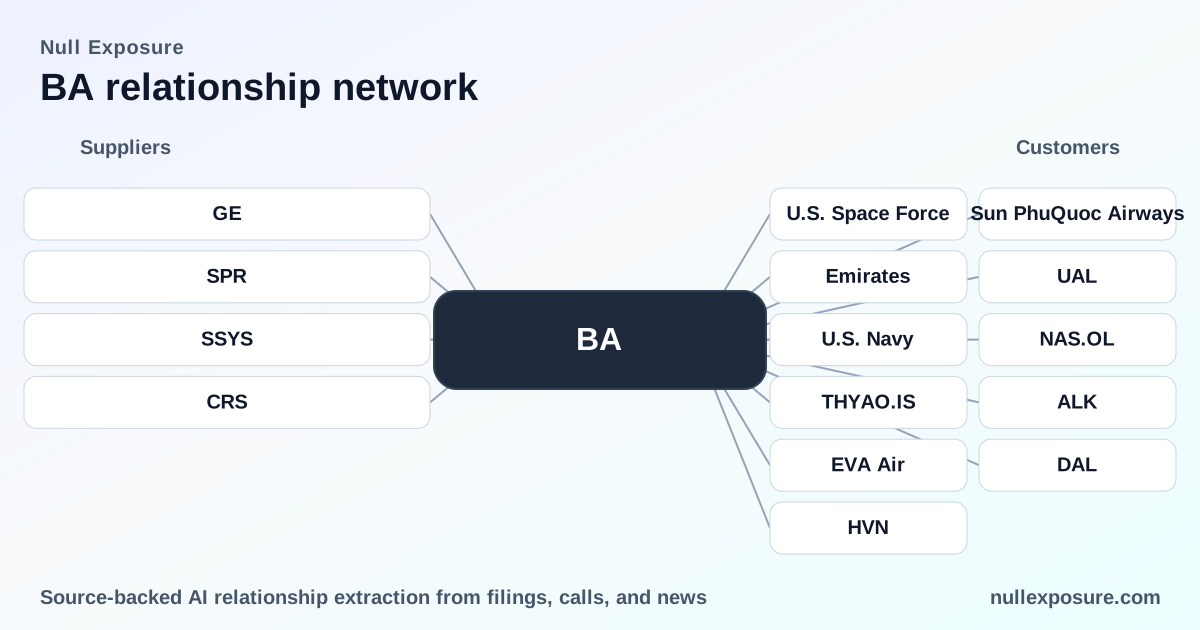
Boeing (BA) as a Supplier Partner: Risks, Leverage, and Key Relationships
Boeing designs, manufactures and supports commercial and defense aerospace platforms and monetizes through aircraft sales, long-term service contracts, leasing and aftermarket spares/support. Its operating model is built on a global network of tier‑1 manufacturers, specialty-material suppliers and tooling vendors, and Boeing extracts margin by integrating design, assembly and lifetime support—but the company’s economics are highly sensitive to supplier performance, input costs and production stability. For hands-on supplier diligence and counterparty mapping, visit https://nullexposure.com/ for supplier-level intelligence.
How Boeing sources value and where supplier risk concentrates
Boeing’s business model converts engineering and assembly scale into durable aftermarket revenue streams, but that monetization path is only as reliable as its supplier base. Boeing discloses that it depends on a large number of U.S. and non‑U.S. suppliers to meet performance, quality and delivery schedules, which makes supplier execution an operational lever and a financial risk driver. Company disclosures also state that many major components are purchased on a sole‑source basis, creating concentration risk where single suppliers can directly influence production cadence and cost.
- Contracting posture: Boeing commonly uses long‑term OEM and subcontractor arrangements, with sole‑source procurement for several major components; this creates bilateral dependency rather than diversified commodity purchasing.
- Concentration: Sole‑source and limited‑vendor relationships concentrate operational risk and negotiating leverage with specific suppliers.
- Criticality: Boeing labels certain materials, parts and subassemblies as essential; disruptions materially affect output and cash flow.
- Maturity: Supplier relationships span established aerospace OEMs and specialized material providers; the commercial maturity of these partners varies by component and product line.
These company-level signals are consistent across recent public comments and filings and should guide any counterparty exposure assessment.
Supplier map: the relationships to watch
GE — engine durability collaboration
Boeing reported a potential durability issue on a 777X engine and is working directly with GE to determine root cause and corrective action, making GE a high‑impact partner for program reliability and schedule recovery. According to Boeing’s 2025 Q4 earnings call (reported March 2026), Boeing is coordinating with GE to finalize corrective measures for that inspection finding.
Spirit AeroSystems — acquisition to stabilize production
Boeing completed the acquisition of Spirit AeroSystems before year‑end to support production stability, bringing a major airframe fabricator inside Boeing’s operational perimeter and reducing some external assembly risk. This move was disclosed on Boeing’s 2025 Q4 earnings call (reported March 2026).
Stratasys Ltd. — tooling and additive manufacturing integration
The Boeing 737 Innovation Center purchased two Stratasys F3300 printers for production tooling in the fourth quarter, signaling targeted adoption of additive manufacturing to shorten tooling lead times and improve in‑house flexibility. A report of Stratasys’s Q4 results noted Boeing’s purchase (InsiderMonkey, March 2026).
Carpenter Technology — high‑temperature alloy supplier benefiting from engine ramp
Carpenter Technology is positioned as a primary beneficiary of the engine production ramp at Boeing and Airbus because its proprietary nickel and cobalt alloys are essential for next‑generation high‑temperature jet engines, making Carpenter a strategic materials supplier for engine programs. This positioning was discussed in a market narrative about Carpenter’s role in the engine ramp (Simply Wall St., March 2026).
For a consolidated view of supplier exposures and to map these relationships against contract terms and delivery history, see https://nullexposure.com/.
What these relationships imply for operations and valuation
Boeing’s strategic moves and supplier calls underscore three investment‑relevant dynamics:
- Operational sensitivity to supplier quality and durability. The GE 777X engine durability issue is a reminder that supplier technical performance feeds directly into program schedules and warranty/reserve needs. Engineers and finance teams must treat such findings as triggers for incremental cost accruals and potential delivery re‑phasing.
- Vertical reintegration as an active mitigation. The Spirit AeroSystems acquisition shows Boeing is willing to bring Tier‑1 manufacturing in‑house to stabilize output and reduce single‑vendor failure points, which improves control but increases Boeing’s capital and integration burden.
- Selective modernization of manufacturing. Tooling purchases from Stratasys indicate a push to shorten lead times and reduce dependence on external tooling suppliers; this reduces some tactical supply risk but does not eliminate material or precision component concentration.
- Material concentration at engine level. The Carpenter Technology linkage highlights that certain alloys remain bottlenecks; demand ramps for engines translate to outsized upside (and pricing power) for specialty metal suppliers while creating supplier leverage for Boeing.
These points translate into measurable portfolio considerations: earnings volatility tied to supplier incidents, potential capex and integration hits from insourcing, and asymmetric upside in aftermarket services if production stabilizes.
If you want a supplier‑level risk scorecard aligned to Boeing’s disclosure signals, Null Exposure provides curated relationship analysis and supplier concentration metrics at scale: https://nullexposure.com/.
Risk management and red flags for investors and operators
- Treat sole‑source arrangements as single point failures that require contingency planning and contractual protections.
- Model warranty, rework and reserve sensitivity to supplier durability issues; the GE engine inspection is a template for how a single technical finding propagates through program costs.
- Monitor capital deployment into vertical integration (e.g., Spirit AeroSystems) for integration risk and one‑off charges versus long‑term gross margin improvement.
- Assess whether additive manufacturing buys (e.g., Stratasys printers) are tactical reductions in lead time or part of an industrial strategy that materially reduces external supplier dependency.
Investment takeaway and next steps
Boeing’s revenue engine depends on complex supplier relationships where materiality and concentration are real and actionable risks, but the company is actively managing those risks through acquisition and selective technology adoption. For investors, the proper framework is to underwrite Boeing not as a pure manufacturing story but as an integrator whose margin and delivery profile are governed by supplier execution and specialty‑material flows.
Key takeaways:
- Supplier issues create direct program and earnings risk (GE engine example).
- Insourcing reduces vendor risk but increases integration and capex exposure (Spirit AeroSystems).
- Targeted tooling investments and material supplier dynamics are second‑order drivers of unit cost and timing (Stratasys, Carpenter).
Explore supplier‑level intelligence and relationship impact analysis at https://nullexposure.com/ to convert these qualitative signals into investment analytics and operational remediation plans.