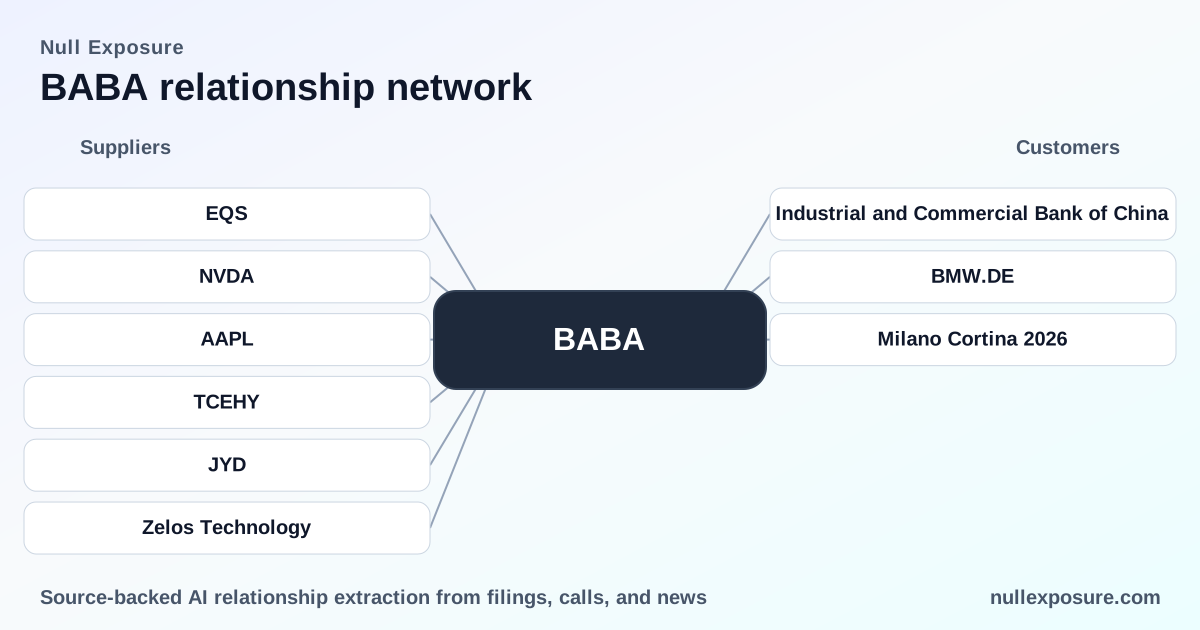
Alibaba Group (BABA) — Supplier relationships and strategic dependencies investors must track
Alibaba operates as a platform conglomerate that monetizes through marketplace transaction fees, advertising and marketing services, cloud infrastructure, logistics-enabled commerce, and increasingly AI-enabled enterprise services. Revenue scale, ecosystem effects, and rising AI/cloud spend drive supplier leverage—Alibaba purchases specialized hardware and partners with logistics and technology providers to sustain its e-commerce, cloud and autonomous-logistics ambitions. For a detailed supplier-monitoring framework tailored to investment due diligence, visit https://nullexposure.com/.
What to watch first: a concise investment thesis
Alibaba’s core monetization mixes high-margin advertising and cloud services with lower-margin retail and logistics operations; cloud and AI investments are now a primary operational lever supporting growth across the portfolio. The firm’s large market capitalization and substantial trailing revenue underpin bargaining power with vendors, but access to advanced semiconductors and logistics partners is a near-term execution risk that will determine the pace of AI-driven monetization.
Visit https://nullexposure.com/ for supplier intelligence that maps these dependencies to actionable risk signals.
Recent supplier and partner mentions in the media — what they mean for investors
Below I cover every relationship cited in the available results, with a plain-English take and source for each mention.
EQS
Alibaba announced a public retail/AI installation called “Alibaba Wonder on Ice” in Milan, presented as an illustration of AI-powered retail and cloud-supported customer experiences; the initiative underscores Alibaba’s push to showcase cloud and AI capabilities in consumer-facing settings. Reported via EQS in March 2026 (media pickup: TS2).
Source: TS2 reporting an EQS release, March 9, 2026.
Nvidia (first mention, Reuters via Finviz)
Chinese authorities cleared a group of large domestic tech firms to purchase Nvidia’s H200 AI chips, and Alibaba is explicitly named among buyers permitted to acquire advanced accelerators—this signals regulatory greenlights that materially reduce supply-side constraints on Alibaba’s AI roadmap. Reported by Reuters and aggregated through Finviz in March 2026.
Source: Finviz summary of Reuters reporting, March 2026.
Apple
A South China Morning Post report highlighted that Alibaba’s Qwen chatbot surged to the top of China’s Apple App Store following a promotional giveaway, overtaking incumbent players—this demonstrates strong consumer traction for Alibaba’s AI services and effective distribution through app ecosystems. Reported in March 2026 and cited via TS2.
Source: TS2 referencing the South China Morning Post, March 9, 2026.
Nvidia (second mention, Simply Wall St)
Coverage noted regulatory clearance for Alibaba to purchase Nvidia H200 chips alongside Alibaba’s rollout of upgraded Qwen models and deeper integration of AI across cloud, commerce, logistics and healthcare—this reinforces a strategic supplier tie to advanced semiconductors as a foundation for expanded AI services. Reported by Simply Wall St in late January / March 2026.
Source: SimplyWall.St summary, early 2026.
WeChat (Tencent ecosystem)
A consumer campaign distribution experienced friction when WeChat blocked users from sharing a campaign QR-code link, highlighting platform-level distribution frictions in China’s tightly integrated social ecosystem that can blunt promotional reach. Reported on March 9, 2026 via TS2.
Source: TS2 reporting, March 9, 2026.
Jayud Global Logistics (JYD)
Jayud Global Logistics achieved Alibaba “Verified Supplier” certification, illustrating third-party logistics partnerships that support Alibaba’s cross-border and domestic commerce fulfillment capabilities and broaden Alibaba’s logistics supplier base. Reported via a press release aggregated in March 2026.
Source: The Globe and Mail press release pickup, March 2026.
Zelos Technology
Cainiao entered a tie-up with Zelos Technology on Level-4 autonomous logistics initiatives, signaling an operational strategy to accelerate automation inside Alibaba’s logistics arm and reduce marginal fulfillment costs over time. Reported by SimplyWall.St in early 2026.
Source: SimplyWall.St coverage, early 2026.
How these relationships translate into operating model characteristics
Alibaba is a diversified platform operator. From the relationships above and company fundamentals, several company-level signals shape supplier risk and opportunity:
- Contracting posture: Alibaba negotiates at scale across cloud, logistics and marketing suppliers; its size creates strong negotiating leverage for standard services but requires strategic buy-in for scarce inputs (advanced AI chips and L4 autonomy technology).
- Concentration risk: Core revenues are supported internally by Alibaba Cloud and Cainiao logistics, which reduces dependency on commodity suppliers; however, specialized suppliers of advanced semiconductors and autonomy software represent concentrated, high-impact dependencies that can drive near-term capital allocation and operational timelines.
- Criticality: Suppliers that provide compute accelerators and autonomous logistics components are operationally critical because they directly affect product performance (AI models) and unit economics (fulfillment automation).
- Maturity and modularity: Alibaba’s in-house capabilities (cloud, AI model development, logistics platform) increase vertical integration and modularity, allowing the company to internalize or switch suppliers for many services—but top-tier chips and certain robotics technologies remain strategic single-source elements until domestic alternatives scale.
Financial context: Alibaba reports substantial scale (revenue and market capitalization in the provided company overview), enabling investment in supply resiliency and strategic supplier agreements.
Investment implications and risk checklist
- Positive: Regulatory clearance for advanced chip purchases removes a key gating factor for AI monetization and should accelerate cloud and model enhancements reflected in user traction (App Store ranking and Qwen rollout).
- Negative: Platform-level distribution controls (e.g., WeChat blocking links) are an ongoing operational risk for campaign effectiveness; Alibaba requires multiple distribution channels to preserve marketing ROI.
- Operational: Logistics partners and autonomy tie-ups will determine long-term fulfillment cost curves; certification of third-party logistics vendors expands capacity but requires continual oversight.
Explore supplier-mapping and monitoring tools tailored for investors at https://nullexposure.com/ to convert these signals into action.
Bottom line: what investors should do now
Alibaba’s strategic supplier relationships confirm the company is executing a deliberate AI and logistics upgrade path while maintaining a broad supplier base for commerce operations. Track vendor-level milestones for chip delivery schedules, autonomous-vehicle pilot outcomes, and any platform-level distribution constraints—these indicators will move near-term operational KPIs and drive valuation re-rating. For a structured tracking playbook and supplier alerts, go to https://nullexposure.com/.
Key takeaway: Alibaba has the scale and cash to convert supplier access into product advantage, but execution timing hinges on a small set of strategic suppliers and platform distribution dynamics.