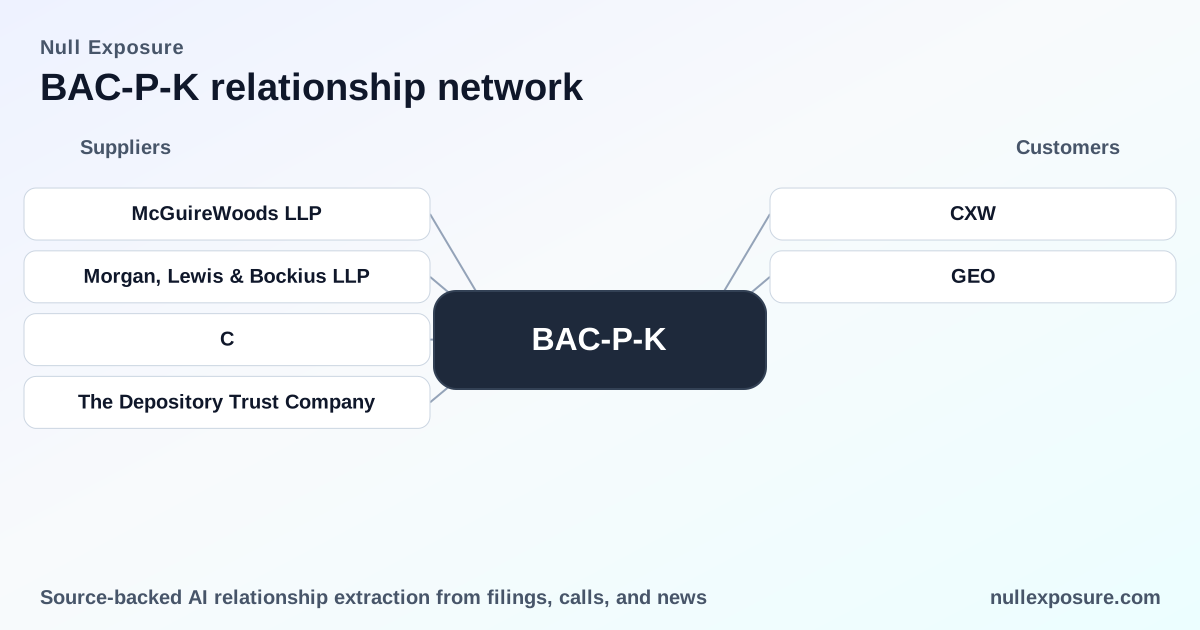
Bank of America (BAC-P-K) — Supplier Relationships and Operational Implications
Bank of America (represented here by the depositary shares series H, ticker BAC-P-K) operates as a large, diversified financial services firm that monetizes through interest margin, fee income across commercial and consumer banking, wealth management fees, and capital markets activities. The preferred depositary share is a capital instrument sitting alongside the bank’s broader balance-sheet funding and investor-return strategy; its operational footprint depends on a small set of external service providers for custody, registrar/paying agency, and legal defense. For a consolidated view of supplier exposure and material third-party links, see Null Exposure’s supplier mapping at https://nullexposure.com/.
Investment thesis in one paragraph
BAC-P-K provides investors exposure to Bank of America’s preferred capital structure while the bank relies on a compact network of high-criticality service providers—custodians/clearing houses and major law firms—to execute redemptions, settle payments, and manage litigation. The combination of deep-market counterparties and established custodial plumbing reduces operational execution risk but concentrates dependency on a small number of systemically important suppliers. Explore a full supplier profile at https://nullexposure.com/.
What the supplier list reveals about how BoA contracts and operates
The relationships uncovered are consistent with a large-bank contracting posture: standardized, high-maturity contracts with global custodians and elite law firms, plus reliance on industry utilities for settlement. The dataset shows no explicit constraints flagged against BAC-P-K in this review, which is a company-level signal that no unusual contractual restrictions or supplier-specific limitations were detected in the sourced material. That absence does not remove counterparty concentration risk given the types of suppliers involved. Key operating-model characteristics indicated by these relationships:
- Contracting posture: centralized engagements with major law firms and financial institutions, aiming for scalability and regulatory robustness.
- Concentration: dependency on a handful of systemically important counterparties (custodians, DTC, large global banks) suggests limited supplier diversity for critical functions.
- Criticality and maturity: counterparties and utilities are mission-critical and mature; operational continuity hinges on their availability and regulatory standing.
For a practical supplier-risk view tailored to institutional investors, visit https://nullexposure.com/.
Supplier relationships found and what each means for investors
McGuireWoods LLP — litigation representation
McGuireWoods LLP is listed as one of the law firms representing defendants in a 401(k) forfeitures litigation involving Bank of America in FY2025. This indicates external legal counsel engagement to manage fiduciary and ERISA-related litigation exposure. Source: PlanAdviser report on the district court denying Bank of America’s motion to dismiss (March 9, 2026) — https://www.planadviser.com/district-court-denies-bank-of-americas-motion-to-dismiss-401k-forfeitures-case/.
Morgan, Lewis & Bockius LLP — defense counsel for ERISA suit
Morgan, Lewis & Bockius LLP is identified alongside McGuireWoods as defense counsel in the same FY2025 401(k) forfeitures case, reflecting continued use of top-tier external counsel for complex employee-benefit litigation. Such legal engagements are standard for large banks and signal active litigation management rather than operational vendor failure. Source: PlanAdviser (March 9, 2026) — https://www.planadviser.com/district-court-denies-bank-of-americas-motion-to-dismiss-401k-forfeitures-case/.
Citibank, N.A. — U.S. registrar and paying agent for redemptions
Citibank, N.A. is referenced as the U.S. registrar and paying agent for a scheduled redemption of notes tied to Bank of America activity in FY2025, indicating Citibank’s role in processing investor payments and maintaining registrar records for the affected securities. This relationship underlines operational dependence on a major global bank for transactional and registry functions. Source: StockTitan coverage of Bank of America redemptions (March 2026) — https://www.stocktitan.net/news/BAC/bank-of-america-n-a-announces-redemptions-of-2-000-000-000-5-650-rkhkk2y6r9e5.html.
The Depository Trust Company (DTC) — settlement and redemption processing
The Depository Trust Company is cited as the settlement facility used to process redemption payments, confirming that settlement and custody for BAC-related securities run through DTC’s central clearing and settlement system, a standard industry utility that is critical to market functioning and timely investor settlement. Source: StockTitan notice on redemptions (March 2026) — https://www.stocktitan.net/news/BAC/bank-of-america-n-a-announces-redemptions-of-2-000-000-000-5-650-rkhkk2y6r9e5.html.
Risk and operational takeaways for investors and operators
- Concentration of critical services is high. The bank routes registrar/paying-agent and settlement functions through Citibank and DTC, both systemically important; disruption or operational failures at these nodes would materially affect issuance and redemption flows.
- Legal spend and litigation posture are managed via elite counsel. Engagement of McGuireWoods and Morgan Lewis signals structured legal risk management for fiduciary and employee-benefit disputes, not ad hoc local counsel.
- Maturity of counterparties reduces execution risk but raises systemic exposure. Relying on established, well-capitalized institutions and DTC lowers idiosyncratic vendor failure risk while increasing dependence on the broader financial plumbing.
- No explicit supplier constraints surfaced in this review. The absence of constraint flags in the sourced material is a company-level signal that no contract-specific restrictions or unusual vendor covenants were reported here, but investors should not equate absence of flags with absence of risk—operational concentration still demands active monitoring.
What investors should do now
- Monitor legal developments in the 401(k) forfeitures case for potential capital or reputational impacts tied to BAC’s preferred instruments.
- Track operational notices from Citibank and DTC regarding settlement or registry changes that could affect redemption mechanics.
- For an organized, investor-focused map of Bank of America’s supplier exposures and to benchmark supplier concentration against peers, review Null Exposure’s supplier analysis at https://nullexposure.com/.
Bank of America’s BAC-P-K sits on a familiar infrastructure: large-bank counterparties and system utilities manage the heavy lifting, which simplifies operational execution but concentrates dependency. Use the links above to drill into supplier relationships and to compare supplier-risk posture across issuers.