Bridger Aerospace (BAERW) — supplier map and what it means for operators and investors
Bridger Aerospace operates aerial wildfire management and firefighting services, monetizing through contract revenues for tanker and aerial support work; the company reported TTM revenue of $122.8 million, gross profit of $51.7 million and EBITDA of $30.7 million, underscoring a services business that sells capacity and aircraft-enabled operations to government and institutional customers. For investors and operators evaluating BAERW supplier relationships, the central investment question is whether Bridger’s access to aircraft and key components is stable and contractually insulated against supply shocks. Learn more and compare supplier exposures across aviation and services providers at https://nullexposure.com/.
How Bridger makes money and what that implies for supply exposure
Bridger’s operating model is asset-intensive: revenue comes from mobilizing aircraft for wildfire suppression, leasing airtankers where necessary and performing contracted aerial services. The business is tightly coupled to aircraft availability and component supply, so financial performance is sensitive to both utilization and fleet readiness. Key financial signals: positive profit margin (3.37%) and a meaningful gross profit pool, but operating margin is negative on a TTM basis, reflecting investment into operations and fleet costs. These figures indicate a business that generates cash at the gross level while still investing in operational scale and readiness.
Because aircraft drive revenue, supplier relationships that affect aircraft acquisition, maintenance and parts flow are strategically critical. For a concise, comparative view of supplier exposures across suppliers and counterparties, visit https://nullexposure.com/.
Operational constraints and business-model characteristics investors should internalize
Bridger’s 10‑K discloses supplier dependencies that translate into a set of practical operating constraints you must price into any valuation or contract negotiation:
- Contracting posture — vendor-backed asset agreements: Bridger relies on formal purchase and lease agreements with third parties for aircraft acquisition and support, which fixes cashflow timing and creates counterparty concentration risk.
- Concentration — limited supplier set: Management states results are dependent on a limited number of suppliers for aircraft and components; this produces single‑point risks for parts availability and price volatility.
- Criticality — aircraft as core production input: Aircraft and their components are critical; downtime directly reduces revenue generation capacity and raises variable costs for substitute capacity.
- Maturity — multi-year capital commitments: Aircraft purchase agreements are multi‑year contracts that lock in delivery and payment schedules, making near-term flexibility limited but providing some predictability for fleet expansion.
These are company-level signals drawn from Bridger’s FY2024 regulatory filing and should be priced into counterparty risk assumptions and scenario analyses for operating leverage, downtime impacts and margin sensitivity.
Suppliers disclosed in the FY2024 10‑K and what they mean for counterparties
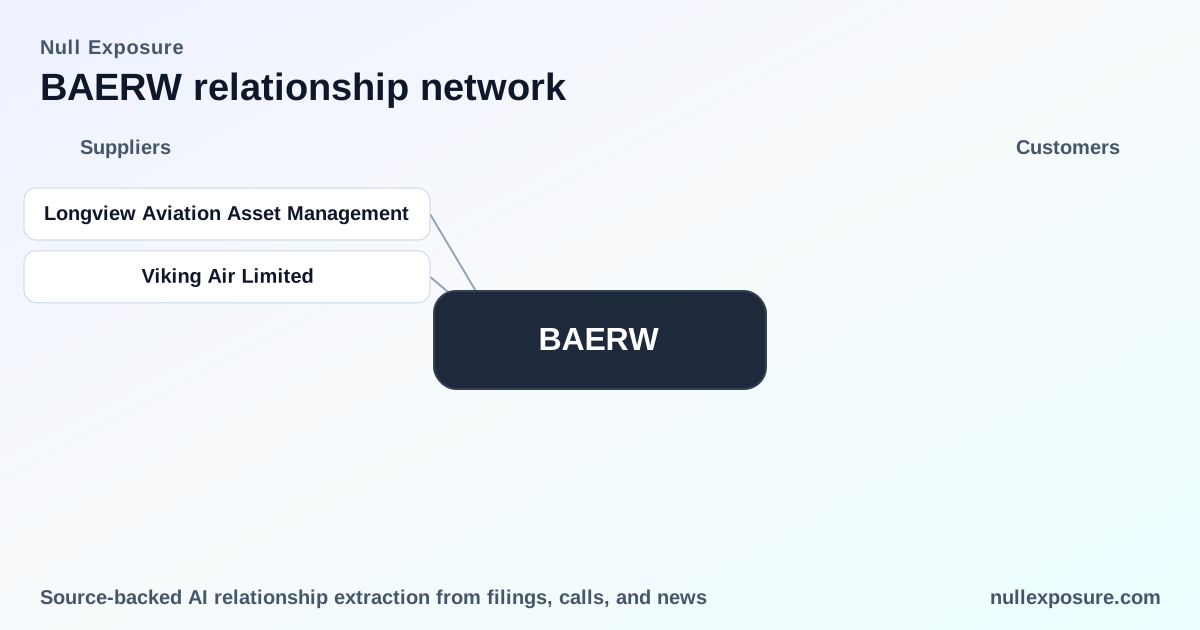
Bridger lists two counterparties in an Aircraft Purchase Agreement referenced in its FY2024 10‑K. Below are plain-English summaries for each disclosed relationship.
Longview Aviation Asset Management
The 10‑K records an Aircraft Purchase Agreement dated April 13, 2018 that names Longview Aviation Asset Management as a party to the contract with Bridger Air Tanker, LLC. This indicates Longview functions as an asset counterparty—likely providing structured financing or ownership of aircraft used in Bridger’s airtanker operations, according to Bridger Aerospace’s FY2024 Form 10‑K.
Viking Air Limited
The same Aircraft Purchase Agreement lists Viking Air Limited as a co‑party to the April 13, 2018 agreement with Bridger Air Tanker, LLC, per the FY2024 10‑K. Viking’s inclusion in the contract identifies it as an essential supply chain participant associated with those aircraft transactions.
(Each relationship citation: details are disclosed in Bridger Aerospace Group Holdings, Inc.’s Form 10‑K for fiscal year 2024, filed and referenced in the company’s public filings.)
What investors should watch and how to act
- Concentration risk is the principal supplier threat. The company explicitly warns that reliance on a limited number of suppliers exposes operations to price and availability volatility; that structural exposure increases the probability of operational interruptions during supply stress.
- Contract terms matter more than counterparty names. For long-lived aircraft relationships, the specifics of delivery schedules, default remedies, termination rights and maintenance obligations are the levers that determine disruption severity and recovery speed.
- Liquidity and capital allocation are focal points. With capital-intensive contracts and a negative operating margin on a TTM basis, Bridger must manage working capital and capital expenditure timing to avoid being squeezed by supplier payment terms or unexpected part shortages.
- Scenario-test utilization sensitivity. Given aircraft are revenue-generating assets, model under-utilization or fleet downtime scenarios to evaluate EBITDA elasticity.
If you are constructing counterparty risk models or doing vendor diligence across aviation suppliers, find comparative exposure tools and supplier profiles at https://nullexposure.com/.
Final takeaways and recommended next steps
Bridger is a specialized, asset-dependent services operator with material supplier concentration identified in its FY2024 filing. The two counterparties named in the disclosed Aircraft Purchase Agreement — Longview Aviation Asset Management and Viking Air Limited — are core to Bridger’s aircraft acquisition path and thus central to operational continuity. For investors and procurement leads, the priority actions are: (1) obtain and stress-test the specific aircraft purchase/lease contract terms, (2) model revenue impact from partial fleet unavailability, and (3) monitor counterparty financial health for Longview and Viking as part of ongoing vendor surveillance.
For a side‑by‑side assessment of supplier risk metrics and to benchmark Bridger against peers in aviation services, start here: https://nullexposure.com/.