BALQ — BlackRock’s iShares relationship and what investors should know
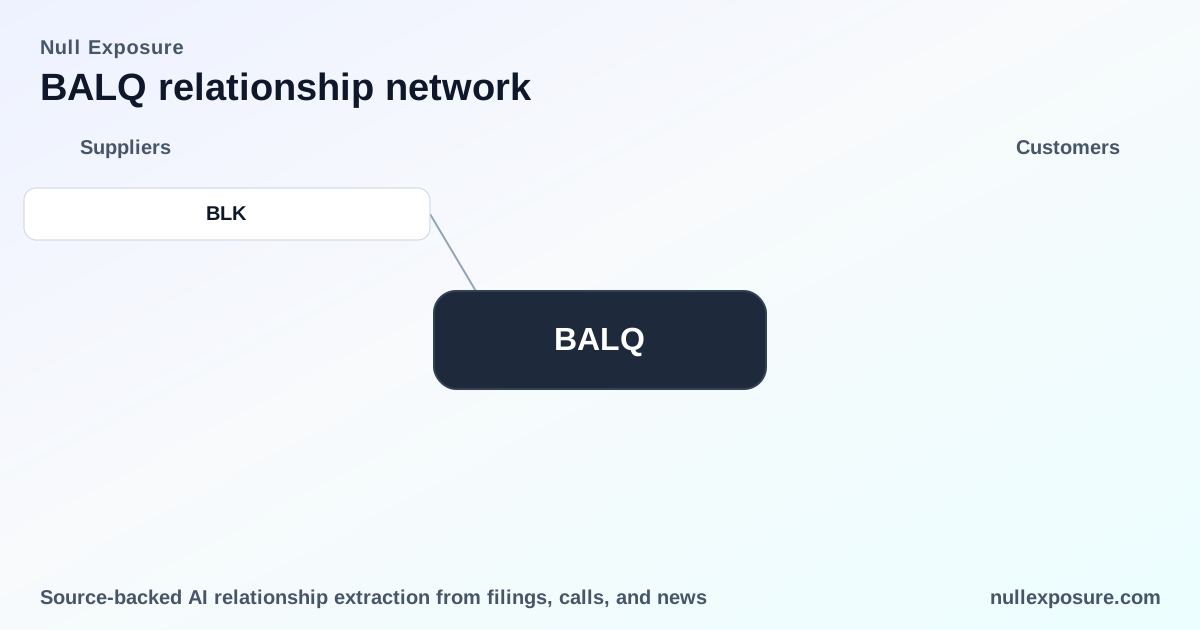
BALQ is distributed as an iShares-branded Nasdaq Premium Income ETF and monetizes through management fees and platform economics tied to BlackRock’s ETF franchise: product-level fee income from assets under management, distribution advantages from the iShares platform, and ancillary revenue from option-premium strategies embedded in the fund’s design. For investors evaluating supplier risk, the critical supplier relationship is the underwriter/issuer and platform support from BlackRock / iShares, which controls product governance, trading support, and branding that drive flows and fee capture. Explore supplier intelligence at https://nullexposure.com/ for deeper diligence.
How BALQ makes money and what that implies for suppliers
BALQ’s economic model centers on delivering equity income plus option premium to investors under a familiar ETF wrapper. Revenue flows to the issuer via expense ratios and ancillary fees associated with portfolio management, while BlackRock’s iShares platform supplies distribution, market-making relationships, and the operational infrastructure that allows the product to trade efficiently. That makes the issuer-platform supplier relationship both revenue-driving and operationally critical.
A supply-side view:
- Concentration: The ETF is effectively produced and distributed by a single dominant supplier (BlackRock/iShares), concentrating operational and commercial risk.
- Contracting posture: Standard industry custody, fund administration, and distribution agreements suggest transactional contracting with high operational SLAs rather than bespoke dependencies.
- Criticality: Platform services (order routing, AP creation/redemption mechanics, secondary market liquidity) are critical to NAV realization and investor experience.
- Maturity: As an iShares product, BALQ leans on mature, established infrastructure and market-making networks, reducing execution risk but increasing strategic vendor dependence.
If you want tailored supplier-risk scoring or to map these dependencies into portfolio-level exposure, start at https://nullexposure.com/.
Known supplier relationships and what they mean for investors
BlackRock — the issuer and platform owner
BlackRock is identified in coverage as the corporate parent and platform under which the iShares Nasdaq Premium Income Active ETF (BALQ) is offered. A Stocktitan note on BlackRock’s product pages described the iShares Nasdaq Premium Income Active ETF (BALQ) as a fund focusing on income from equity holdings and option premiums tied to the Nasdaq 100 Index (FY2025). This positions BlackRock as the primary commercial and operational supplier for BALQ, responsible for product design, distribution, and client-facing activities. (Source: Stocktitan coverage of BLK, FY2025 — https://www.stocktitan.net/news/BLK/)
iShares — the ETF brand and distribution engine
iShares is referenced specifically in institutional-ownership listings tied to BALQ, with Quiver Quant’s institutional ownership pages referencing “iShares Nasdaq Premium Income Institutional Ownership” (FY2026). This confirms iShares as the branded conduit for distribution and market positioning, and therefore the revenue capture vehicle and operational supplier that interfaces directly with authorized participants, market makers, and end investors. iShares’ role is functionally inseparable from BlackRock for this product, and the brand’s scale materially affects BALQ’s flow dynamics. (Source: Quiver Quant institutional page for BALQ, FY2026 — https://www.quiverquant.com/stock/BALQ/institutions/)
What the relationship map implies for risk and opportunity
BlackRock/iShares’ control of both product and platform for BALQ produces a concentrated supplier posture that elevates a small set of key considerations for investors and operators:
- Operational concentration is high. A single supplier handles fund governance, NAV processes, and market-making relationships, so operational or reputational issues at the supplier propagate quickly to product flows and performance.
- Commercial dependence on platform distribution. iShares’ distribution muscle drives onboarding and asset growth; withdrawal of marketing or re-pricing of distribution terms would directly affect fees and AUM growth.
- Execution criticality is elevated but mature. The supplier relationship is mission-critical, yet the underlying infrastructure is mature and standardized within the ETF industry, which mitigates some operational idiosyncratic risk.
- Negotiation leverage is asymmetric. Given BlackRock’s scale and brand, smaller counterparties and service providers face limited bargaining power around fee schedules and operational terms.
Practical monitoring checklist for operators and investors
To convert the relationship intelligence into actionable monitoring, focus on a few high-value indicators:
- Monitor flow and AUM trends relative to iShares’ comparable products to detect distribution shifts.
- Track authorized participant and market-maker activity for liquidity changes that presage trading spreads widening.
- Review regulatory and product filings from BlackRock for fee changes, structural amendments, or strategy updates.
- Maintain a watch on brand-level reputation events at BlackRock/iShares that could trigger redemptions across related ETFs.
These observational steps convert supplier insight into tactical early warning signals for portfolio and operational management.
If this analysis is useful and you want a supplier-risk profile modeled into your fund due diligence, visit https://nullexposure.com/ to request a deeper assessment.
Closing view and investor actions
BALQ’s supplier footprint is compact and dominated by BlackRock/iShares, which supplies the fund’s commercial, operational, and brand infrastructure. That concentration simplifies counterparty mapping but concentrates risk — the product’s performance and distribution are tightly coupled to the platform’s conduct and strategy. For investors and operators, the priority is continuous monitoring of platform-level flows, fee posture, and market-making health rather than chasing granular vendor lists.
- Action 1: Integrate BlackRock/iShares platform metrics into fund-level exposure dashboards.
- Action 2: Use market-maker activity and authorized participant behavior as primary liquidity indicators.
- Action 3: Keep regulatory filings and product updates from BlackRock in your watchlist for structural changes.
For a tailored supplier assessment that quantifies these exposures for your book, learn more at https://nullexposure.com/.