Brookfield Asset Management (BAM) — Supplier relationships, operating posture, and what investors should price in
Brookfield Asset Management monetizes through asset management fees, carried interest, and balance-sheet activity: it sources and operates real assets, raises capital via funds and public securities, and uses corporate facilities and partnerships to amplify scale and liquidity. Revenue derives from managing third‑party capital, earning performance fees on realised returns, and deploying corporate capital where it secures strategic upside. This review isolates the supplier and market-facing relationships surfaced in recent coverage and ties them to company-level contracting and spend signals that matter to operators and investors. For a structured supplier-risk view, start with our analyst portal at https://nullexposure.com/.
Quick read: the relationships that matter today
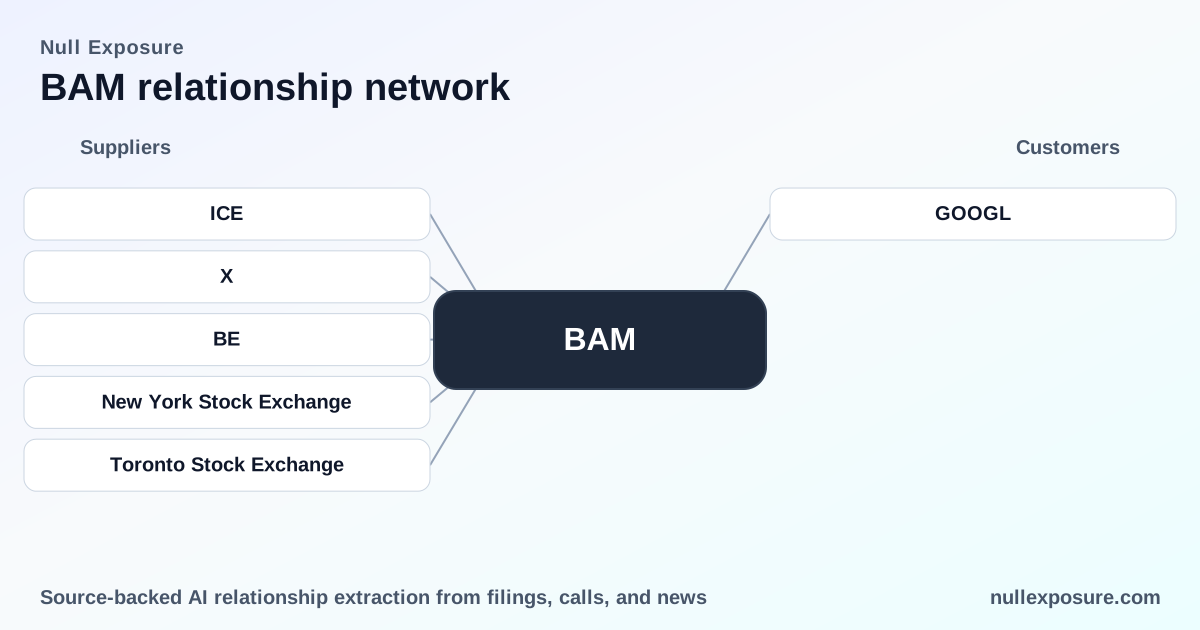
The public record captured three relationship nodes tied to BAM’s market activity and strategic partnerships: the New York Stock Exchange, the Toronto Stock Exchange, and Bloom Energy. Each plays a distinct role: the exchanges are the trading venues BAM uses for open‑market activity, while Bloom Energy is a strategic commercial partner for technology deployment at scale.
New York Stock Exchange — venue for market activity
Brookfield disclosed that share repurchases and purchases under certain bids will be conducted on the open market through the facilities of the New York Stock Exchange (NYSE). This is an operational statement about execution channels rather than a vendor contract, but it confirms BAM’s use of established liquidity venues to manage capital returns. The detail comes from a Brookfield press release distributed via Ritzau on March 9, 2026.
Toronto Stock Exchange — domestic trading venue
Brookfield likewise specifies that purchases under its bid will be made through the Toronto Stock Exchange (TSX) when appropriate, reflecting its dual‑listed operational footprint and the Canadian base of many Brookfield entities. This routing is noted in the same March 9, 2026 press release and repeated in other market notices during the same period.
Bloom Energy — strategic capital and technology partner
Brookfield announced a strategic partnership with Bloom Energy that includes up to $5 billion of investment to deploy Bloom’s advanced fuel cell technology, positioning Brookfield as a capital provider and commercial partner in energy infrastructure. This strategic investment is documented in a press release covered by The Globe and Mail (reported March 2026) describing the $5 billion commitment to scale Bloom’s technology across Brookfield platforms.
How these relationships map into the operating model
The raw relationship entries are limited in number but meaningful in type: exchange execution channels and a large-scale strategic industrial partner. Investors should translate that into operational implications rather than treating them as isolated press mentions.
- Execution dependency: Use of NYSE and TSX for share purchases confirms Brookfield’s reliance on deep public markets for liquidity management and corporate capital programs. That reduces operational execution risk compared with bespoke OTC arrangements.
- Strategic capital deployment: The Bloom Energy tie is a capital‑intensive, commercially sensitive partnership that signals Brookfield’s intent to allocate corporate and fund capital into decarbonizing infrastructure — a potential earnings lever and reputational exposure point if project execution slips.
If you want deeper supplier-risk mapping and portfolio-level exposure analytics, visit our product page: https://nullexposure.com/.
Company-level constraints and what they reveal about contracting posture
The disclosure set includes contract and spend excerpts that, taken together, create a coherent company-level signal about BAM’s maturity and vendor posture:
- Mixed contract maturity posture. Brookfield operates both long‑term facilities (a five‑year revolving $500 million credit facility established November 8, 2022) and shorter-term cash arrangements (deposits withdrawable on two business days’ notice). This shows a deliberate mix of committed liquidity and flexible cash management to support operations and opportunistic capital deployment.
- Material committed spend on credit lines. As at December 31, 2024, BAM had drawn $219 million against the $500 million facility, signaling meaningful ongoing reliance on committed lender relationships rather than purely on capital markets for short-term liquidity.
- Real estate commitments with multi‑year visibility. Lease disclosures show aggregate minimum commitments through 2031 and rental expense around $4.5 million per year, indicating predictable occupancy costs and modest operating lease exposure relative to balance-sheet scale.
- Brand licensing as a strategic operating lever. BAM’s use of a non‑exclusive, royalty‑free trademark sublicense to use the “Brookfield” name confirms formal licensing relationships that govern brand use across the group — important for reputational and contractual control over co‑branding.
- Role diversity with third parties. Public excerpts identify BAM as a distributor, licensee, and service provider in different contexts, which implies a multi‑faceted vendor ecosystem where the company both buys services and resells access to its products through intermediaries.
None of these constraints is unique to any single exchange or partner; they are firm-level indicators that shape how suppliers will be contracted, monitored, and paid.
Investment implications — what operators and allocators should watch
- Liquidity and funding risk: $219 million drawn on a $500 million revolving facility as of Dec 31, 2024 is material; investors should monitor leverage trends and covenant language at renewal (facility established Nov 2022). If growth accelerates, funding reliance may increase; if markets tighten, cost of funds can compress margins.
- Execution risk on strategic deployments: The $5 billion commitment to Bloom Energy elevates project execution as a value driver and a risk vector. Track deployment schedules, performance guarantees, and counterparty credit for large-scale deployments.
- Concentration of market access: Use of NYSE and TSX for open-market purchases is operationally conservative, but it concentrates execution risk into regulated exchanges — watch for regulatory changes or trading disruptions that would impact capital programs.
- Operational maturity and supplier governance: The presence of formal licensing, multi‑year leases, and third‑party access policies indicates mature supplier governance, which reduces vendor risk but increases the importance of compliance and reputational controls.
Key operational checklist for analysts:
- Confirm covenant terms and maturity dates for the revolving credit facility.
- Monitor public updates on the Bloom Energy rollout and related off‑take or service agreements.
- Verify whether brand sublicense terms change in any upcoming governance filings.
- Track cash drawdown trends and lease renewals into the 2030 window.
Visit https://nullexposure.com/ for structured monitoring and alerts on these items.
Final takeaway and next steps
Brookfield’s disclosed supplier footprint in the recent record is compact but meaningful: exchange venues for capital programs and a high‑stakes strategic partner in Bloom Energy. Company disclosures show a deliberate combination of long‑term commitments and short‑term cash flexibility, governed by mature supplier policies and brand licensing arrangements. For investors, the two immediate lenses are funding/leverage trajectory and execution on large-scale strategic investments — both of which will drive near- and medium-term value realization.
For continuous tracking of Brookfield’s supplier exposures and to integrate these signals into portfolio decisioning, explore our analyst tools at https://nullexposure.com/.