BANC supplier map: what investors need to know about funding, vendors and operational risk
Banc of California (BANC) operates as a regional commercial bank that monetizes through lending spreads, fee businesses (including merchant acquiring), and a mix of wholesale funding. Its supplier footprint reflects that business model: secured long‑term advances from the Federal Home Loan Bank for liquidity, third‑party workflow and IT platforms for customer servicing and internal automation, and reseller relationships through independent sales organizations for merchant services. These supplier relationships are directly tied to funding cost, operational continuity, and client distribution — the three core drivers of bank economics for BANC. For a concise supplier exposure dashboard and supplier due‑diligence tools visit https://nullexposure.com/.
How funding and vendor strategy shape the business
BANC’s balance sheet funding and vendor mix show a deliberate operating posture: lean internal platforms around homeowner association (HOA) servicing and reliance on established third‑party enterprise software for back‑office workflow. That combination supports scale without heavy fixed IT spend, while concentrated wholesale funding relationships create a predictable but critical counterparty dependency. Investors should view the supplier set as an engine for margin provision (funding) and a lever for efficiency (software and resellers) — both of which carry discrete operational and concentration risks.
All disclosed relationships, one by one
-
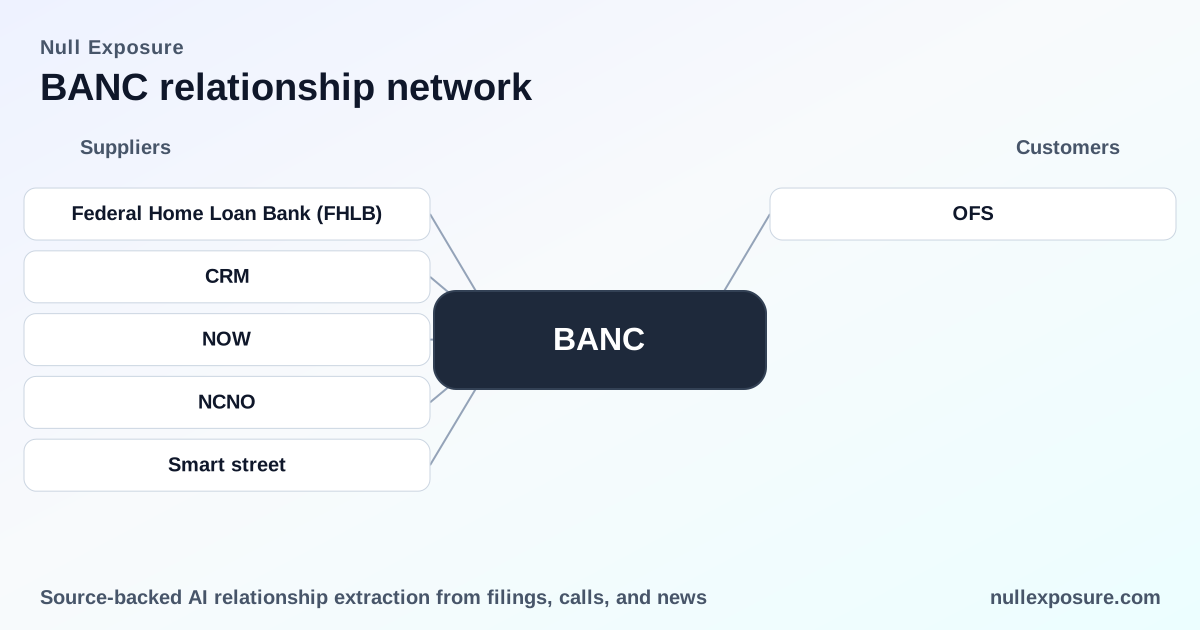
Federal Home Loan Bank (FHLB) — BANC uses long‑term secured advances from the FHLB as core wholesale funding; the company disclosed paydown of higher‑cost borrowings and replacement with lower‑cost long‑term FHLB advances, driving a 76 basis‑point reduction in average borrowing cost to 4.92% in FY2026. Source: company disclosure in a March 2026 press release on Yahoo Finance (FY2026) (https://ca.finance.yahoo.com/news/banc-california-inc-reports-fourth-211500745.html).
-
Salesforce (CRM) — BANC references Salesforce as part of its back‑end and workflow technology stack used to support customer workflows and process automation. Source: Q4 2025 earnings call transcript published on AlphaStreet (reported March 2026) (https://news.alphastreet.com/banc-of-california-inc-banc-q4-2025-earnings-call-transcript/).
-
ServiceNow (NOW) — The bank lists ServiceNow among the enterprise tools it leverages, indicating reliance on established IT service management for internal operations. Source: Q4 2025 earnings call transcript on AlphaStreet (reported March 2026) (https://news.alphastreet.com/banc-of-california-inc-banc-q4-2025-earnings-call-transcript/).
-
Cino (NCNO) — BANC specifically named Cino as a workflow platform in tandem with or in place of Salesforce for certain back‑end processes, signaling a multi‑vendor workflow approach. Source: Q4 2025 earnings call transcript on AlphaStreet (reported March 2026) (https://news.alphastreet.com/banc-of-california-inc-banc-q4-2025-earnings-call-transcript/).
-
Smart street — BANC is reinvesting in its Smart street HOA platform to position it as a top‑tier client servicing product for HOA customers, reflecting selective build‑rather‑than‑buy strategy in a niche product. Source: Q4 2025 earnings call transcript on AlphaStreet (reported March 2026) (https://news.alphastreet.com/banc-of-california-inc-banc-q4-2025-earnings-call-transcript/).
Contracting posture, concentration and criticality — what the constraints tell investors
-
Long‑term secured funding is explicit and measurable. Evidence shows callable term advances with maturities into 2034 and $1.1 billion of outstanding FHLB secured advances; this is a deliberate long‑duration funding posture that reduces short‑term rollover risk while increasing dependence on FHLB access. (Constraint evidence excerpts reference callable term advances and FHLB secured advances.)
-
Funding counterparty concentration is material. The bank reported secured financing capacity with the FHLB of $6.9 billion and $1.1 billion outstanding at year‑end 2024; that creates a lender‑dependency dynamic where FHLB availability and pricing directly affect net interest margin. (Constraint evidence cites secured capacity with FHLB.)
-
Vendor relationships include framework and SLA exposures at the corporate level. The company acknowledges framework service agreements and service level obligations; failing vendor performance under these frameworks could be disruptive and financially material, which signals elevated operational dependence on third‑party providers beyond any single supplier name. (Company‑level constraint evidence about framework contracts and SLA risk.)
-
Reseller channel creates credit and operational exposure. The bank uses independent sales organizations to distribute merchant acquiring services; those intermediaries extend reach but introduce credit and compliance risk into the merchant portfolio. (Company‑level constraint evidence referencing ISOs.)
-
Third‑party technology dependence is broad and operationally critical. The bank relies on external communications, information and control systems and has specific service arrangements (for example IntraFi for insured cash sweep services), indicating multiple outsourced dependencies that amplify SLA and cyber‑resilience considerations. (Company‑level constraint evidence references IntraFi and reliance on third‑party systems.)
What these supplier relationships mean for risk and return
-
Funding cost is controllable but dependent on access. The swap from higher‑cost short‑term borrowings to long‑term FHLB advances materially lowered BANC’s average cost of borrowings in FY2026, supporting margin expansion once credit spreads normalize. That is a direct positive for return on assets, provided FHLB access remains stable.
-
Operational continuity rests on a small set of enterprise vendors. Relying on Salesforce, ServiceNow and Cino reduces bespoke engineering spend but concentrates operational risk across a few providers; successful integrations improve efficiency, but any sustained outage or SLA failure would be disproportionately disruptive.
-
Distribution is partially outsourced through resellers. ISOs expand merchant reach but insert credit and compliance variability into the origination funnel, which requires stronger underwriting controls from BANC.
If you want a deeper supplier risk scorecard or automated monitoring for these vendor and funding relationships, check our platform at https://nullexposure.com/.
Actionable investor takeaways
- Watch FHLB exposure and advance maturities as primary liquidity and margin signals; rising FHLB pricing or reduced capacity would directly compress net interest income.
- Monitor vendor SLA metrics and integration progress for Salesforce/Cino/ServiceNow to assess operational resilience and cost efficiency gains from modernization.
- Scrutinize merchant portfolio performance behind ISOs for hidden credit risk that could translate into loan losses or chargebacks.
For ongoing tracking of BANC’s supplier exposures and to set up alerts when vendor or funding signals move, visit https://nullexposure.com/.
Bottom line
BANC’s supplier footprint is intentionally pragmatic: long‑duration wholesale funding from the FHLB underpins liquidity and margin, while a compact set of enterprise software vendors and reseller channels support scale and client distribution. That structure delivers efficiency and predictable funding costs today, but it concentrates counterparty and SLA risk that investors must monitor through funding metrics, vendor performance indicators, and merchant portfolio quality. For a hands‑on supplier due‑diligence toolkit and continuous monitoring, go to https://nullexposure.com/.