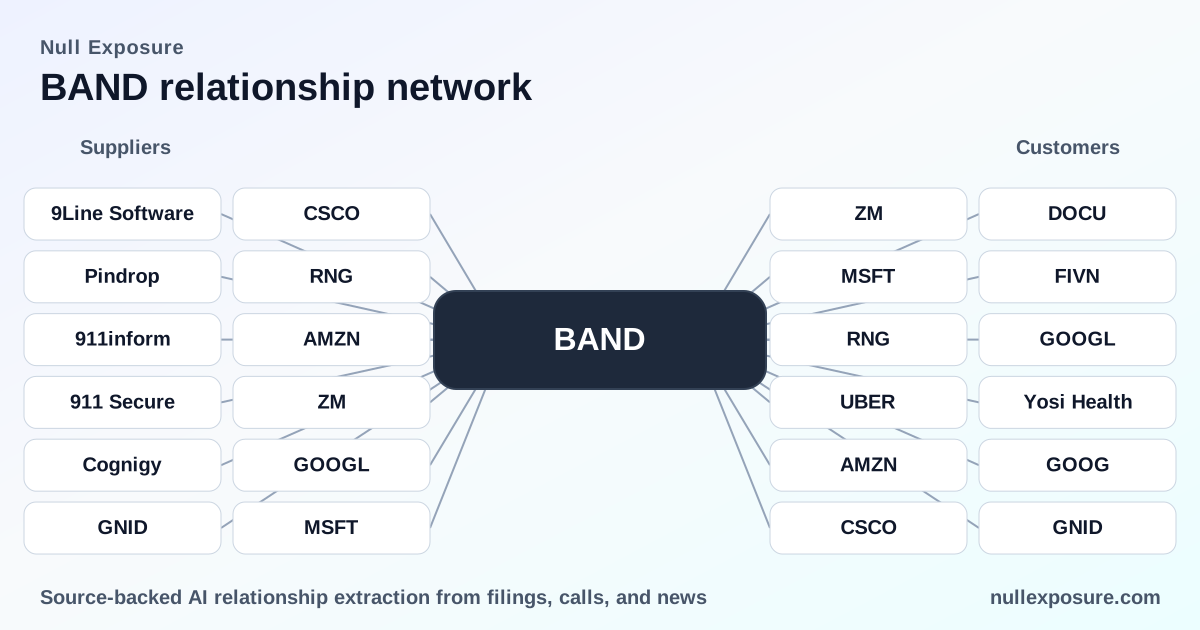
Bandwidth (BAND) — Supplier relationships that reshape its platform economics
Bandwidth operates as a cloud communications and network operator that sells carrier-grade voice, messaging and contact-center services to enterprise and platform customers. The company monetizes through a combination of network services (PSTN replacement, call verification), platform subscriptions for enterprise CX and contact center workflows (Maestro), and usage-based carrier fees, with strategic pre-integrations that accelerate adoption inside large UCaaS and CX ecosystems.
If you are evaluating Bandwidth as a supplier partner or potential counterparty, the partner list and the company’s contracting posture are as important as its product roadmap. For a concise vendor-risk and opportunity readout, visit https://nullexposure.com/.
Why the Maestro integration list matters for revenue and distribution
Bandwidth’s Maestro announcement positions the company as both a network operator and an integrator for AI-enabled customer experience stacks. Pre-integrations with market-leading UC and AI vendors convert network capacity and verification services into addressable platform revenue — enterprises buying cloud contact center or unified communications solutions can select Bandwidth as a turnkey PSTN and telephony stack inside existing vendor relationships. The technical point is commercial: by embedding into RingCentral, Microsoft Teams, Cisco Webex and other front-end platforms, Bandwidth converts upstream voice and verification traffic into predictable volume and incremental SaaS-style services.
- Distribution advantage: Integration into large UC vendors accelerates enterprise procurement cycles; channel economics are favorable because Bandwidth supplies infrastructure while partners bring distribution and account control.
- Monetization mix: Expect a combination of transaction-level revenue (minutes, messages, verification) plus higher-margin software subscriptions as Maestro bundles AI and CX capabilities.
Learn more about how supplier relationships map to financial exposure at https://nullexposure.com/.
Partnership roll-call: what Bandwidth announced (each relationship covered)
Cisco — Bandwidth listed Cisco Webex Calling among Maestro’s pre-integrations, signaling a direct go-to-market pathway into enterprise Webex customers for PSTN replacement and cloud calling services. Source: PR Newswire (Maestro release, March 9, 2026).
RingCentral — RingCentral MVP is included in the pre-integrations, giving Bandwidth channel access to RingCentral’s SMB and mid-market installed base for voice and PSTN services. Source: PR Newswire (Maestro release, March 9, 2026).
Amazon — Bandwidth will integrate speech-to-text and text-to-speech from Amazon as part of the Maestro ecosystem, positioning the company to offer bundled AI voice services with major cloud provider tooling. Source: PR Newswire (Maestro release, March 9, 2026).
Zoom — Zoom Phone is a named pre-integration, enabling Bandwidth to monetize voice traffic inside Zoom’s unified communications footprint. Source: PR Newswire (Maestro release, March 9, 2026).
Google — Google Dialogflow and Google speech services are pre-integrated into Maestro, aligning Bandwidth with Google’s conversational AI and cloud voice tooling for contact centers. Source: PR Newswire (Maestro release, March 9, 2026).
Microsoft — Microsoft Teams Direct Routing and Operator Connect for Teams are included, making Bandwidth an on-ramp for enterprises standardizing on Microsoft Teams telephony. Source: PR Newswire (Maestro release, March 9, 2026).
Pindrop — Pindrop is a pre-integration partner for Maestro, enabling Bandwidth to layer voice fraud detection and caller authentication into its verification and CX offerings. Source: PR Newswire (Maestro release, March 9, 2026).
Cognigy — Cognigy’s conversational AI platform is listed among the Maestro pre-integrations, enhancing Bandwidth’s ability to sell AI-driven contact center workflows together with its telephony stack. Source: PR Newswire (Maestro release, March 9, 2026).
Genesys — Genesys Cloud CX is a launch integration, which places Bandwidth inside enterprise-grade contact center deployments and opens routes to large-scale contact-center usage. Source: PR Newswire (Maestro release, March 9, 2026).
9Line Software — As part of a separate announcement extending 911 emergency services capability, Bandwidth contracted with 9Line Software to integrate caller location management and emergency-services workflows for large enterprises. Source: PR Newswire (911 capabilities release, March 9, 2026; FY2021 context).
911inform — Bandwidth added 911inform to its emergency-services partner list to build a full-stack solution for enterprise 911 caller location management and integrations with non-fixed IP systems. Source: PR Newswire (911 capabilities release, March 9, 2026; FY2021 context).
911 Secure — 911 Secure is also named in the emergency-services agreements, completing the trio of vendor relationships that expand Bandwidth’s enterprise 911 footprint and integrations with systems like Avaya, Cisco/BroadWorks and Mitel. Source: PR Newswire (911 capabilities release, March 9, 2026; FY2021 context).
Operational constraints that shape supplier risk and capital exposure
Bandwidth’s public filings and disclosures frame a mixed contracting posture that matters for counterparty risk and capital planning:
- Long-term fixed commitments coexist with short-term supplier arrangements. The company discloses substantial non-cancelable lease obligations (including a 20-year headquarters lease) and convertible debt alongside the reality that many third-party suppliers operate on short notice cancellation terms. This creates a leverage of fixed overhead against variable supplier relationships.
- Role as an integrated service provider. Bandwidth depends on third-party carriers, fiber, hardware and colocation facilities to operate its network; these suppliers are functionally service providers that are critical to operations, which elevates operational concentration risk if alternative routing or sourcing is constrained.
- Active, staged relationships. The firm’s statements show active efforts to replace intermediaries with direct connections over time, but it will continue to rely on intermediaries for some services in the near term, implying transitional sourcing risk during scaling.
- Scale of committed spend. The company-level signal for future minimum rent and purchase obligations crosses the $100m+ spend band, indicating material fixed-cost exposure that affects operating leverage and supplier negotiation dynamics.
These constraints are company-level signals that influence how trade credit, service-level guarantees and contingency sourcing should be evaluated for any supplier relationship.
What this means for investors and operators
Bandwidth’s partnership strategy converts network assets into scalable enterprise distribution through major UC and AI vendors. The commercial upside is clear: embedded PSTN replacement and verification inside market-leading UCaaS and CX platforms accelerates volume growth and creates cross-sell opportunities into higher-margin software services. The risk profile is also explicit: fixed real-estate and financing commitments create high operating leverage while day-to-day supplier relationships remain partially short-term and critical to uptime.
For procurement and risk teams, prioritize:
- contractual SLAs and redundancy for carrier and colocation partners,
- margins on bundled Maestro services versus raw minutes,
- monitoring of lease and debt servicing when modeling free cash flow.
For a detailed supplier-risk dashboard and structured exposure mapping, visit https://nullexposure.com/.
Conclusion: verdict and next steps
Bandwidth’s announced integrations are a strategic commercial lever that materially improves go-to-market reach and product stickiness. Investors should view these relationships as distribution multipliers that convert infrastructure into platform revenue, offset by the need to manage fixed-cost commitments and third-party operational concentration. Operators contracting with Bandwidth should insist on redundancy, clear escalation paths for emergency services, and alignment of incentives on usage growth.
If you want a tailored vendor-risk evaluation or to benchmark Bandwidth’s supplier posture against peers, get started at https://nullexposure.com/.