BancFirst (BANF): Supplier and acquisition activity that reshapes deposit and service risk
BancFirst Corporation operates as a regional commercial bank, monetizing through net interest margin on its loan portfolio and fee income from retail and small-to-medium business clients while expanding scale through targeted acquisitions. Recent purchase-and-assumption transactions and the completion of a 2025 bank acquisition increase deposit scale and localized footprint in Oklahoma, and they change the vendor and integration profile investors should monitor. For a structured view of supplier and counterparty relationships tied to BANF, visit https://nullexposure.com/ for deeper intelligence.
How BancFirst makes money and why supplier relationships matter
BancFirst’s core economics are straightforward: interest income on lending and securities plus fee income, supported by a conservative capital profile and above-industry profitability metrics. Market capitalization stands near $3.6 billion, trailing P/E about 15x and a return on equity around 13.9%, indicating profitable operations for a regional bank. These economics give the company room to pursue bolt-on acquisitions that increase deposit funding and fee-generating relationships.
Supplier and transaction counterparties are strategically important because acquisitions and outsourced cybersecurity or advisory services change integration risk, deposit concentration, and operational dependency. Acquisitions boost scale but increase vendor, systems, and deposit-assumption complexity; third‑party advisors reduce internal technical exposure while adding counterparty risk. Explore a breakdown of BANF’s counterpart relationships at https://nullexposure.com/ to see primary connections and source documents.
Recent counterparty moves that matter now
BancFirst has executed transactions that are immediately relevant to underwriters, risk teams, and portfolio managers evaluating BANF exposure. Below are the recorded relationships from public reporting and news aggregation.
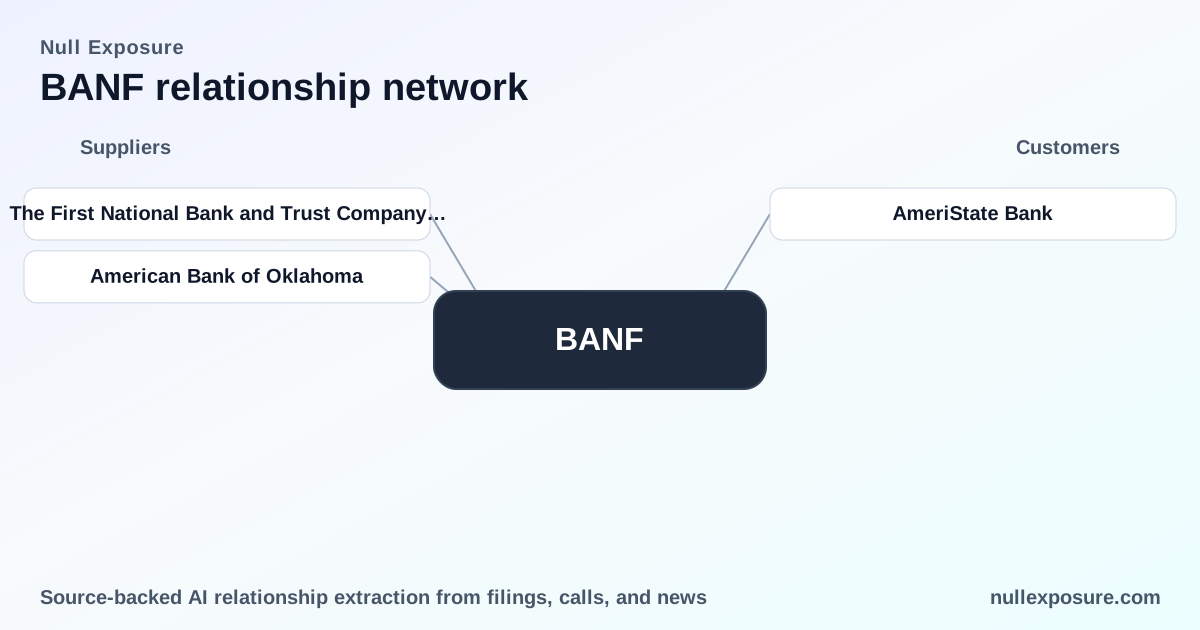
The First National Bank and Trust Company of Vinita, Oklahoma
BancFirst entered a purchase-and-assumption agreement to acquire assets and assume deposits of The First National Bank and Trust Company of Vinita, Oklahoma. This transaction is a classic deposit-accretion move that increases local deposit balances and requires operational assimilation of deposits and loan-servicing processes. According to a StockTitan news page (March 9, 2026), the purchase-and-assumption agreement was announced in FY2026 (https://www.stocktitan.net/news/BANF/page-3.html).
American Bank of Oklahoma
BancFirst announced an agreement to acquire American Bank of Oklahoma in May 2025 and officially completed that acquisition in November 2025, reported via an 8‑K disclosure. This completed acquisition expanded BancFirst’s branch footprint and deposit base in Oklahoma while adding a set of customer relationships to integrate into BancFirst’s systems and platforms. A StockTitan summary noted the announcement and the 8‑K completion (news page, March 2026 — https://www.stocktitan.net/news/BANF/page-3.html).
What the relationships imply for contracting posture and supplier risk
BancFirst’s pattern of small, regional bank acquisitions signals a proactive contracting posture: the company pursues strategic asset-and-deposit deals rather than passively waiting for organic growth. That posture drives several company-level signals:
- Concentration and criticality: Acquisition-driven growth increases the complexity of deposit and IT integrations but spreads concentration risk across more retail and SMB relationships. High insider ownership (~31%) alongside institutional ownership (~57%) creates a governance mix that supports strategic transactions.
- Maturity of relationships: These are predominantly traditional banking relationships—purchase-and-assumption transactions and branch integrations—which reflect established integration playbooks rather than first‑time platform bets.
- Use of external specialists: BancFirst engages third‑party consultants and advisors to assess and manage cybersecurity threats, indicating reliance on external service providers for specialized operational risk functions. This is a company-level signal derived from public disclosures on vendor engagement and cybersecurity staffing.
Additionally, BancFirst’s public disclosures note that credit risk in its debt securities portfolio is immaterial enough that the company has not recorded an allowance for credit losses against those securities. This company-level disclosure signals a conservative approach to securities risk accounting and suggests the securities book is not a major source of counterparty credit exposure.
For investors wanting a consolidated view of these relationships and their documents, consult https://nullexposure.com/ for a supplier-focused dossier.
Financial and operational implications for investors
Acquisitions that assume deposits accelerate balance-sheet growth with limited near-term capital strain, but they also increase reliance on accurate integration of systems and third‑party vendors. Key investor takeaways:
- Positive for core funding: Assuming deposits is immediately accretive to low-cost funding and supports loan growth without issuing expensive wholesale funding.
- Operational and cybersecurity risk: Outsourced cybersecurity advisory is prudent and reduces in-house exposure, but it creates new vendor dependencies that require contract diligence and contingency planning.
- Valuation context: BancFirst trades at a mid-teens P/E with a Price/Book under 2x and a modest dividend yield. The market will price successful integrations into a re-rating if deposit and fee synergies are realized; conversely, integration missteps would put pressure on margins and capital.
At this point, analysts assigned consensus “Hold” orientations, which signals that the market expects steady performance rather than immediate re-rating; investors should watch integration metrics and expense synergy realization closely.
If you manage institutional exposure or operational contracts with regional banks, review vendor and counterparty documents for these transactions at https://nullexposure.com/ to confirm contract terms and post-close obligations.
Risk checklist for relationship monitoring
- Confirm the scope of assumed deposits and liabilities in each purchase-and-assumption agreement; these define short-term funding and liquidity impacts.
- Verify systems integration timelines and vendor transition plans, especially for payment processing and core banking platforms.
- Review third‑party cybersecurity engagement terms and SLAs to ensure continuous coverage during migration windows.
- Track regulatory communications and 8‑K filings that finalize transactional details and identify any contingent liabilities.
Bottom line and next steps
BancFirst’s recent activity is an explicit strategy to grow deposits and local market share through targeted bank acquisitions while outsourcing specialized functions like cybersecurity. This strategy strengthens funding and fee potential but shifts the risk profile to integration execution and vendor management. Investors should focus diligence on integration KPIs, contract terms with third‑party advisors, and subsequent Form 8‑K disclosures for completed deals.
For a practical, document-linked review of BANF’s supplier and acquisition relationships, use the NullExposure supplier view at https://nullexposure.com/ to access the filings and summaries you need before taking position or operational decisions.
Take action: visit https://nullexposure.com/ to see the complete relationship timeline and supporting filings.