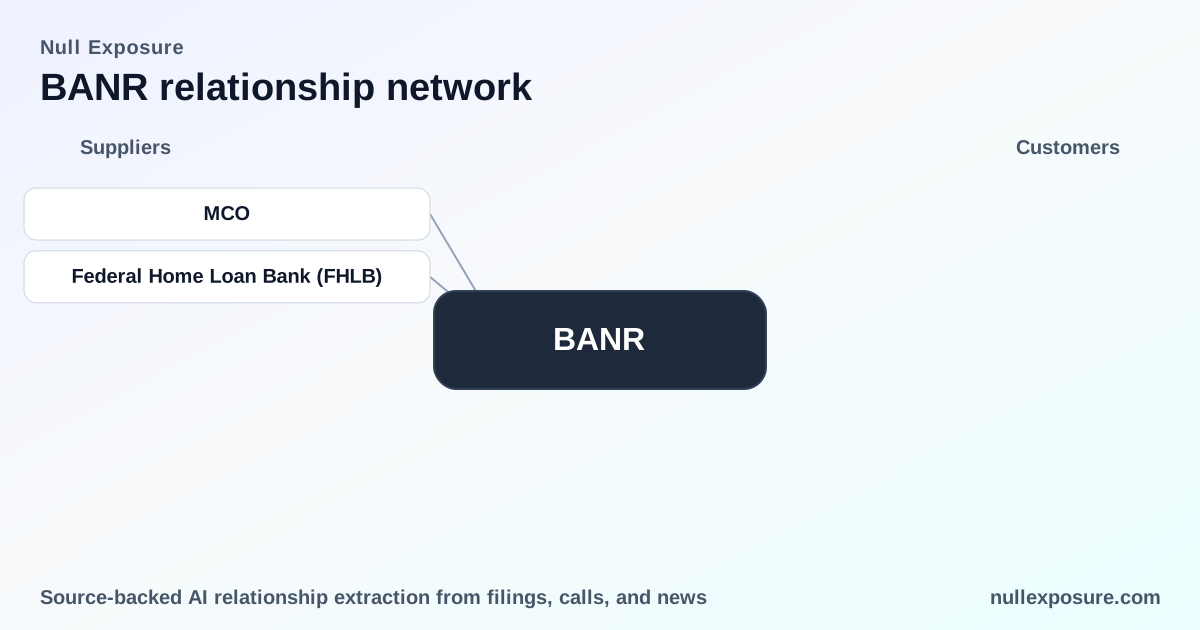
BANR supplier relationships: funding partners and analytics vendors that shape capital and risk
Banner Corporation (BANR) runs a regional banking franchise that monetizes through net interest income, fee income, and balance-sheet management. The company operates with a typical banking supplier posture: it outsources specialized services (risk analytics, card processing) while accessing contingent wholesale liquidity lines; revenue and margins depend on effective interest-rate forecasting and inexpensive access to short-term funding. Understanding who provides those analytics and funding—and the scale of contractual commitments—is material to valuation and operational risk. For a concise view of BANR’s supplier footprint, visit https://nullexposure.com/ for deeper supplier intelligence.
Executive snapshot: what matters to investors
Investors should focus on two functional supplier categories in BANR’s public record: market-data and analytics providers used to set risk assumptions and wholesale funding counterparties that provide liquidity and balance-sheet optionality. The public signals show both a reliance on expert vendors for forecasting and an increase in secured liquidity drawdowns. These are not incidental vendor relationships; they influence capital allocation and short-term stress resilience.
- Key operational lever: data and analytics that drive interest-rate exposure and loan pricing.
- Key balance-sheet lever: FHLB advances that substitute for deposits when funding pressure arises.
- Contract scale: documented purchase obligations of $18.9 million for vendor services for the year ending December 31, 2025, implying mid-sized contractual spend with external suppliers.
For a deeper supplier mapping tied to risk and procurement posture, see https://nullexposure.com/.
The public relationships you must know
Moody’s — forecasting inputs for interest-rate management
BANR uses Moody’s products for interest-rate forecasting and scenario inputs to its risk models. This relationship is a strategic analytics coupling: Moody’s supplies forward curves and scenario data that inform net interest income projections and capital planning. According to a Q4 2025 earnings call transcript published on InsiderMonkey (March 9, 2026), management stated, “We use Moody’s for our interest rate forecasting.” Source: https://www.insidermonkey.com/blog/banner-corporation-nasdaqbanr-q4-2025-earnings-call-transcript-1682295/.
Federal Home Loan Bank (FHLB) — wholesale liquidity provider
BANR increased FHLB advances to $150.0 million at December 31, 2025, up from $100.0 million at September 30, 2025, signaling greater reliance on secured wholesale funding during the quarter. This uptick in FHLB borrowings is a direct indicator of funding strategy and balance-sheet management choices. Financial reporting summarizing Q4 2025 results noted the 50% increase in advances; see the company’s earnings coverage on StockTitan (March 9, 2026): https://www.stocktitan.net/news/BANR/banner-corporation-reports-net-income-of-51-2-million-or-1-49-per-4kt2j3oquzrb.html.
What the disclosed constraints tell investors about BANR’s supplier posture
BANR’s public disclosures and the relationship records together reveal a cohesive operating model:
- Contracting posture: The bank relies on numerous external vendors for day-to-day operations and has a defined set of purchase obligations. Management reports $18.9 million of purchase obligations under contracts with key vendors for the year ending December 31, 2025, primarily for information technology services. This positions BANR as a moderately vendor-dependent operator with formal contractual commitments rather than ad-hoc purchases.
- Spend concentration and scale: The disclosed purchase obligations fall in the $10 million–$100 million band, which implies material but not outsized third-party spend. Investors should treat supplier outages as operationally significant, though not on the scale of large, systemically critical banks.
- Service-provider reliance: The relationship-role dimension classifies many suppliers as service providers (confidence 0.80). This reflects outsourcing of specialized functions—analytics, card processing, IT—rather than commodity procurement.
- Maturity and criticality signals: These constraints indicate a mature vendor contracting posture with multi-year obligations for technology and services; such contracts support continuity but create switching costs and operational concentration risk.
These are company-level signals; the constraints do not attach exclusivity or specific spend amounts to individual named suppliers unless explicitly stated in a disclosure.
Investment implications: risks and opportunities
BANR’s supplier footprints translate into concrete investment considerations:
- Risk — funding concentration: The 50% quarter-to-quarter increase in FHLB advances is a clear funding signal. Rising reliance on FHLB can compress liquidity buffers if deposit inflows weaken; monitor advances relative to total assets and collateral availability. Source: StockTitan coverage of Q4 2025.
- Risk — vendor lock and IT spend: $18.9 million of purchase obligations for IT and services creates vendor dependency and switching costs; cyber, outage, or contract-renegotiation events would carry operational and cost impacts.
- Opportunity — better forecasting yields margin stability: Outsourcing interest-rate forecasting to Moody’s provides a forward-looking input that supports disciplined pricing and hedging. High-quality analytics improves management’s ability to protect net interest income when markets reprice. Source: Q4 2025 earnings call transcript on InsiderMonkey.
- Operational leverage: If BANR optimizes vendor contracts or sources alternative, lower-cost analytics, it can modestly expand margins without asset growth.
Key near-term monitoring items for investors:
- Trajectory of FHLB advances versus deposits.
- Quarterly disclosure of purchase obligations and vendor concentration.
- Any change in analytics suppliers or expanded service-provider relationships.
Practical next steps for investors and operators
- Review BANR’s next quarterly filing for evolution in FHLB usage and explicit collateral or covenant language tied to advances.
- Track changes in purchase obligations line items and vendor disclosure supplements to detect concentration shifts.
- For procurement and risk teams, benchmark existing vendor terms and contingency plans for card processing, IT, and forecasting services.
For a focused supplier risk report tailored to BANR’s counterparties, visit https://nullexposure.com/ and commission a supplier mapping tailored to banking counterparties.
Conclusion: a balanced signal set worth active monitoring
BANR’s public supplier signals are straightforward: Moody’s provides critical forecasting inputs, and FHLB advances represent material, discretionary liquidity that rose substantially in late 2025. Company-level constraints—$18.9 million of contractual purchase obligations and a service-provider orientation—point to moderate vendor dependence with measurable switch costs and operational implications. Investors must watch the interplay between forecasting inputs and funding strategy because both directly affect earnings stability and downside resilience.
Act now to incorporate supplier intelligence into your BANR thesis: visit https://nullexposure.com/ to access supplier-driven risk scoring and tailored reports that convert these disclosures into investment-grade signals.