Credicorp (BAP) — Supplier Spotlight: Mibanco’s move to Temenos SaaS and what it means for investors
Credicorp (NYSE: BAP) is Peru’s dominant financial-services holding, earning revenue through traditional banking activities—net interest income, loan origination and servicing fees, and ancillary financial services—while expanding digital channels across retail and microfinance. A strategic supplier relationship has emerged: Mibanco, Credicorp’s microfinance unit, is migrating its core to Temenos’ SaaS platform, a transition that recalibrates cost structure, operational risk, and the scalability of small-business lending. For investors and operators, that single vendor decision is both an efficiency lever and a concentration risk that warrants active monitoring. Explore full supplier insights at https://nullexposure.com/.
What the market reported about the deal
Two contemporaneous news items in March 2026 describe the same operational shift: Mibanco is moving to Temenos’ SaaS core-banking platform to modernize digital microfinance services and support higher profitability through scale and product delivery.
- Mibanco will modernize its core banking by partnering with Temenos and adopting a SaaS delivery model for its microfinance operations, according to reporting published in March 2026. (Simply Wall St, March 9, 2026 — https://simplywall.st/stocks/us/banks/nyse-bap/credicorp/news/credicorps-mibanco-saas-upgrade-with-temenos-and-what-it-sig/amp)
- The transaction is framed as part of Credicorp’s strategy to pair rising earnings with investments in digital microfinance services for SMEs, per a second March 2026 report. (Simply Wall St, March 9, 2026 — https://simplywall.st/stocks/us/banks/nyse-bap/credicorp/news/should-credicorps-rising-earnings-and-mibancos-saas-shift-re)
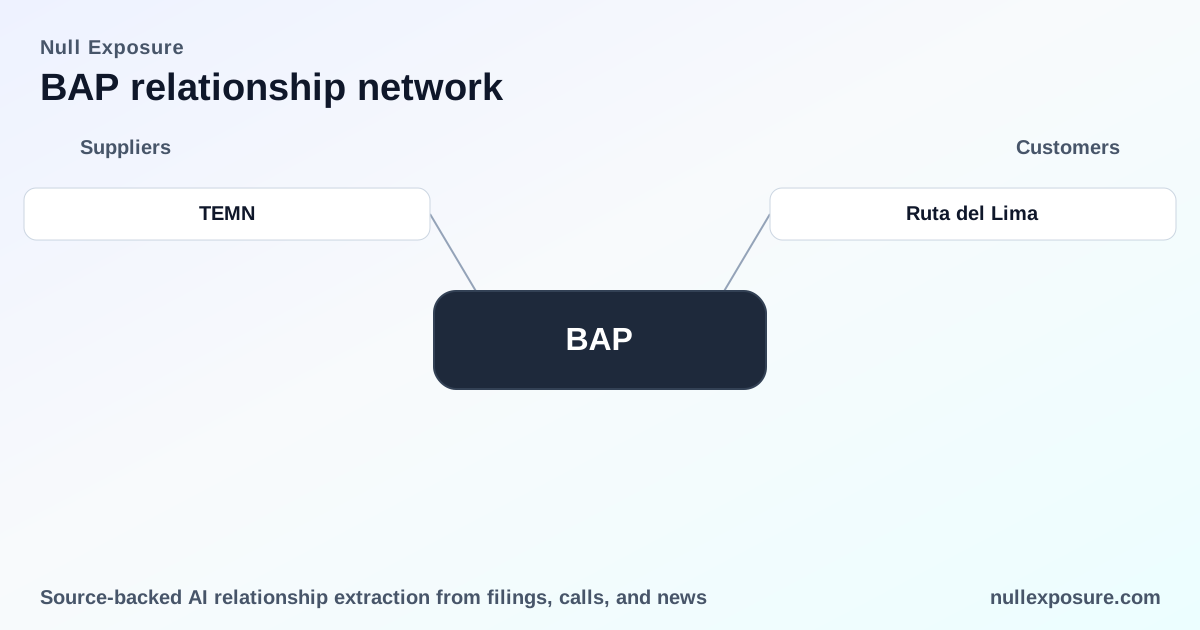
Relationship map — Temenos (TEMN)
Temenos is the only supplier relationship identified in the available reporting for BAP’s supplier scope.
- Temenos will provide a SaaS core-banking platform to Mibanco, shifting critical infrastructure to a vendor-managed cloud model; this is presented as a modernization step intended to improve service delivery for small and medium enterprises. (Simply Wall St coverage, FY2026 — https://simplywall.st/stocks/us/banks/nyse-bap/credicorp/news/credicorps-mibanco-saas-upgrade-with-temenos-and-what-it-sig/amp; https://simplywall.st/stocks/us/banks/nyse-bap/credicorp/news/should-credicorps-rising-earnings-and-mibancos-saas-shift-re)
Why this supplier decision matters to a fiduciary
This is a clear operating decision with measurable strategic consequences. Shifting Mibanco to Temenos SaaS converts discrete legacy IT investments into a recurring vendor expense, accelerates time-to-market on digital products, and reduces in-house maintenance overhead. For a lender focused on micro and SME customers, those benefits translate to faster product rollout, potentially higher cross-sell, and improved customer experience metrics that support revenue growth.
At the same time, vendor concentration increases operational dependency: core ledger, transaction processing, and customer-facing capabilities will rely on Temenos availability, SLAs, and roadmap alignment. For investors, that elevates the importance of contract terms, data residency and security provisions, business-continuity plans, and exit provisions.
Contracting posture and company-level signals
The available supplier data contains no explicit contractual constraints or restriction excerpts. That absence is itself a signal at the company level: Credicorp has not publicly disclosed supplier-level constraints in these reports, which indicates standard commercial disclosure rather than a detailed vendor-risk narrative. From an operating-model perspective this implies:
- Contracting posture: Credicorp is adopting an outsourced, vendor-managed model for parts of its core banking stack, shifting enforcement from internal engineering teams to contractual SLAs and vendor governance.
- Concentration: The decision centralizes critical processing with a named third-party provider, increasing counterparty concentration risk for the microfinance unit.
- Criticality: The supplier is functionally critical—core banking operations are non-negotiable for deposit and lending operations—so vendor resilience and contractual recourse are paramount.
- Maturity: Using a market-leading vendor’s SaaS product signals a move to standardized, mature cloud-native core platforms rather than bespoke legacy systems.
These are company-level observations derived from the transactional nature of adopting a SaaS core; they are not tied to any specific contractual excerpt because none is provided in the source material.
Discover broader supplier risk signals and governance checklists at https://nullexposure.com/.
Investment implications and a practical risk checklist
Investors should treat the Temenos engagement as a strategic efficiency play with definable upside and concentrated operational risk.
Key implications:
- Potential margin uplift over time as digital distribution scales and maintenance CAPEX declines, converted to predictable vendor OPEX.
- Execution risk during migration that could temporarily disrupt origination and servicing flows, with near-term operational P&L and reputational implications.
- Concentration risk because critical processing sits with a single vendor; contractual robustness and contingency planning are decisive.
- Regulatory and data-residency exposure given cross-border vendor hosting and Latin American compliance frameworks.
Practical checklist for monitoring:
- Confirm implementation timelines and milestone metrics published by Credicorp.
- Review reported SLAs, uptime guarantees, and penalties if disclosed in investor materials.
- Monitor operational KPIs for Mibanco (loan origination volumes, book growth, NPL flows) for signs of transition stress or acceleration in growth.
- Assess whether Credicorp publishes contingency or exit strategies should vendor performance degrade.
Steps operators and investors should take now
Operators and governance teams should prioritize contract review and contingency planning; investors should prioritize transparency and metric-based monitoring. Specifically:
- Demand visibility into SLA terms, incident history, and disaster recovery testing outcomes.
- Track migration milestones and any customer-impact incidents in quarterly reporting or investor calls.
- Evaluate whether the SaaS model changes capital allocation—less legacy IT spend, more vendor fees—and how that maps to medium-term EPS guidance.
For a deeper supplier-focused diligence framework and ongoing monitoring tools, visit https://nullexposure.com/.
Bottom line
The Temenos SaaS engagement for Mibanco is a strategic modernization that rebalances Credicorp’s operating model toward outsourced, scalable core infrastructure, with upside to efficiency and product velocity and commensurate concentration and execution risk. No supplier-level constraints are disclosed in the reporting, which places a premium on contract transparency and operational monitoring by investors and operators. Active oversight of SLAs, migration execution, and early operational KPIs will determine whether this supplier decision translates into durable value for BAP shareholders.