Battalion Oil (BATL): Supplier relationships reshaped — operational pivot and financing recap
Battalion Oil Corporation operates as an independent onshore oil and gas E&P, monetizing its acreage through upstream production sales while managing midstream service contracts and hedging obligations to stabilize cash flows. Recent corporate actions — termination of a gas-treating agreement, a private placement, and amendments to its secured credit facilities — materially change counterparty exposure and near-term operating reliability. Investors should view BATL as an operator that is actively re-contracting midstream services and shoring up liquidity while operating under multi-year hedging and volume commitments.
Explore more supplier intelligence at https://nullexposure.com/.
Company snapshot
Battalion reports material revenue from oil and gas production (Revenue TTM $183m) and uses long-term commercial contracts and derivative hedges to manage price and operational risk. The company’s market capitalization ($246m) and leverage metrics reflect a mid-cap E&P balancing growth through asset sales and capital raises while maintaining a secured credit agreement with institutional lenders. Key financial levers are production throughput, midstream access, and the terms of secured lending and placement agreements.
What the operating model and contract posture tell investors
- Battalion executes long-term commercial commitments: the company discloses multi‑year hedging obligations under its amended term loan and minimum-volume obligations under gas‑treating arrangements, which signal predictable revenue coverage but also fixed operational costs. These contractual dynamics favor cash-flow stability when production runs but increase fixed-cost exposure if throughput is disrupted.
- Counterparty profile tilts to large enterprise counterparties for hedging and lending, indicating management’s preference for creditworthy institutional partners when transacting derivatives or amending secured debt.
- Concentration and criticality: the termination of a single gas-treating counterparty has immediate operational consequences because gas treating and acid gas injection are critical choke points for production flow; replacement with a large-cap midstream provider reduces operational concentration risk and raises reliability.
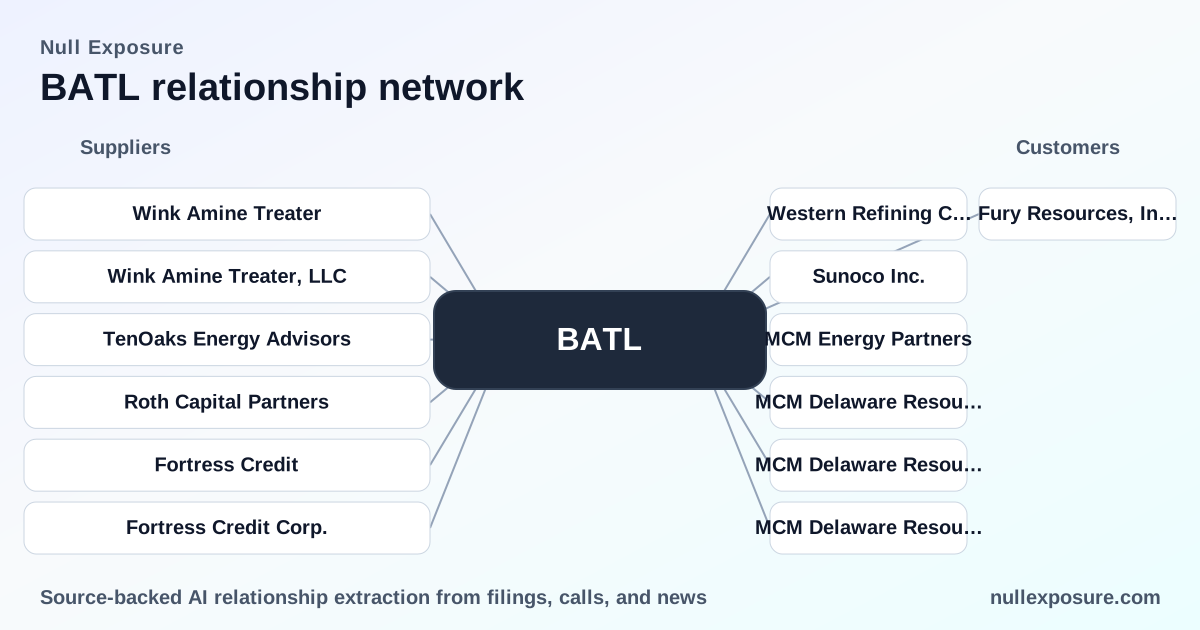
Supplier and related-party roll call (concise summaries and sources) The following sections cover every named relationship returned in our search results.
Wink Amine Treater
Battalion terminated its Gas Treating Agreement with Wink Amine Treater following the cessation of operations at WAT’s acid gas injection facility around August 11, 2025; the termination freed Battalion to redirect volumes to a larger midstream provider to restore processing reliability. Source: Battalion 8‑K and related press coverage in January 2026 (see filings reported on StockTitan and other news outlets).
Wink Amine Treater, LLC
The company’s 8‑K on January 19, 2026 states that Battalion exercised contractual rights to terminate the GTA with Wink Amine Treater, LLC due to the continued offline status of the AGI facility, triggering operational re-routing of gas processing. Source: Official 8‑K and press releases summarized on GlobeNewswire and news aggregators in January 2026.
TenOaks Energy Advisors
TenOaks Energy Advisors served as Battalion’s financial advisor in connection with the asset transaction referenced in the company’s operational updates, providing sell‑side advisory services tied to the asset realignment. Source: Transaction announcements and an 8‑K summary reported by StockTitan and CityBiz in early 2026.
Roth Capital Partners
Roth Capital Partners acted as sole placement agent for Battalion’s private placement that raised approximately $15.0 million via common stock and/or prefunded warrants at $5.50 per share, reinforcing the company’s liquidity position in FY2026. Source: Private placement disclosure and coverage by StockTitan and Simply Wall St (reported as FY2026 activity).
Fortress Credit (Fortress Credit Corp.)
Fortress Credit is named as administrative agent under Battalion’s Second Amended and Restated Senior Secured Credit Agreement (the 2024 Term Loan Agreement) and appears in subsequent credit amendments and lender consents tied to asset sales and prepayments. Fortress and other lenders provided consent for a West Quito sale and an amended credit facility with a $40 million prepay component. Source: Company press releases and filings referenced on GlobeNewswire and TradingView (FY2025–FY2026 filings and summaries).
Why these relationships matter for valuation and operational risk The termination of Wink Amine Treater contracts is the operational headline: moving away from an offline AGI provider to a large-cap midstream partner materially reduces production downtime risk and increases throughput, which translates into immediate revenue and margin recovery potential. Battalion’s ability to re-route production and restore an average oil uplift (reported in press coverage) demonstrates operational flexibility that supports near-term cash generation.
On the financing side, the Roth-led private placement (≈$15m) and Fortress-managed secured credit arrangements are complementary moves: the placement strengthens equity liquidity while Fortress’s amended term loan codifies hedge and prepayment requirements that shape free-cash-flow profiles. TenOaks’ advisory role confirms that these were structured transactions rather than ad-hoc financings.
Firm-level constraints that shape counterparty strategy
- Long-term contracting behavior: Battalion operates under multi-year hedging obligations and minimum volume commitments that create predictable cover for production but also lock the company into fixed delivery and price-protection structures over rolling four-year horizons. This is a company-level signal drawn from the amended term loan and the former gas-treating agreement language.
- Large-counterparty preference: management transacts hedges and secured lending with creditworthy institutional counterparties, a company-level indicator of conservative counterparty selection for financial contracts rather than diversified small counterparties.
Implications for investors and operators
- Upside: Replacement of an unreliable gas treater with a larger midstream partner lifts operational risk and can recover lost production — a direct lever for near-term revenue improvement.
- Liquidity and covenant profile: The Roth placement and Fortress amendments improve liquidity but maintain structured hedging and prepayment mechanics that will influence cash available for growth versus debt service.
- Execution risk: The benefits assume successful integration of new midstream arrangements and full lender cooperation on asset sales and prepayments; monitor subsequent 8‑K filings and midstream reception.
If you evaluate supplier counterparty exposure or need ongoing monitoring, see more in-depth supplier mapping and supplier risk briefs at https://nullexposure.com/.
Conclusion — what to track next Track three items to update a BATL investment view: (1) confirmation of volumes brought online under the new midstream partner and realized production uplift, (2) detailed terms and covenants from any amended Fortress credit documents and hedging schedules, and (3) follow-on equity or strategic investor commitments that change ownership or governance dynamics. For continued coverage and supplier-focused intelligence, visit https://nullexposure.com/.