Bayview Acquisition Corp (BAYA): legal partners, vendor posture, and what suppliers signal for investors
Bayview Acquisition Corp (Ticker: BAYA) is a SPAC that monetizes by raising capital in a trust, executing a business combination with a target company, and capturing sponsor economics and transaction-related fees upon closing. The company’s revenue runway to investors is tied to successful deal execution rather than ongoing operating cash flows, and its supplier relationships—especially legal, administrative, audit, and trustee arrangements—are functionally critical to completing a de-SPAC transaction. For investors and operators evaluating supplier exposure, the focus should be on: counterparty reliability, contract terms and fixed-fee commitments, and where spend concentration could create execution risk. Learn more about supplier intelligence at the NullExposure homepage: https://nullexposure.com/.
Why the law firms matter and how BAYA structures external services
Legal advisors are not discretionary vendors for a SPAC; they are execution-critical partners during diligence, deal structuring, and cross-jurisdictional closings. Bayview’s disclosed relationships show a typical SPAC arrangement: a U.S. legal advisor for the sponsor/issuer and local counsel in target jurisdictions (PRC, Cayman). These advisors reduce transactional friction and are a necessary input to value realization for shareholders.
Below are the explicit relationships surfaced in public reporting.
Relationship snapshots: the firms named in public reporting
-
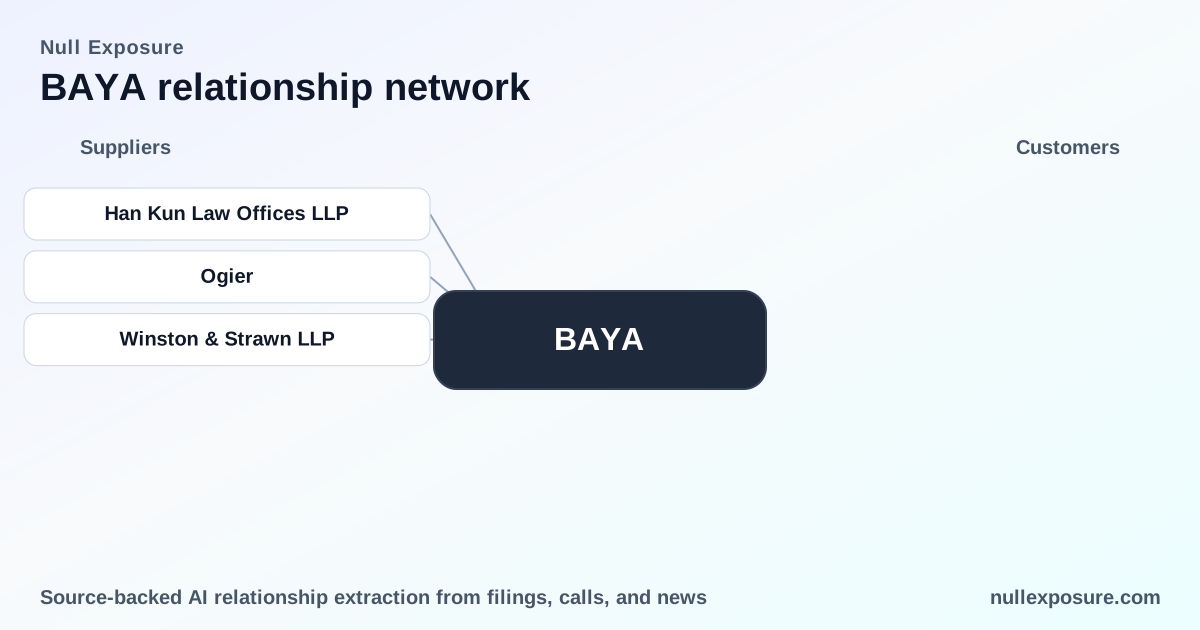
Winston & Strawn LLP — Serving as BAYA’s U.S. legal advisor for the announced transaction. This role covers transactional documentation, SEC and NASDAQ processes, and deal negotiation support. Source: CityBiz article on March 9, 2026 (coverage of BAYA’s acquisition announcement) — https://www.citybiz.co/article/564927/bayview-acquisition-corp-to-acquire-oabay/.
-
Han Kun Law Offices LLP — Engaged as the PRC legal advisor to BAYA for cross-border aspects of the proposed business combination, including local regulatory compliance and target-side coordination. Source: CityBiz coverage of the transaction (March 9, 2026) — https://www.citybiz.co/article/564927/bayview-acquisition-corp-to-acquire-oabay/.
-
Ogier — Retained as Cayman Islands counsel to support entity-level structuring and closing mechanics in that jurisdiction, a typical requirement when targets or SPAC vehicles use Cayman entities. Source: CityBiz coverage of the transaction (March 9, 2026) — https://www.citybiz.co/article/564927/bayview-acquisition-corp-to-acquire-oabay/.
What the supplier constraints tell us about BAYA’s operating model
Public disclosures and filing excerpts present a clear picture of Bayview’s vendor posture and spending profile:
-
Contracting posture: outsourced and fee-driven. BAYA relies on third-party professional services for core functions—legal work, audit, administrative support, and trustee services. Filing language explicitly notes reliance on external vendors and fixed-fee arrangements for administrative services.
-
Spend scale and predictability. Reported vendor-level amounts fall into multiple bands: small operating fees under $100k for some services, mid-range audit and administrative fees in the $100k–$1M band (audit fees of $144,115 and an administration fee of $120,000 for FY2024), and transaction-scale costs in the $1M–$10M band (cash underwriting fees of $1.2M and deferred underwriting fees of $2.1M). These numbers signal that transaction economics dominate cost volatility while routine operations are under fixed or modest fees.
-
Criticality and maturity. The relationships are active and transaction-focused. The company has an administrative services agreement (TenX Global Capital LP) and uses third-party accounting and audit support (Ascendant Global Advisors, UHY) to meet SEC reporting and closing timelines. These are signs of a SPAC in an active stage of business combination execution.
-
Concentration and governance signals. Market data shows high insider ownership (51.87%) and moderate institutional ownership (25.22%), indicating sponsor-aligned decision-making and concentrated governance. A $60 million trust account sits at Bank of America (with Equiniti Trust Company, LLC as trustee), which is standard but emphasizes the trustee and escrow arrangements as operationally critical to deal completion.
(These observations derive from company filings, periodic disclosures, and the constraint excerpts in the FY2024/FY2025 reporting.)
How these supplier relationships affect valuation and execution risk
Legal and administrative suppliers are inexpensive relative to potential transaction upside, but their role is binary: they enable or block a closing. Investors should vet three dimensions:
-
Counterparty capability: The named international law firms (Winston & Strawn, Han Kun, Ogier) have the scale for complex cross-border closings; their presence is a de-risking signal for legal execution.
-
Fee concentration at closing: Underwriting and offering-related fees are material and reduce net proceeds available for a target and post-close runway; filings list $1.2M in cash underwriting fees and $2.1M deferred underwriting fees as explicit transaction costs.
-
Operational friction points: Fixed administrative contracts ($10,000/month with TenX, per disclosed terms) and reliance on third-party preparation of financial statements (Ascendant’s quarterly fee of $5,250) imply predictable operating burn, but also dependence on external calendars and capacity to deliver timely filings required by regulators.
For more supplier intelligence and to see how these relationships compare across SPACs, visit NullExposure: https://nullexposure.com/.
Practical checklist for investors and operators
- Confirm legal coverage across jurisdictions. Ensure U.S., PRC, and Cayman counsel are in place and have executed engagement letters aligned with closing timelines.
- Quantify transaction drag. Model underwriting, deferred fees, and offering costs against expected deal proceeds to assess dilution to public shareholders.
- Assess vendor lock-in and contingency plans. Determine whether key administrative and audit functions can be replaced quickly without delaying SEC filings or shareholder votes.
- Monitor sponsor concentration. High insider ownership concentrates control; understand sponsor incentives and any related-party service agreements.
Bottom line and next steps
Bayview’s supplier relationships are standard for a deal-stage SPAC: experienced transactional law firms, trustee arrangements, and fixed-fee administrative and audit vendors. These relationships reduce legal execution risk but do not eliminate the primary investment questions: target selection quality, sponsor alignment, and net proceeds after transaction costs. The public disclosures present transparent spend bands—routine fees are modest while transaction fees are the material driver of investor outcomes.
If you’re evaluating SPAC supplier risk across a portfolio or preparing for a de-SPAC diligence cycle, explore curated supplier maps and vendor risk signals at NullExposure: https://nullexposure.com/.