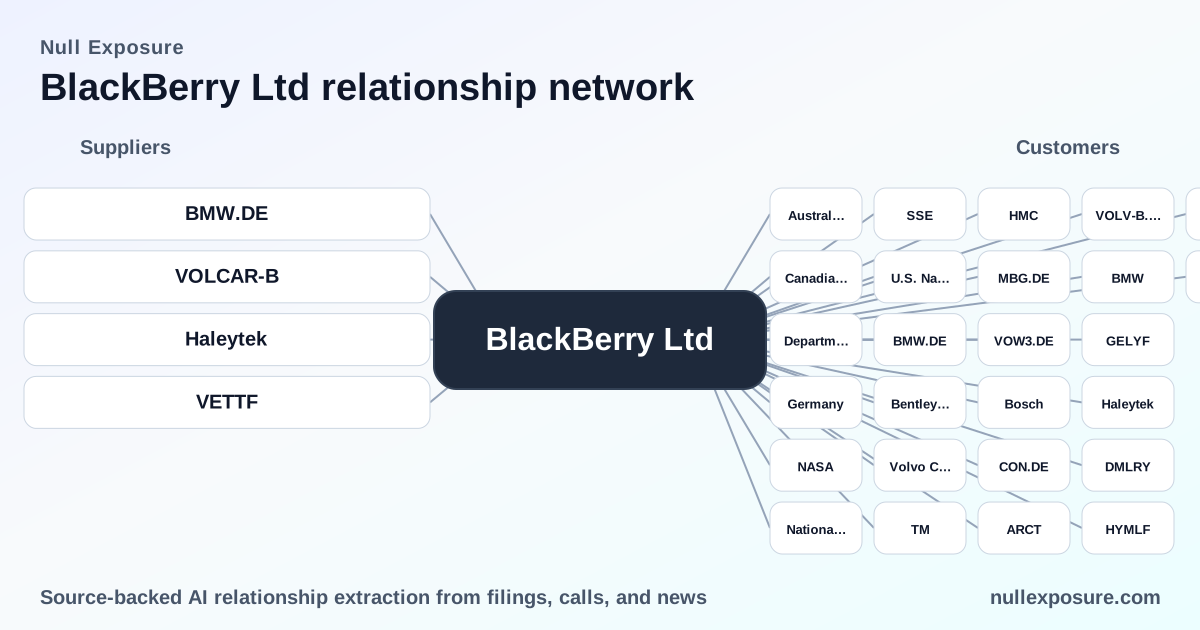
BlackBerry as a Supplier: Commercializing QNX and Security into OEM Partnerships
BlackBerry operates as a software-first vendor that monetizes through enterprise security subscriptions, automotive software licensing (QNX and the new Alloy Kore platform), and services tied to those products. The company sells to businesses and governments while acting as a supplier to automotive OEMs and their middleware partners, generating recurring licence and services revenue alongside a smaller hardware procurement footprint for units such as BlackBerry Radar. For investors, BlackBerry’s value is driven by software monetization with strategic OEM relationships that convert platform technology into high-margin recurring revenue. For more structured supplier intelligence, visit https://nullexposure.com/.
How BlackBerry’s supplier posture shapes commercial outcomes
BlackBerry’s commercial model combines direct sales of security software with platform licensing to automotive manufacturers and co-development partnerships with middleware vendors. This leads to a hybrid contracting posture: co-development and strategic OEM licensing on the automotive side, and buyer-driven procurement for hardware components tied to specific products. The company’s FY2025–FY2026 disclosures show continued focus on QNX and new platform rollouts (Alloy Kore) that strengthen its position as a strategic supplier to tier‑1 automotive customers.
Operationally, that means:
- Contracting is collaborative for OEM software deals, with multi-year licenses and integration work that raises switching costs for manufacturers.
- Procurement discipline is formalized for hardware, as BlackBerry documents due diligence on conflict minerals for Radar components, signaling mature supplier governance.
- Concentration is material in the automotive vertical, where a handful of OEM relationships can disproportionately affect momentum and visibility into future revenue.
Key supplier relationships and what they mean
Below are every relationship recorded in recent reporting and press coverage, each summarized in plain English with source attribution.
-
BMW — strategic vehicle software supplier relationship
BlackBerry is working with BMW on new vehicle software, positioning QNX as part of BMW’s in-vehicle software stack in FY2026. According to a Finviz news piece dated March 9, 2026, the companies announced collaboration on vehicle software initiatives (https://finviz.com/news/266081/heres-why-analysts-are-neutral-on-blackberry-limited-bb). -
Volvo Cars — QNX and software-defined audio for EX60 EV
BlackBerry’s QNX automotive platform is referenced alongside an integration with Haleytek to deliver software‑defined audio for Volvo Cars’ EX60 EV SUV, indicating QNX’s role in vehicle multimedia and domain integration in FY2026. The Finviz report (March 9, 2026) highlights the Volvo collaboration and the OEM’s use of QNX in recent quarters (https://finviz.com/news/266081/heres-why-analysts-are-neutral-on-blackberry-limited-bb). -
Haleytek — audio software partner for Volvo integration
BlackBerry and Haleytek have joined forces to deliver software‑defined audio solutions for Volvo’s EX60, showing BlackBerry’s platform being extended through specialist audio middleware to OEMs in FY2025–FY2026. A StockTITAN article (Feb 3, 2026) covered the QNX and Haleytek collaboration for Volvo’s EX60 (https://www.stocktitan.net/news/BB/black-berry-to-announce-third-quarter-fiscal-year-2026-results-on-6s658czmqgp3.html). -
Vector — co-developer of Alloy Kore and middleware partnership
Vector and BlackBerry are co-developing Alloy Kore, a new vehicle software platform aimed at OEMs; this partnership has attracted interest from automakers including Mercedes‑Benz, underlining Vector’s middleware role in accelerating software-defined vehicle development in FY2025–FY2026. Morningstar’s coverage (CES announcement) and an earnings transcript reference show BlackBerry’s co-development with Vector and public rollout details (https://global.morningstar.com/en-ca/stocks/blackberry-strong-qnx-strategy-bolstered-by-alloy-kore-announcement-ces; additional context in an earnings call transcript from InsiderMonkey, Jan 2026, https://www.insidermonkey.com/blog/blackberry-limited-nysebb-q3-2026-earnings-call-transcript-1662788/).
Constraints and what they signal about BlackBerry’s operating model
Company-level procurement disclosure identifies BlackBerry as a buyer in its supply chain with documented due diligence into conflict minerals for hardware components principally tied to its BlackBerry Radar product. This is not a relationship-specific restriction; it is a corporate signal about how the company manages hardware sourcing.
Implications:
- Contracting posture (company-level): BlackBerry enforces supplier due diligence for physical components, which indicates formal procurement and compliance controls for hardware channels.
- Maturity: The existence of conflict‑minerals due diligence reflects established supplier governance consistent with public-company compliance requirements.
- Criticality: While software revenues dominate, hardware lines (Radar) have enough operational sensitivity to prompt formal procurement controls, suggesting cross‑functional supplier management between product and procurement teams. These are company-level signals and do not attach to any single OEM partner unless explicitly stated in source excerpts.
Investment implications and risk profile
BlackBerry’s FY‑TTM financials show $534.8M in revenue, gross profit of $400.9M, and an operating margin of 13.1%, reflecting a software-heavy revenue base with improving operating leverage. Valuation metrics—trailing PE of 82.5 and forward PE of 20.24—indicate the market is pricing future growth into the stock and expects margin expansion or higher recurring revenue. Analyst coverage skews conservative: one Buy, six Hold, one Sell with an analyst target price near $4.84, implying mixed expectations on execution.
Key takeaways for investors:
- Upside is driven by OEM adoption of Alloy Kore and expanded QNX footprint across vehicle domains. Partnerships with BMW, Volvo, and middleware providers like Vector and Haleytek translate R&D into payable license and services contracts.
- Downside centers on concentration and execution risk. Automotive deals are sizable and complex; slippage or slower-than-forecast OEM integration will materially affect growth visibility.
- Procurement governance reduces operational risk in hardware supply chains but underscores that BlackBerry retains some exposure to component sourcing through Radar and similar products.
For deeper supplier mapping and relationship monitoring, explore https://nullexposure.com/ for an enterprise view of counterparty concentration and supplier-criticality scoring.
What operators and procurement teams should act on
Operators evaluating BlackBerry as a supplier should treat it as a strategic software partner with strong OEM alignment and formal procurement practices for hardware components. Procurement teams must account for compliance workflows tied to conflict minerals when contracting hardware components, while product and engineering teams should budget integration cycles for QNX/Alloy Kore projects.
- Negotiate multi-year licensing and clear integration milestones to align incentives.
- Require supplier attestations on sourcing and conflict-minerals compliance for any hardware agreements.
- Monitor OEM rollouts for adoption signals that correlate with BlackBerry’s recurring revenue trajectory.
For a consolidated supplier intelligence briefing tailored to investors and procurement teams, visit https://nullexposure.com/.
Bottom line: BlackBerry’s supplier relationships are strategically concentrated in automotive OEMs and middleware partners, turning platform IP into recurring revenue while retaining procurement controls for the hardware elements of the business. Investors should weight near-term execution risk against the long-term upside of platform adoption. For ongoing monitoring and supplier analytics, see https://nullexposure.com/.