Concrete Pumping Holdings (BBCP): supplier relationships and what they mean for investors
Concrete Pumping Holdings operates a capital-intensive services business that earns revenue by contracting concrete pumping and waste-management services across the U.S. and the U.K., supported by a fleet of specialized pumping equipment and dealer/manufacturer relationships that underpin operations. The company monetizes through project fees, equipment utilization, and recurring waste-management contracts; its margins and cash flow are highly dependent on uptime of pumping assets and supplier access to replacement equipment and parts. For diligence on supplier risk and contracting posture, see more at https://nullexposure.com/.
The operating and financing picture investors should start with
Concrete Pumping Holdings is a service operator with asset-driven economics and a national footprint. Financially, the company shows modest profitability relative to scale (TTM revenue ~$397M, EBITDA ~$95.8M, trailing P/E ~76.7 but forward P/E ~12.45), and valuation multiples consistent with an asset-backed services peer group (EV/EBITDA ~7.8). Balance-sheet and financing arrangements are central to operational continuity, given the capital intensity of pump fleets.
A material financing signal: the Second Amendment to an asset-based lending agreement references Wells Fargo Capital Finance (UK) Limited as the UK security agent, which indicates cross-border credit arrangements and EMEA legal/financial exposure in the credit structure. This is documented in the company’s Form 8‑K filing referenced in the credit amendment language. That credit posture implies a lender-centric contracting framework where asset liens and security agents are actively managed.
For investors tracking supplier and IR channels, Concrete Pumping’s public communications are routed through retained PR/investor relations resources — an operational detail relevant to how the company manages market perception and earnings access. For further supplier risk intelligence and relationship mapping, visit https://nullexposure.com/.
What supplier constraints tell you about business risk
The filings and public excerpts expose three company-level signals that affect commercial risk:
- Supplier concentration: The company explicitly depends on a small set of equipment manufacturers (Schwing, Putzmeister, and Alliance). This is a structural constraint on capacity and parts availability and represents a single point of operational vulnerability in high-utilization periods.
- Criticality of suppliers: Concrete pumping equipment suppliers are critical vendors; interruptions or degradation in their service, parts or support will directly affect revenue. The company statement on supplier dependence frames those relationships as essential to both growth and maintenance.
- Cross-border financing exposure: The ABL credit amendment naming a UK security agent reflects mature financing arrangements with international covenants and possible EMEA legal encumbrances on assets, which investors should consider in stress scenarios.
These constraints shape contracting posture (lender protections and supplier dependence), concentration risk (a few manufacturers), and criticality (equipment uptime drives revenue). Assess these alongside utilization metrics and capex plans when modeling downside scenarios.
Relationships uncovered in news and filings — what they mean for partners and investors
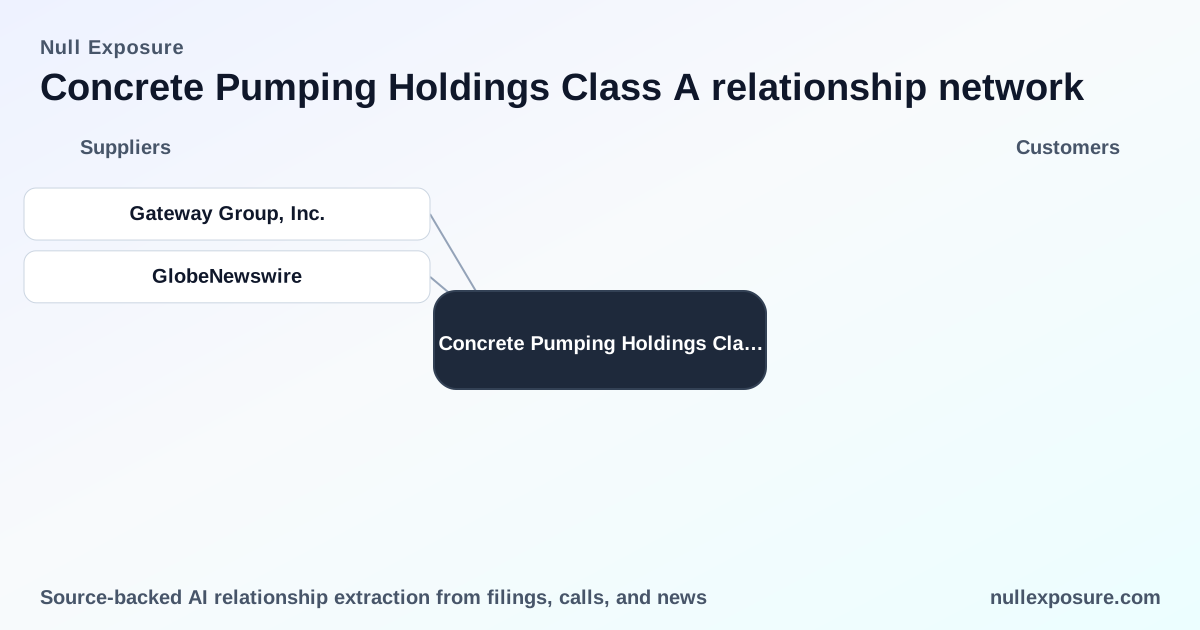
Gateway Group, Inc.
- Gateway Group is acting as the company’s investor relations and communications provider, with named contact Cody Slach and a dedicated investor email and phone line for earnings and conference-call connections. This indicates the company uses a retained IR/PR partner to manage earnings calls and investor access. Source: company press release notices distributed via Quiver Quant and StockTitan referencing Gateway Group contact details (press release for Q4 and FY2025 results, Jan 2026; notices seen Mar 2026).
Gateway Group, Inc. (repeat entry)
- Multiple news notices reference Gateway Group in the same investor-relations role, underscoring its ongoing operational function of routing investor connections and press-services logistics. Source: StockTitan news notice and Quiver Quant press release aggregation (Mar 9, 2026).
GlobeNewswire
- GlobeNewswire is the distribution channel used for at least one of BBCP’s press releases; one distribution reference includes a disclaimer that the published summary was AI-generated, which signals how releases are being prepared or republished through services. Source: Quiver Quant’s aggregation of the GlobeNewswire-distributed press release for the Q4 and FY2025 results (Jan 2026).
(Each of the above relationships is reflected in the public press-release trail and investor-call notices; the Gateways references provide the direct IR route, while GlobeNewswire is the distribution medium.)
What these relationships imply for commercial diligence
- Communications and transparency: The presence of an external IR firm means investor access is coordinated and professionalized; that supports market liquidity and consistent messaging during earnings windows. Expect formalized call logistics and press distribution.
- Operational sourcing risk: Reliance on three primary equipment manufacturers is a material operational constraint. Procurement strategy and spare-parts inventory policy are key levers to reduce downtime risk.
- Credit and cross-border complexity: The ABL amendment naming a UK security agent is a concrete sign of cross-jurisdictional lien structures that can complicate asset redeployment or sale. This increases legal complexity in recovery scenarios and should be considered when stress-testing covenant headroom.
Key takeaway: supplier concentration and structured lender protections are the dominant lenses through which to evaluate operational continuity and downside exposure.
For a deeper look at supplier exposures, procurement risk, and how they map to financial covenants, explore more at https://nullexposure.com/.
Investment implications and action checklist
- Evaluate capex and spare-parts inventories relative to utilization to assess uptime risk driven by supplier dependence.
- Stress-test the ABL covenants under a diverted-revenue scenario to understand lender remedies tied to UK security arrangements.
- Monitor IR notices and press-distribution channels for timing and tone of earnings commentary; Gateway Group and GlobeNewswire are primary conduits for that information flow.
Bottom line: Concrete Pumping Holdings runs a leverageable, asset-heavy services model where equipment manufacturer relationships and cross-border credit mechanics are central operational risks. Investors and counterparties should prioritize supplier continuity and covenant resilience in their diligence.
For ongoing relationship monitoring and supplier exposure analysis, start your review at https://nullexposure.com/.