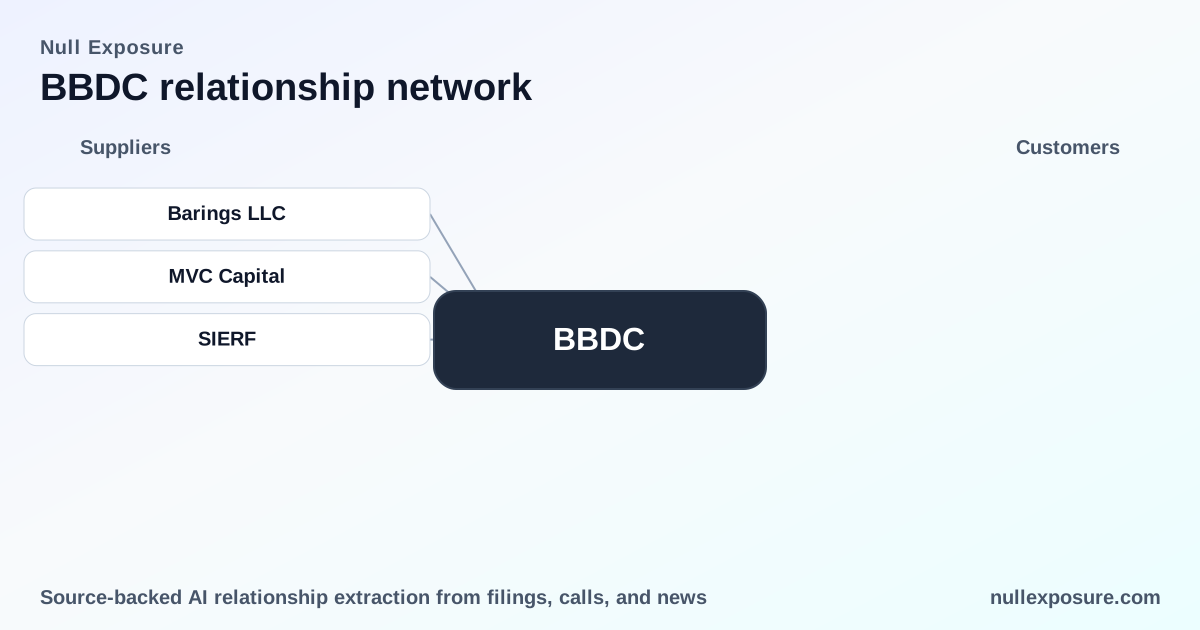
Barings BDC (BBDC): the supplier relationships that underwrite its yield story
Barings BDC is an externally managed, closed‑end business development company that monetizes through interest income, capital gains on private debt/equity positions, and an external management fee structure. The firm outsources investment sourcing, portfolio management and administration to Barings LLC and leverages credit facilities and credit‑support arrangements to scale middle‑market lending—generating distributable income that supports the company’s dividend policy and NAV profile. For a timely vendor‑and-counterparty view, see NullExposure’s analysis at https://nullexposure.com/.
The single most important supplier: Barings LLC — management, execution, and balance-sheet support
Barings LLC is the external investment adviser and administrator that runs Barings BDC’s day‑to‑day investment program and provides the employees and systems that deliver the company’s core operations. According to BBDC’s filings and multiple market summaries, Barings was appointed as investment adviser after management was externalized and continues to be the firm’s principal service provider (FY2026 10‑K coverage and related press). (Source: TradingView summary of BBDC 10‑K, FY2026; MarketBeat dividend and earnings alerts, Feb–Mar 2026.)
Barings’ role is contractual and material: the advisory and administration arrangements are annual, board‑approved agreements that renew subject to annual re‑approval, and they include fee schedules, income‑based incentives and historical credit support commitments tied to prior mergers and portfolio acquisitions. The advisory relationship is active and critical to operations—BBDC has no employees and relies on Barings’ personnel and IT systems to source, execute and monitor investments. Fee scale is material: the base management fee and income‑based incentive fees together represented tens of millions of dollars in 2024, and the adviser has provided explicit credit support facilities tied to prior mergers. (Source: BBDC advisory agreement disclosures and related market summaries, 2020–2026; PR Newswire merger releases.)
Key takeaway: Barings LLC is not an ancillary vendor — it is the operating engine for BBDC, with long‑term advisory mechanics, concentrated operational exposure and material fee flow that directly affects NAV and distributable earnings.
Legacy sellers and absorbed portfolios: MVC Capital
MVC Capital was a significant deal counterparty in BBDC’s earlier consolidation activity; BBDC completed an acquisition of MVC’s assets and amended advisory and credit support agreements aligned with that transaction. The post‑transaction arrangements included an amended advisory agreement effective January 1, 2021 and a MVC‑specific credit support agreement. (Source: PR Newswire release on MVC merger, Dec 2020; InsiderMonkey transcript references, Q4 2025.)
The Sierra transaction and its follow‑through
BBDC completed a merger with Sierra Income Corporation and retained Barings as the external manager for the combined company, with the transaction creating a larger combined portfolio and pro‑forma assets under management. The Sierra merger also generated a $100 million credit support commitment from the adviser to cover specified realized and unrealized losses on the acquired Sierra portfolio over a multi‑year period. (Source: PR Newswire merger release, Feb 2022; market summaries 2022–2026.)
How these relationships shape the operating model and investor exposure
The constraints and contract excerpts disclosed across filings reveal a clear operating model:
-
Contracting posture — long‑term but annually renewed: The advisory agreement is structured to continue annually with board approval, establishing an effectively multi‑year operating relationship but with periodic governance checkpoints. This arrangement creates predictability in service continuity and fee economics while preserving board oversight. (Company signal: advisory agreement renewal language, FY2024–FY2026 filings.)
-
Concentration and criticality: BBDC has no employees; the adviser supplies executive officers, investment teams and back‑office services, which makes the advisory relationship critical to operations and creates single‑provider concentration risk. The company explicitly depends on the adviser’s communications and information systems for its business. (Company signal: management and systems reliance excerpts.)
-
Maturity and activity: The relationship with Barings is active and operationally mature—Barings determines portfolio composition, executes investments, and administers day‑to‑day activity. This is not a passive, low‑touch vendor model but an integrated management arrangement. (Company signal: advisory agreement responsibilities.)
-
Scale and spend: Management fees and incentive fees are material—the base management fee was approximately $32.4 million and income‑based fees were $23.8 million for 2024—placing advisory fees in a multi‑million-dollar annual spend band and indicating material economics tied to Barings’ performance and portfolio outcomes. Borrowings under credit facilities are also substantial (hundreds of millions), and adviser credit support commitments tied to legacy acquisitions total in the tens to hundreds of millions. (Company signal: fee and credit support figures, FY2024 disclosures.)
-
Short‑term counterparty activity: BBDC also engages in short‑term contracts such as foreign currency forwards, evidencing routine treasury counterparties and hedging operations. (Company signal: foreign currency forward with BNP Paribas, Jan 2025 excerpt.)
Mid‑article resource: for a structured supplier and counterparty view linked to portfolio cash flows and governance, visit https://nullexposure.com/.
Investment implications: risk and upside in supplier structure
-
Upside: A seasoned, global manager like Barings brings distribution, deal flow and underwriting scale; Barings’ AUM and platform enable diversified deal sourcing, which supports BBDC’s ability to achieve the targeted yield profile and to manage credit cycles. (Source: Barings AUM disclosures in press and filings, FY2026 summaries.)
-
Primary risk: Operational concentration — BBDC’s reliance on a single external manager for personnel, IT, compliance and investment execution is a governance and operational risk that directly affects NAV stability if the adviser relationship were disrupted. The adviser’s fee economics also create a fixed cost burden that compresses distributable earnings in stressed markets.
-
Balance‑sheet considerations: Material borrowings under credit facilities and adviser credit‑support commitments linked to past mergers create contingent and explicit exposures that investors should model into downside scenarios. (Source: credit facility balances and credit support agreement excerpts, FY2023–FY2024 filings.)
Quick relationship summaries (one to two sentences each)
-
Barings LLC: Barings LLC is the external investment adviser and administrator that manages BBDC’s investment activities, supplies executive staff and administers back‑office services under an annually re‑approved advisory agreement; the relationship includes significant base and incentive fees as well as credit‑support arrangements tied to prior mergers. (Sources: BBDC 10‑K summaries on TradingView and MarketBeat alerts, PR Newswire merger coverage, FY2020–FY2026.)
-
MVC Capital: MVC Capital was the subject of a 2020 acquisition; following the transaction, BBDC entered amended advisory and MVC‑specific credit support agreements to integrate MVC’s legacy portfolio into BBDC’s book. (Source: PR Newswire release on the MVC merger, Dec 2020; InsiderMonkey Q4 2025 transcript references.)
-
Sierra: BBDC completed a merger with Sierra Income Corporation and retained Barings as manager for the combined business, with an adviser credit support agreement that provided up to $100 million of protections tied to the acquired Sierra portfolio. (Source: PR Newswire release on Sierra merger, Feb 2022; subsequent market coverage.)
Bottom line and next steps
Barings BDC’s yield proposition is inseparable from its supplier architecture: an active, high‑touch external manager, material fee economics, and significant balance‑sheet interdependencies. Investors evaluating BBDC should stress‑test scenarios around adviser continuity, fee pressure and credit‑support realizations, and monitor any governance actions tied to the annual advisory re‑approval cycle.
Explore NullExposure’s platform for deeper supplier and counterparty analytics: https://nullexposure.com/. If you want a tailored supplier risk brief for BBDC, request it through our homepage at https://nullexposure.com/ — our team will prioritize a governance and counterparty stress summary for portfolio review.