Banco Bradesco (BBDO) — Private-banking takeovers change the supplier landscape
Banco Bradesco S.A. operates as a universal bank in Brazil, monetizing across retail deposits, commercial lending, wealth-management fees, and insurance distribution through a large branch and agency network. The company generates core revenue from net interest margin and fee-based wealth management, and is actively growing higher-margin private-banking flows by acquiring client portfolios from international peers — a strategy that increases recurring fee income and cross-sell opportunities.
Learn more about supplier relationships and exposure mapping at NullExposure.
Why the recent private-client moves matter to investors
Bradesco’s recent deals to absorb private-client portfolios from international banks are strategically consistent: shift share from foreign wealth managers into Bradesco’s domestic franchise, boosting assets under management and fee income without the full cost of greenfield client acquisition. The bank’s valuation metrics support a capital-efficient growth play: trailing P/E ~7.9 and price-to-book ~1.01 on roughly $34.4 billion market capitalization (as provided in public company metadata). Those multiples price the stock as a value banking exposure with operational leverage to rising fee revenue.
The relationships: who Bradesco is buying clients from (and what that means)
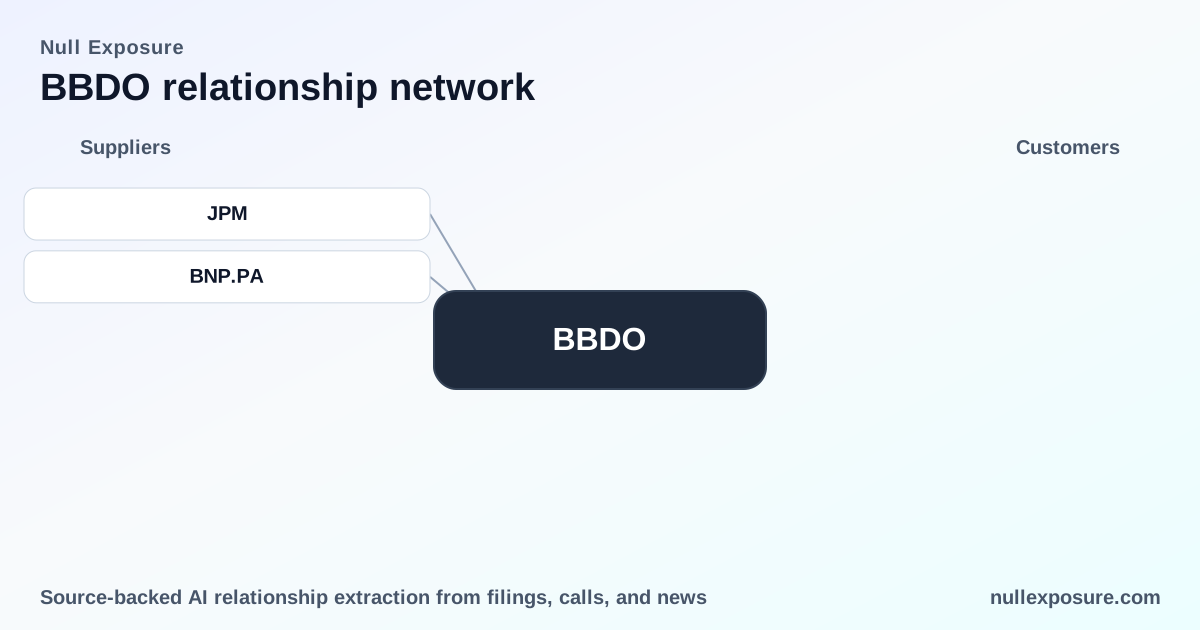
Bradesco’s publicized supplier relationships in recent coverage include two international private-banking peers. Each relationship below is summarized with the original reporting.
-
J.P. Morgan (JPM) — Bradesco reports it has captured “almost the entirety” of J.P. Morgan’s private-client book after a negotiated transfer, signaling successful conversion of a foreign bank’s local high-net-worth roster into Bradesco-managed relationships. (Reported by Extra Globo, March 9, 2026: https://extra.globo.com/economia-e-financas/bradesco-sela-acordo-para-absorver-15-bi-de-clientes-private-do-bnp-25531388.html)
-
BNP Paribas (BNP.PA) — Bradesco executed an agreement to absorb BNP Paribas’ private-client portfolio (clients with more than US$1 million in assets), expanding its high-net-worth base and fee-bearing assets under management. (Reported by Extra Globo, March 9, 2026: https://extra.globo.com/economia-e-financas/bradesco-sela-acordo-para-absorver-15-bi-de-clientes-private-do-bnp-25531388.html)
Key takeaway: both relationships are client-portfolio transfers rather than large-scale capital investments or equity partnerships; the outcome is incremental fee income and increased cross-sell potential into insurance and lending products.
How these supplier outcomes affect Bradesco’s operating model
These portfolio transfers reveal several company-level operating characteristics important to suppliers and investors:
-
Contracting posture — bilateral and acquisitive. Bradesco negotiates direct transfer agreements with foreign banks to acquire client lists and associated assets, indicating a preference for negotiated, deal-by-deal contracting rather than open competitive bids.
-
Concentration and diversification. The bank retains a broad domestic franchise (retail, commercial, insurance) while selectively concentrating higher-margin wealth-management flows via targeted acquisitions. This reduces customer-acquisition costs for HNW segments and increases dependency on successful integration.
-
Criticality to fintechs and service suppliers. For wealth-management technology, custodial providers, and advisors, Bradesco becomes a more critical counterparty as its private-banking AUM grows; suppliers integrated early stand to capture greater scale.
-
Maturity of relationships. These are mature commercial transfers: the counterparties are established global banks, and the deals transfer clientele with existing commerce patterns and revenue streams, reducing start-up risk but raising integration and retention execution requirements.
No explicit operational constraints were flagged in the reviewed records; the above are company-level signals derived from reported behavior and financial position.
Financial context you should weigh
Bradesco reports substantial revenue (Revenue TTM ~BRL 89.27 billion as provided) and a healthy profit margin (approximately 26.5%), with return on equity of ~13.8%. The stock trades on depressed multiples relative to growth prospects (trailing P/E ~7.9, forward P/E ~6.1), which creates a valuation cushion for investors who expect successful monetization of newly acquired private-client flows.
- Opportunity: Private-client transfers accelerate fee-income growth without proportional branch expansion, improving revenue per client and return on capital.
- Execution risk: Client retention post-transfer and systems/integration costs determine realized earnings; suppliers that enable seamless custody, reporting, and CRM migration are strategically valuable.
Explore how supplier concentration and client-migration risk affect portfolio exposure at NullExposure.
Supplier and investor risk checklist
Investors and suppliers should monitor three practical risks tied to these relationship movements:
-
Client retention: Transferred portfolios generate fees only if high-net-worth clients remain after migration; retention incentives and service continuity are decisive.
-
Integration costs: Operational, compliance, and IT migration expenses can depress near-term margins; suppliers offering proven, low-friction migration services reduce this risk.
-
Regulatory and reputational oversight: Transferring high-net-worth clients involves KYC, tax, and cross-border considerations that increase regulatory scrutiny; any lapses can be material to reputation and capital.
For suppliers, the relations position Bradesco as a strategic counterparty with growing scale in wealth management — contract terms should reflect client-retention milestones and data-security SLAs.
What investors should do next
- Monitor retention metrics and fee-income disclosure in upcoming quarters; early signs of above-target fee collection validate acquisition economics.
- Assess supplier exposure: custodians, CRM vendors, and compliance platforms that support Bradesco’s private-banking flows become higher-value partners.
- Revisit valuation: if fee growth proves sustainable, multiples should re-rate higher given Bradesco’s low 2026 forward P/E and solid ROE.
For a consolidated view of supplier relationships and exposure analytics, visit NullExposure and subscribe for tailored reporting.
Bottom line
Bradesco’s absorption of private-client portfolios from BNP Paribas and the effective capture of J.P. Morgan’s local private clients is a clear strategic push into higher-margin wealth management. This is a low-capex, high-returns approach to scale fee income that enhances Bradesco’s supplier importance and shifts where operational and regulatory risk sits. Investors should watch client retention, integration execution, and fee recognition closely; suppliers that enable low-friction transfers will be essential to realizing the value of these relationships.
Stay current on supplier dynamics and counterparty risk at NullExposure.