Beasley Broadcast Group (BBGI): supplier relationships and what they mean for investors
Beasley Broadcast Group runs a network of U.S. radio stations and monetizes through local and national advertising sales, strategic station acquisitions and swaps, and ancillary services such as digital and event advertising representation. Revenue is driven by spot advertising, retransmission/digital sales and the leverage of national rep arrangements, while capital allocation shows active asset transactions and conservatively managed property leases. For a tactical supplier-risk view and ongoing monitoring, visit https://nullexposure.com/ to see how these relationships map to BBGI’s operating profile.
Why suppliers matter for a broadcaster’s risk profile
Broadcasters are service-heavy businesses: lease commitments, third‑party sales representation, auditors, and brokers all influence both cost structure and strategic optionality. Supplier relationships for BBGI are operationally material because they affect cash outflows (leases and broker fees), revenue distribution channels (national rep firms), and reporting integrity (external auditor). Read more on supplier mapping at https://nullexposure.com/.
The relationship list: what the record shows
Below I cover every supplier and counterparty appearing in the available records and what each relationship signals for operators and investors.
-
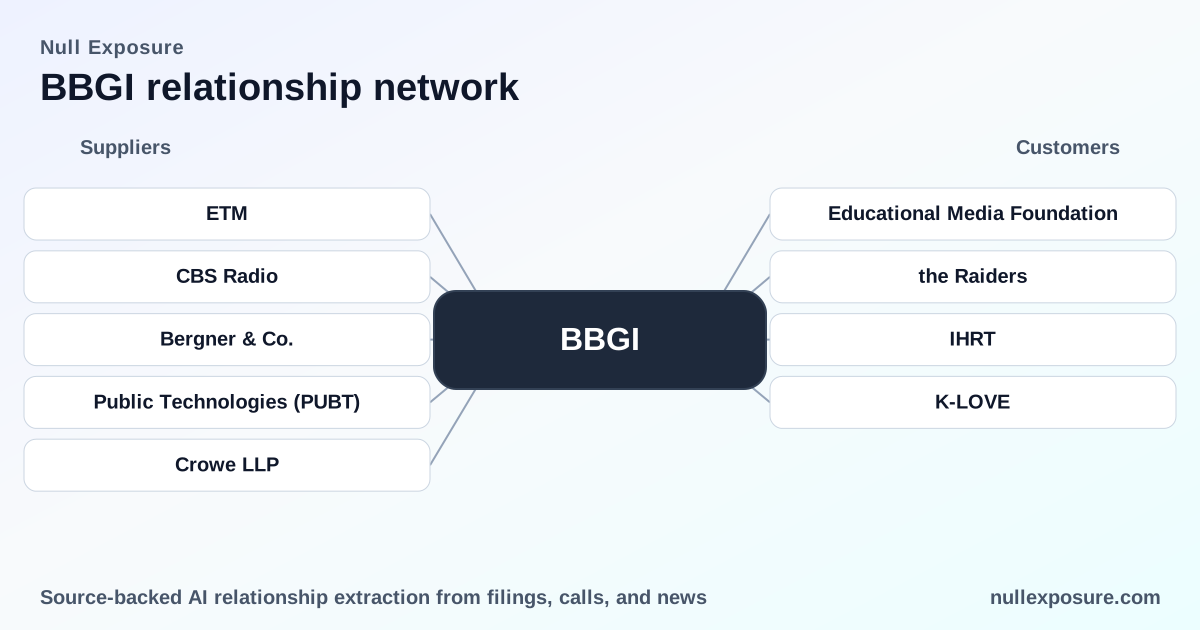
Entercom Communications Corp. — Beasley acquired WXTU-FM in Philadelphia from Entercom for $38.0 million in cash, a clear example of station-level M&A to recalibrate market footprints and revenue potential. Source: Beasley press release on bbgi.com (FY2018).
-
CBS Radio — Historical asset exchange activity is cited as the transaction that originally integrated WXTU-FM into Beasley’s portfolio, showing a precedent of strategic swaps rather than purely cash acquisitions. Source: Beasley press release on bbgi.com (referencing the 2014 exchange).
-
Bergner & Co. — A broker relationship surfaced in FY2025 where an $8 million transaction held a $400,000 deposit with a Beasley broker of record, Michael Bergner of Bergner & Co., showing reliance on external brokers for certain deal execution steps. Source: Radio & Television Business Report coverage (FY2025).
-
Public Technologies (PUBT) — Distribution services were used for press communications (a Marketscreener distribution on November 5, 2025), indicating third‑party dissemination platforms support Beasley’s investor and market communications. Source: MarketScreener distribution (Nov 5, 2025).
-
Crowe LLP — Shareholders ratified Crowe LLP as Beasley’s external auditor with strong support (99.1%), indicating stable auditor engagement and an explicit governance/legal service supplier in FY2026. Source: SEC/filing aggregation reported on StockTitan (FY2026).
What these relationships collectively tell investors
BBGI’s supplier map is operationally conventional but strategically active. The company executes market-level transactions (acquisitions and swaps), relies on brokers for deal flow execution, uses third‑party services for market communications, and retains an established external auditor.
-
Transactional posture: The Entercom and CBS Radio entries demonstrate that Beasley uses both cash purchases and asset exchanges to manage station portfolios—a mixed M&A playbook that supports geographic and format optimization.
-
Commercial distribution: The citation of a national representation firm (company-level disclosure) and use of Public Technologies for distribution highlight a dual revenue approach—local sales plus national rep channels—broadening advertiser reach and monetization levers.
-
Governance and control: Ratification of Crowe LLP as auditor is a stabilizing governance signal that supports financial reporting credibility.
For deeper monitoring of how these supplier relationships evolve alongside financials and contracts, visit https://nullexposure.com/.
Constraints and operating-model signals investors should absorb
Company-level disclosures include three supplier/contract constraints that shape operating flexibility:
-
Long-term contracting posture: the company has a lease that expires December 31, 2031, signaling multi-year fixed occupancy commitments that reduce short-term location flexibility but improve predictability of occupancy costs.
-
Buyer/lessee role: Beasley reports being the lessee of its principal executive offices with rental expense of approximately $0.3 million per year (reported for 2023 and 2024), indicating steady, modest fixed overhead tied to its corporate footprint.
-
Reliance on third‑party sales channels: Beasley retains a national representation firm to sell to advertisers outside local markets, which is a strategic outsourcing of national ad distribution that expands revenue reach but creates vendor concentration risk for national ad inventory monetization.
These constraints translate into a corporate profile that is operationally mature on facilities, outsourced on national sales, and transactional on station ownership—useful when modeling cash-flow sensitivity to rent and rep-fee fluctuations.
Investment implications and risk checklist
- Revenue diversification is real but limited: local ad sales remain core; national rep arrangements expand reach but introduce counterparty dependence.
- Asset-turnover is a lever: station acquisitions and swaps have been used to reweight markets—this drives upside but requires disciplined capital allocation.
- Fixed-cost stability: long-dated leases cap location risk but reduce tactical real-estate flexibility.
- Governance intact: ratification of Crowe LLP supports audit continuity and reporting reliability.
Investors should prioritize monitoring broker-dependent deals (e.g., deposits and escrow arrangements), national rep contract terms, and lease expirations as triggers that can affect margins and free cash flow.
Final takeaways and next steps
Beasley’s supplier ecosystem is predictable in structure and active in execution: long-term facility leases, external representation for national advertising, brokers for transaction execution, distribution platforms for communications, and an established auditor. Each relationship affects either costs, reach, or reporting integrity—core drivers for valuation-sensitive investors.
For a hands-on supplier-risk evaluation and continuous tracking of these counterparties, go to https://nullexposure.com/ and see supplier mappings and alerts tailored for investors and operators.
If you want a concise supplier risk memo or a watchlist based on these relationships, contact the team at NullExposure via https://nullexposure.com/ for a tailored briefing.