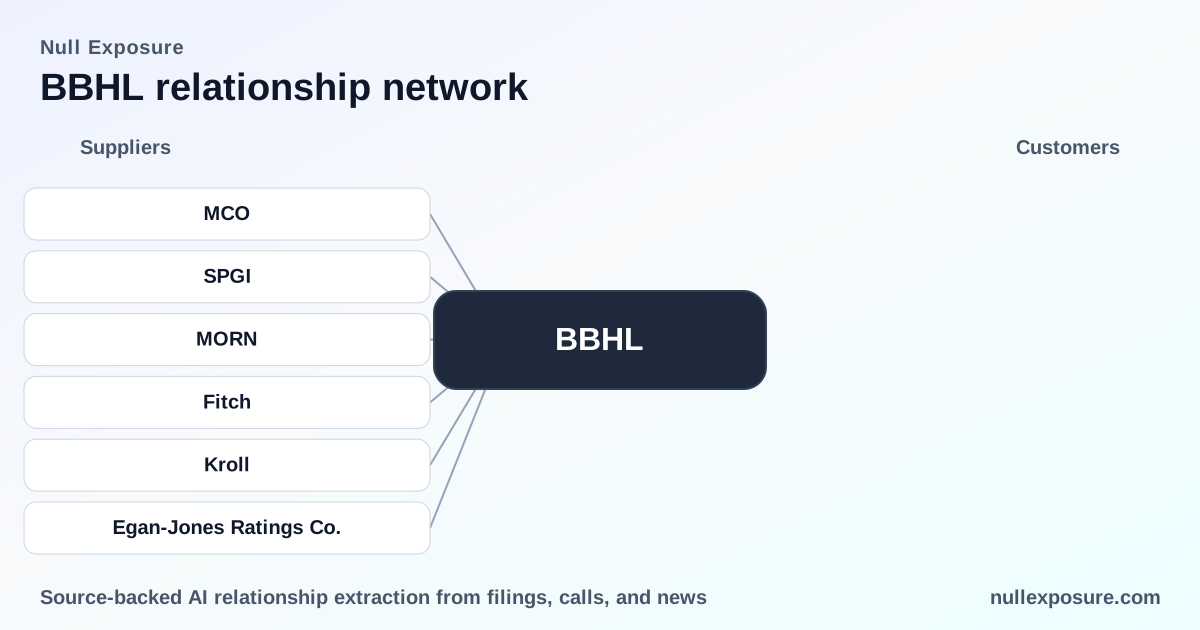
BBHL supplier landscape: how credit agencies fit into the investment operating model
BBHL operates as an investment manager and servicer that relies on external credit assessments to classify and communicate portfolio credit quality; the firm monetizes through asset management and related service fees while outsourcing rating inputs to established credit agencies to support investor disclosures and compliance. For investors and operations teams, the supplier relationships documented in BBHL materials are less about revenue share and more about governance, disclosure reliability, and downstream risk tolerance. Explore more background and supplier intelligence at https://nullexposure.com/.
Why BBHL leans on third-party credit ratings
BBHL’s public materials show the company uses external ratings as a primary mechanism to standardize credit quality across holdings. That approach reduces internal rating overhead but creates operational dependency on vendor outputs for reporting and risk buckets. According to BBH’s Q4 2025 fact sheet, the firm displays credit quality letters drawn from major agencies and selects the highest available rating when multiple agencies cover a security, while turning to secondary providers or private-credit ratings when coverage is absent. This is stated explicitly in the firm’s FY2025 fact sheet on bbh.com.
The specific relationships (plain English, one per vendor)
- Moody’s: BBHL includes Moody’s ratings among the primary sources used to produce credit quality letters and to determine the displayed credit for securities where multiple agency views exist. According to BBH’s Q4 2025 fact sheet, Moody’s is one of the agencies whose ratings are presented as the higher of available ratings for a security (FY2025, bbh.com).
- Standard and Poor’s: Standard & Poor’s ratings are treated symmetrically with other lead agencies; BBHL will present S&P ratings and use the highest available rating among the core providers when compiling credit quality letters. This usage is documented in BBH’s Q4 2025 institutional fact sheet (FY2025, bbh.com).
- Fitch: Fitch is listed alongside Moody’s and S&P as a primary rating source whose rating can determine the displayed credit quality for securities. BBH’s Q4 2025 fact sheet describes Fitch as part of the primary ratings trio used for investor-facing credit letters (FY2025, bbh.com).
- DBRS: When a security lacks coverage from the three primary agencies, BBHL will consider DBRS (and Kroll) as alternative public ratings to fill gaps in coverage. The Q4 2025 fact sheet on bbh.com cites DBRS as a secondary public-rating source for such cases (FY2025, bbh.com).
- Kroll: Kroll is grouped with DBRS as an alternative public rating provider BBHL may use when Standard & Poor’s, Moody’s, and Fitch do not rate a security, as noted in the firm’s Q4 2025 institutional fact sheet (FY2025, bbh.com).
- Egan-Jones Ratings Co.: For securities without a public rating, BBHL will display private-credit ratings if contractually permitted by the issuer; Egan-Jones is explicitly called out as a possible private-rating source. This allowance is described in BBH’s Q4 2025 fact sheet and reflects the firm’s handling of privately rated instruments (FY2025, bbh.com).
What this vendor mix tells investors about BBHL’s operating model
BBHL’s reliance on a small set of legacy public rating agencies plus selective secondary and private providers signals a deliberate operating posture:
- Contracting posture: BBHL outsources credit assessment for public disclosure rather than maintaining a broad internal ratings engine; this reduces fixed overhead but creates dependency on contract terms and vendor availability.
- Concentration: Core reliance on Moody’s, S&P, and Fitch concentrates operational risk around the Big Three; fallback arrangements with DBRS, Kroll, and private ratings mitigate coverage gaps but do not eliminate vendor concentration for public ratings.
- Criticality: Ratings are operationally critical for reporting and positioning products to institutional clients; any change in vendor coverage standards, licensing, or data delivery could materially affect BBHL’s disclosures and client communications.
- Maturity and governance: The mix of long-established agencies and conditional private-rating acceptance reflects a mature disclosure approach that balances regulatory-recognized credentials (Big Three) with pragmatic solutions for unrated instruments.
These are company-level signals derived from BBH’s public fact sheet rather than relationship-specific contract excerpts.
Operational and investment risks to monitor
BBHL’s supplier footprint creates a concentrated set of risk levers for investors and operations teams to watch:
- Rating coverage shocks: Withdrawals of coverage by a primary agency or changes in rating methodology could force rapid reclassification of portfolio holdings.
- Operational dependency: Vendor outages, licensing disputes, or data-delivery failures would impair BBHL’s ability to generate timely client reporting.
- Private-rating diversity: Acceptance of private ratings (e.g., Egan-Jones) improves coverage but introduces heterogeneity in rating standards that influences comparability across portfolios.
Actionable monitoring priorities include contractual SLAs for data delivery, documented fallback procedures when primary ratings are unavailable, and a formal policy to reconcile private-credit ratings against public benchmarks.
If you want a structured vendor-risk checklist tied to BBHL’s disclosures, review our supplier intelligence hub at https://nullexposure.com/.
Practical recommendations for investors and operators
- Require evidence of service-level commitments from BBHL for rating data feeds and a traceable audit trail showing which vendor produced each displayed credit letter.
- Insist on transparency around the ‘highest rating’ rule: review how BBHL selects which agency’s rating to display when multiple agencies cover a security and how that selection affects portfolio-level risk metrics.
- Validate the governance and due diligence applied to private-credit ratings before accepting those ratings for compliance, valuation, or risk-bucket purposes.
These steps turn vendor disclosures into operational controls that protect portfolio integrity and investor reporting.
Final read: what matters most and next steps
BBHL’s supplier list in the FY2025 fact sheet demonstrates a clear, conventional credit-rating strategy: use the Big Three (Moody’s, S&P, Fitch) as primary sources, fall back to DBRS and Kroll when needed, and permit private ratings such as Egan-Jones with issuer permission. The core takeaway for investors is that BBHL outsources a key element of credit assessment, concentrating dependence on a small group of major vendors while adopting pragmatic fallbacks for unrated instruments. For deeper supplier analysis and tailored operational due diligence, visit https://nullexposure.com/.