BridgeBio Pharma (BBIO): supplier relationships and what they mean for investors
BridgeBio develops and supplies therapeutics for genetic diseases and monetizes through product commercialization, strategic supply contracts with larger pharmas, and licensing/partnering arrangements that convert development-stage assets into near-term revenue streams. The company's supplier posture is integration-light: clinical and commercial manufacturing is outsourced to third parties while BridgeBio captures value through product sales and partner supply agreements, most notably a manufacturing-and-supply arrangement tied to Bayer. For a concise view of supplier risk and counterparty exposure, see https://nullexposure.com/.
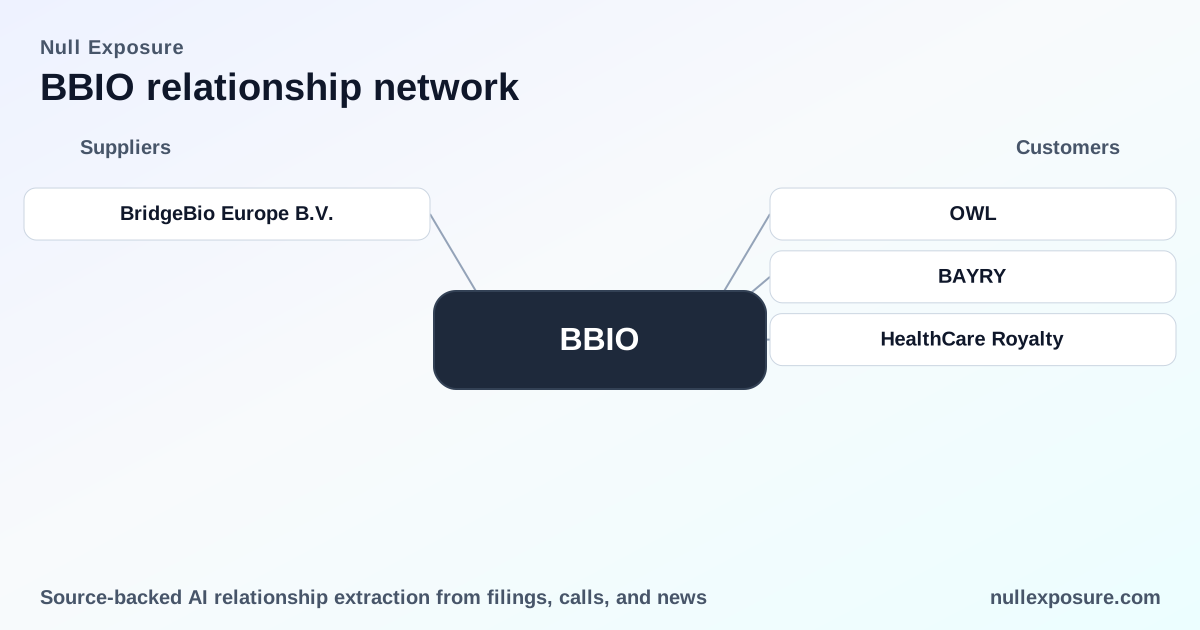
The headline relationship: Bayer supply through BridgeBio Europe B.V.
BridgeBio Europe B.V. entered a Bayer Supply Agreement with an initial 30-month term ending December 2026 under which BridgeBio B.V. will manufacture and supply product to Bayer. According to BridgeBio’s FY2024 Form 10‑K, the agreement establishes an explicit short‑term commercial supply commitment that drives near-term revenue recognition tied to product shipments. The 10‑K also notes that BridgeBio has contracted a German third‑party CMO to manufacture and package the final drug product Beyonttra to support obligations under the Bayer Supply Agreement, signaling operational reliance on an EMEA-based manufacturing partner.
Takeaway: this is a revenue‑bearing commercial supply deal with a major pharma counterparty, but it carries near‑term renewal and execution risk because the initial term expires in December 2026 and production is dependent on an external CMO in Germany.
A concise list of supplier relationships (all items from the public filing)
- BridgeBio Europe B.V. — BridgeBio B.V. signed a Bayer Supply Agreement with an initial 30‑month term ending December 2026 to manufacture and supply product to Bayer. Source: BridgeBio FY2024 Form 10‑K (filed for period ending 2024).
This single explicit relationship in the company’s supplier disclosures is accompanied by broader manufacturing and services commitments discussed elsewhere in the filing; those are summarized in the next section. If you want a structured supplier risk briefing, visit https://nullexposure.com/ for further analysis.
How supplier constraints shape the operating model
BridgeBio’s public disclosures paint a clear operating profile: the company outsources nearly all manufacturing and relies on external development and manufacturing services to move assets from clinic to market. Several company‑level signals are material for investors:
- Geographic concentration in EMEA for commercial manufacturing: BridgeBio explicitly contracted a German CMO to support the Bayer Supply Agreement and conducts clinical work outside the U.S., indicating a meaningful EMEA footprint for manufacturing and trials. Source: FY2024 Form 10‑K.
- High supplier concentration for critical components: BridgeBio states that drug substance and drug product for certain candidates are manufactured by single‑source suppliers or CMOs. The company classifies this dependency as material because switching suppliers could cause significant development or commercialization delay. Source: FY2024 Form 10‑K.
- Outsourced manufacturer role is primary: The firm “relies entirely on third parties” for manufacturing Attruby, Beyonttra and its product candidates, using CMOs for raw materials, drug substance, drug product and packaging. This is a durable contracting posture focused on vendor reliance rather than in‑house scale. Source: FY2024 Form 10‑K.
- Service provider relationships extend to integrated DMSAs: In September 2023 BridgeBio Gene Therapy, LLC and Adrenas entered Development and Manufacturing Services Agreements and related project agreements with Resilience US, Inc. for development, manufacturing, testing and related services for gene therapy candidates BBP‑812 and BBP‑631, indicating reliance on large integrated CDMOs for advanced programs. Source: FY2024 Form 10‑K.
Operational implication: BridgeBio’s model converts development risk into counterparty and execution risk — sales hinge on the company’s ability to manage outsourced manufacturing and to preserve continuity with single‑source CMOs during the transition from clinical to commercial volumes.
What investors should focus on next
- Contract tenor and renewal risk: The Bayer Supply Agreement’s initial 30‑month term creates a near‑term inflection around December 2026 when pricing, quantities and renewal terms will materially affect revenue visibility.
- Concentration and contingency planning: Single‑source dependencies are material; investors should ask for evidence of qualified backups, tech‑transfer plans, and inventory hedging to assess downside from supplier interruption.
- Regulatory and quality execution: Outsourced manufacturing magnifies regulatory inspection and release timelines; quality holds at a CMO can delay shipments and revenue recognition.
- Strategic upside from partners: Supply agreements with a counterparty like Bayer and platform agreements with Resilience position BridgeBio to scale product sales without large capital outlays, preserving cash for R&D — a structural benefit if manufacturing execution is consistent.
BridgeBio’s public metrics support the strategic view: trailing revenue is meaningful relative to a development‑heavy biotech, and market valuation reflects expectations of future product sales. For a tailored supplier exposure report, visit https://nullexposure.com/ and request the BridgeBio supplier dossier.
Bottom line: risk balanced by structurally valuable partnerships
BridgeBio converts R&D into commercial sales largely through outsourced manufacturing and selective supply agreements that offload capital intensity but concentrate operational risk. The Bayer Supply Agreement is the clearest near‑term commercial lever, supported by an EMEA CMO, while company disclosures about single‑source suppliers and Resilience service agreements highlight concentration and outsourced execution as defining features of the operating model.
For counterparties and institutional investors, the core diligence priorities are contract longevity, backup manufacturing readiness, and demonstrated CMO quality controls. BridgeBio’s approach is strategically efficient — it monetizes therapeutic assets with low fixed manufacturing investment — but execution will determine whether the company realizes the revenue potential embedded in its partner contracts.
Explore supplier risk visualizations and request briefings at https://nullexposure.com/ to translate these disclosures into actionable counterparty exposure and operational risk insight.