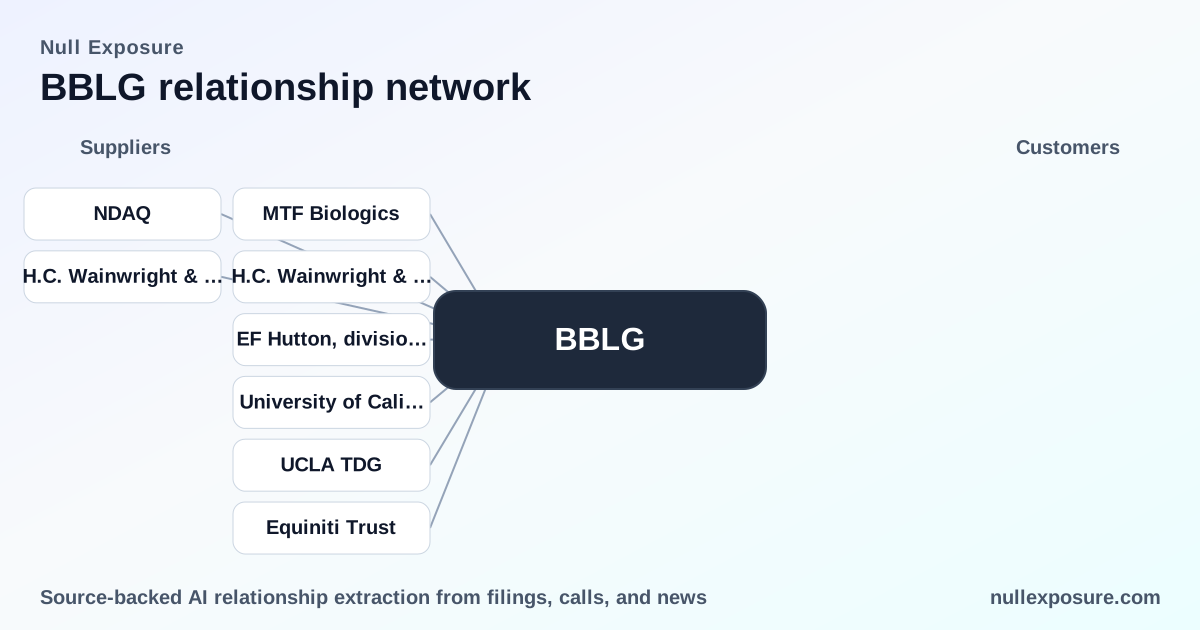
Bone Biologics (BBLG) — supplier relationship map and operational implications
Bone Biologics develops and commercializes NELL‑1 for bone regeneration in spinal fusion and adjacent indications, monetizing through proprietary licensing of the NELL‑1 protein, clinical advancement of an NB1 bone graft product matched with third‑party DBM components, and episodic capital raises to fund development. Revenue is currently nominal and the business model is dependent on licensed IP, external manufacturing and clinical services, and recurring capital markets activity to sustain operations. For a structured view of counterparties and supplier risk, see more at https://nullexposure.com/.
Executive read: how BBLG runs the program and where value is created
Bone Biologics operates as a clinical‑stage, IP‑centric medtech company. Core value is the exclusive NELL‑1 license from UCLA, which underpins product exclusivity; productization relies on demineralized bone matrix (DBM) components sourced from third parties; and program execution depends on contract manufacturers and CROs for trials and production. The funding engine is equity and registered offerings coordinated by placement agents and underwriters. Given 2024–2025 disclosures, this is a low‑revenue, high‑dependency model where supplier relationships are operationally critical and capital relationships are strategically material. If you evaluate BBLG as a counterparty or invest alongside suppliers, focus on IP terms, manufacturing redundancy, and liquidity corridors.
Visit https://nullexposure.com/ for deeper supplier intelligence and to track counterparties across the lifecycle.
How the operating model shapes supplier risk
Bone Biologics demonstrates a classic small‑cap clinical playbook:
- Contracting posture: Heavy reliance on licensing and third‑party manufacturing / CRO agreements rather than internal scale. This creates a supplier‑centric execution risk where service providers and IP licensors carry outsized influence on timing and pathway to commercialization.
- Concentration: Licensing fees to UCLA and a defined relationship with a single DBM provider (MTF) indicate moderate counterparty concentration on critical inputs.
- Criticality: The licensed NELL‑1 technology and the DBM convenience kit are central to product claims; any disruption to those agreements or to CMO supply chains would materially impair development timelines.
- Maturity: Active pilot clinical activity in 2024 shows the program is early but live; procurement spend is small in absolute terms (sub‑$1m annual payments disclosed), consistent with early‑stage development but significant relative to company resources.
Key takeaway: the company’s clinical and manufacturing progress is supplier‑dependent; counterparties carry operational leverage and any diligence should prioritize license covenants, manufacturing quality controls, and capital provider terms.
Supplier and capital relationships — what you need to know
Below I cover every relationship flagged in public disclosures and filings. Each entry is a concise, plain‑English summary with a source note.
MTF Biologics
Bone Biologics uses demineralized bone matrix (DBM) from MTF Biologics as the matrix component in its NB1 convenience kit for spinal fusion; DBM Putty from MTF is FDA‑cleared for spine indications and is integral to the product configuration. According to the company’s FY2024 10‑K, the firm is focused on lumbar fusion using NELL‑1 in combination with DBM from MTF Biologics (FY2024 10‑K filing).
H.C. Wainwright & Co.
H.C. Wainwright has served repeatedly as exclusive placement agent and ATM program manager, handling registered and at‑the‑market equity issuance and earning defined commissions on gross proceeds; the company raised approximately $1.1 million net in 2024 via an ATM with Wainwright. Multiple 2025–2026 press reports and the company’s FY2025 disclosures identify H.C. Wainwright’s placement role (news reports in 2026; FY2025 company reporting).
EF Hutton, division of Benchmark Investments, LLC
EF Hutton acted as the sole book‑running manager for a $5.0 million underwritten public offering reported in news coverage, positioning the firm as an underwriting counterparty on that capital raise. A March 2026 news release referenced EF Hutton’s book‑running role for the offering (financial news reporting, March 2026).
University of California, Los Angeles (UCLA) / UCLA Technology Development Group (UCLA TDG)
Bone Biologics holds an exclusive worldwide license to NELL‑1 from UCLA TDG, which is the foundational IP for its product program; license payments are modest but ongoing. The company’s Amended and Restated Exclusive License Agreement with UCLA TDG (effective April 9, 2019) is documented in SEC filings, and PR Newswire and company SEC commentary note the exclusive licensing relationship (PR Newswire 2014; FY2025 10‑K commentary).
Equiniti Trust
Equiniti Trust is the company’s transfer agent for share ownership communications, notably handling notices after corporate actions such as the 1‑for‑30 reverse stock split; this role was referenced in company announcements regarding the split (citybiz article covering FY2023 corporate action).
Nasdaq
Bone Biologics’ common stock and warrants trade on Nasdaq under symbols BBLG and BBLGW, and the company maintains its listing relationship with Nasdaq for market access and reporting compliance (citybiz coverage of FY2023 corporate actions; Nasdaq listing references).
H.C. Wainwright & Co., LLC (ATM agreement)
Separately from placement activity, the ATM agreement with H.C. Wainwright, executed in September 2024, establishes an ongoing channel to raise equity via sales under the ATM, with a 3.0% commission on gross sales; this is disclosed in FY2025 company filings and trading commentary (FY2025 trading reports and company filings).
Company‑level constraints and what they imply for countersigning partners
Public disclosures and constraint signals provide actionable operating insights:
- Licensing and licensor relationship are explicit and core. The Amended and Restated Exclusive License Agreement with UCLA TDG is central to product exclusivity and commercialization rights (company license agreement, effective April 2019).
- Supplier spend is modest but contractually committed. Payments to UCLA were $129,867 in 2024 and $30,845 in 2023, with an estimated remaining commitment of approximately $370,991 as of December 31, 2024; these figures indicate predictable, single‑digit hundreds‑of‑thousands spend on IP obligations.
- Manufacturing and service provider model is standard for early clinical programs. The company uses CMOs, CROs and third parties for manufacturing and clinical work, and requires security and compliance assurances from service providers; this forms the backbone of operational delivery.
- Relationship stage is active. Treatment of the first patients in a multicenter randomized pilot clinical study in 2024 confirms live, operational supplier engagements.
These signals translate into practical diligence checkpoints for partners: confirm license term covenants, assess single‑source manufacturing exposure, require visibility into CMO quality systems, and ensure capital‑provider terms do not impose restrictive covenants that could interfere with supplier payments.
For ongoing tracking of these counterparties and their contractual footprints, explore comprehensive supplier profiles at https://nullexposure.com/.
Investment and operational conclusion — what matters now
Bone Biologics is a small‑cap, IP‑led clinical business whose operational progress is tightly coupled to a small set of suppliers and capital partners. For investors, underwriters and supplier partners, the priority checklist is straightforward: validate the UCLA license scope and obligations, confirm manufacturing redundancy and quality controls around DBM and CMOs, and monitor capital markets activity given the company’s reliance on placement agents and ATM offerings.
For enterprise teams assessing supplier risk or for investors modeling pathway timing, the most immediate levers are license stability, CMO/CRO performance, and near‑term financing capacity. Track these vectors and review counterparties on NullExposure to reduce execution risk: https://nullexposure.com/.