Beta Bionics (BBNX) — supplier relationships that determine manufacturing rhythm and risk
Beta Bionics sells the iLet automated insulin delivery system and monetizes through device and consumable sales while absorbing recurring cost obligations under a control-algorithm license; its operating economics depend on a narrow set of contract manufacturing and component suppliers that enable product delivery and recurring consumable replacement. For investors and operators, the supplier story is a balance of commercial traction and concentrated counterparty risk: sales are growing but production is tied to a handful of named partners whose contracts and single-site footprints drive near-term operational leverage. Explore more supplier intelligence at https://nullexposure.com/.
How Beta Bionics sources components and what that means for supply continuity
Beta Bionics operates a hybrid sourcing posture: a small number of framework or supply agreements for critical consumables coexist with purchase-order sourcing for many components. The company’s 2024 disclosures make this duality explicit — it maintains formal agreements for key elements of the iLet while continuing to purchase many parts on a spot or PO basis. That structure reduces fixed overhead but concentrates execution risk with a few specialists.
- Contracting posture: the company holds framework-style supply agreements for core consumables and also relies on purchase orders for numerous components, creating variability in lead times and supplier negotiation leverage. The 10‑K states that Beta Bionics does not have long-term agreements for most components and often buys on a purchase-order basis.
- Concentration and criticality: several components are single-sourced, and management warns that loss of one supplier could cause significant production delays and revenue impact. The filing names specific suppliers for infusion sets, cartridge connectors and pump motors as the sole sources for those items.
- Geographic footprint and maturity: suppliers operate in multiple regions including Switzerland, Mexico, China and Taiwan, exposing Beta Bionics to cross-border logistics and geopolitical risk while the company itself is a commercial-stage manufacturer with an extended lease position (management expects to extend a manufacturing lease through 2032).
- Spend and cost profile: disclosed royalties under the control-algorithm agreement are a recurring line in cost of sales (Beta Bionics recorded $2.2 million of royalties in 2024), and clinical supply purchases for trial phases have been material at the mid-six-figure level (about $0.9 million ordered and a corresponding deposit recognized for Phase 2 clinical material).
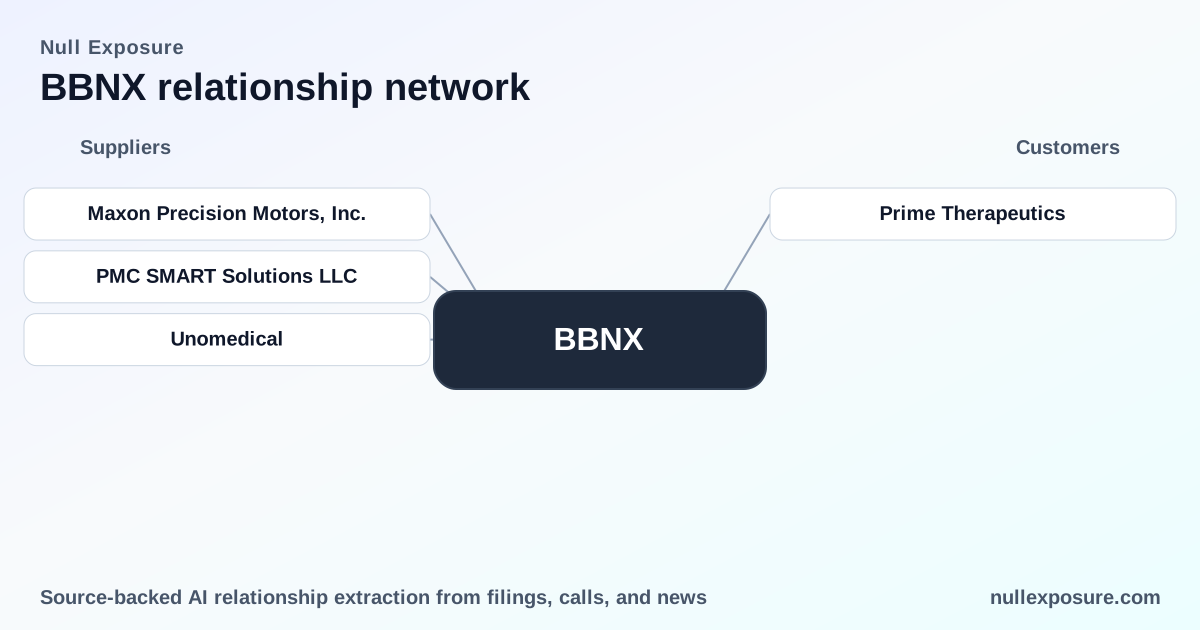
Supplier map: the three named partners you should know
Maxon Precision Motors, Inc.
Beta Bionics has a supplier quality agreement with Maxon for pump motors that power the iLet, making Maxon the designated source for that motion-critical component. According to Beta Bionics’ FY2024 Form 10‑K, Maxon is the contracted supplier of pump motors for the iLet (FY2024 10‑K disclosure).
PMC SMART Solutions LLC
PMC is the contract manufacturer of the cartridge connectors used in the iLet, meaning connector assembly and readiness for final integration are routed through PMC under a manufacturing agreement. The company’s FY2024 10‑K identifies a contract manufacturing agreement with PMC SMART Solutions LLC for cartridge connectors (FY2024 10‑K disclosure).
Unomedical (affiliate of ConvaTec Group Plc)
Beta Bionics maintains a supply agreement with Unomedical for infusion sets — the consumable that patients replace periodically — and the filing notes Unomedical is an affiliate of ConvaTec Group Plc. The FY2024 10‑K states the company has a supply agreement with Unomedical for infusion sets for the iLet (FY2024 10‑K disclosure).
What the named relationships imply for operations and risk
Each of the three named suppliers is integral to a specific, production-critical element of the product: pumps, connectors, and infusion sets. Management explicitly warns that Unomedical, PMC and Maxon are the only suppliers of infusion sets, cartridge connections and pump motors, respectively, and that termination or incapacity at any of those suppliers would force Beta Bionics to qualify alternatives — a process that would cause material production delay (company disclosure in FY2024 10‑K). That makes the counterparty set both functionally specialized and operationally critical.
Company-level signals add texture to that risk profile:
- Long-term vs spot mix: while some suppliers operate under supply agreements, many components remain purchased on a PO basis, which keeps flexibility but limits advance capacity commitments.
- Geographic dispersion: suppliers are located across Switzerland, Mexico, China and Taiwan, which lowers single-country exposure but raises logistics and regulatory complexity.
- Contract maturity and obligations: Beta Bionics carries a long-term lease posture for its manufacturing footprint through 2032, and continues to service royalty obligations under a decades-spanning control algorithm license that affects gross margins (royalty expense recorded in 2024).
Learn more about supplier concentration and counterparty risk at https://nullexposure.com/.
Investment implications — what to watch and when to act
- Concentration is the primary operational risk. The business will scale revenue efficiently if supply holds, but a failure at one of the three named partners would create immediate production pressure and likely revenue disruption.
- Margin sensitivity includes built-in royalty drag. Royalty payments under the Control Algorithm Agreement are a recurring cost of goods sold; the company recorded $2.2 million in royalty expense in 2024, which should be modeled as a fixed gross-margin pressure as revenue scales.
- Sourcing flexibility is limited today but fixable. The reliance on purchase orders for many components gives Beta Bionics procurement agility but creates the need for supplier qualification programs; investor focus should be on management’s progress in dual-sourcing and inventory strategies.
- Operational maturity indicators to track: progress on qualifying secondary suppliers for pump motors, cartridge connectors and infusion sets; timeline and costs to transfer production if needed; and any contractual changes with Unomedical, PMC or Maxon disclosed in subsequent filings.
Actionable recommendations for investors and operators
- For due diligence: request supplier continuity plans and qualification timetables for each named supplier; confirm inventory buffers and lead times for the three critical components.
- For portfolio managers: model a sensitivity case where one critical supplier experiences a 3–6 month outage and quantify revenue and margin impact.
- For operators and procurement teams: prioritize dual-sourcing for pump motors, cartridge connectors, and infusion sets and negotiate backup capacity clauses into existing agreements.
For a deeper supplier-risk view and ongoing monitoring, visit https://nullexposure.com/.
Beta Bionics is a commercial-stage company demonstrating product-market traction, but its path to predictable production and margin expansion runs directly through a small set of supplier contracts. Investors should reward demonstrated diversification and supplier resiliency; until then, the company’s concentrated supplier footprint is a primary operational watchpoint.