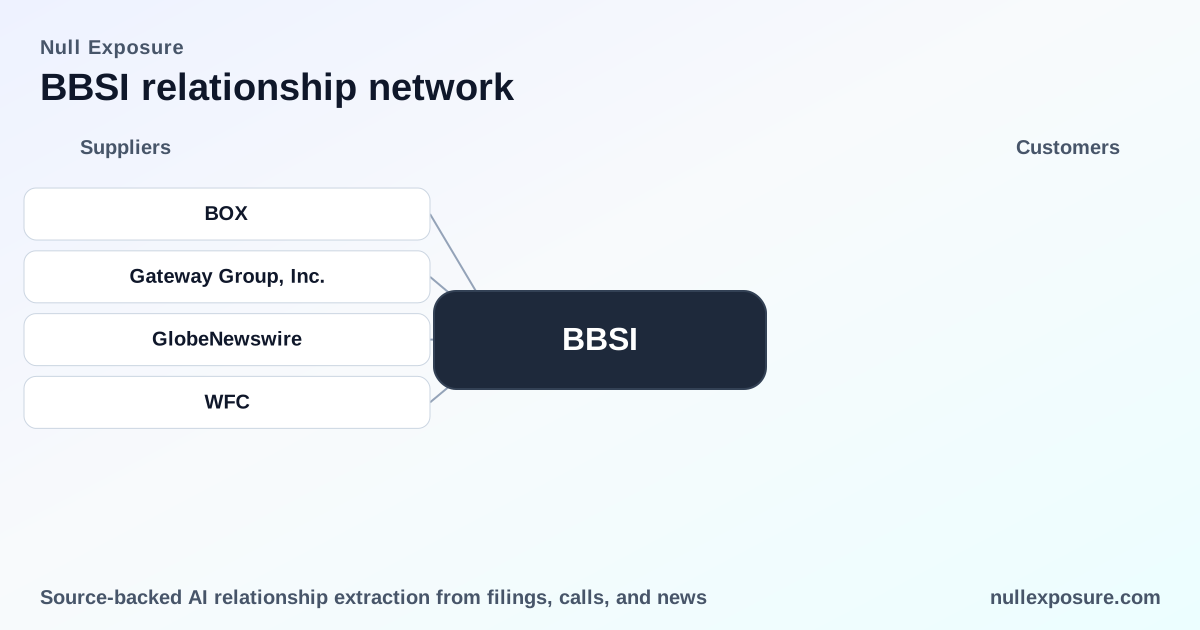
Barrett Business Services (BBSI) — Supplier relationships investors should track
Barrett Business Services (BBSI) operates as a professional employer organization (PEO) and staffing/HR outsourcing provider to U.S. small and mid‑sized businesses, monetizing through a combination of client service fees, payroll and benefits administration margins, and value‑added HR technology modules. BBSI’s economics derive from recurring payroll/PEO flows, embedded insurance arrangements, and incremental revenue from technology-enabled client services — a mix that ties operating leverage to both client retention and third‑party supplier economics. For investors evaluating counterparty and operational risk, the company’s supplier set shows a mix of strategic technology partners, communications/IR vendors, and banking counterparties that collectively influence growth, margin and disclosure reliability. Learn more on the firm’s supplier footprint at https://nullexposure.com/.
Snapshot: why suppliers matter to a PEO model
BBSI’s model depends on three supplier categories: technology partners that host and secure client data and HR workflows; insurance carriers that underwrite benefit programs; and banking/credit providers that fund operations and seasonal payroll cycles. Each supplier class affects a different risk vector — product stickiness for clients, benefit cost pass‑through and regulatory compliance, and short‑term liquidity/capital structure respectively. BBSI reported roughly $1.24 billion in trailing revenue and a market capitalization near $708 million, which makes supplier selection material to margin stability and growth scalability.
Operating posture and company-level signals
BBSI positions itself as the sponsor and administrator of PEO benefit programs and contracts with third‑party insurance carriers to enter into fully‑insured arrangements for medical, dental, vision and ancillary benefits. This disclosure frames BBSI’s contracting posture as a buyer in benefits relationships, with the company procuring insurance capacity from carriers rather than self‑insuring those lines. That posture implies:
- Moderate supplier concentration risk where a few large carriers can influence pricing and plan availability.
- High criticality of benefits suppliers for client retention, because benefits offerings are central to the PEO value proposition.
- Mature contracting practices typical of long‑standing PEOs that rely on standardized fully‑insured arrangements rather than bespoke captive programs.
These are company‑level signals drawn from BBSI’s benefits administration disclosure rather than a single vendor document.
Supplier relationships that matter (clear, direct summaries)
-
Box — BBSI launched an Employee File Cabinet HRIS module built in collaboration with Box to provide a secure, centralized repository for employee documents inside the BBSI Client Portal. This integration is positioned to improve compliance and client UX by leveraging Box’s content‑management and security capabilities, and was announced in a GlobeNewswire release on January 5, 2026 and reiterated across investor coverage in March 2026. (Source: GlobeNewswire, 2026‑01‑05; press mentions March 2026.)
-
Gateway Group, Inc. — Gateway Group is listed repeatedly as BBSI’s investor relations contact on press releases and earnings notices, serving as the company’s external IR/communications agent across FY2025–FY2026 disclosures. This relationship standardizes how BBSI routes earnings, branch openings and conference‑call logistics to the market. (Source: GlobeNewswire press releases and related distribution in FY2025–FY2026.)
-
GlobeNewswire — BBSI uses GlobeNewswire as a primary press distribution channel for corporate announcements including branch openings and product launches, ensuring broad, time‑stamped dissemination of material news to investors and media. Multiple press releases across FY2025–FY2026 were released via GlobeNewswire. (Source: GlobeNewswire distribution, FY2025–FY2026.)
-
Wells Fargo Bank, National Association — Wells Fargo is documented as the principal bank and credit facility counterparty, with public references to amendments to BBSI’s credit facility, signaling an ongoing bank financing relationship that supports working capital and potential covenant oversight. Market coverage referenced these credit‑facility amendments in FY2026. (Source: MarketScreener summary referencing credit facility amendments, FY2026.)
What each relationship implies for investors
BBSI’s Box partnership upgrades the company’s client portal capabilities, creating a clearer product differentiation for HR documentation and compliance — a direct route to higher client retention and potential upsell of HRIS modules. The reliance on Box for content management introduces a technology dependency, but also lowers the time‑to‑market and security burden for BBSI as it scales digital services. (Source: GlobeNewswire, January 2026.)
The use of Gateway Group and GlobeNewswire reflects disciplined investor communications and standardized press distribution; that improves transparency and reduces the probability of missed or delayed disclosures, which is relevant for market‑sensitive events like quarterly results or new product launches. (Source: Multiple press releases FY2025–FY2026.)
The Wells Fargo relationship demonstrates that BBSI maintains traditional banking lines to fund operations and payroll cycles; amendments to the credit facility suggest active balance‑sheet management and potential covenant negotiation. For fixed‑income‑sensitive investors, bank counterparty dynamics and covenant terms are a material operating consideration. (Source: MarketScreener FY2026.)
Risk profile and concentration assessment
- Supplier concentration: BBSI’s model creates natural concentration around a small number of carriers for benefits and a few platform partners for HR technology; a handful of suppliers can materially affect cost of goods sold and service delivery.
- Operational criticality: Benefits carriers and payroll banks rate as high‑criticality suppliers because interruptions or adverse contract re‑pricing would directly impact margins and client retention.
- Maturity and contracting: The company exhibits mature contracting behavior — standard fully‑insured arrangements and bank credit facilities — which reduces bespoke risk but leaves BBSI exposed to market insurance pricing cycles and interest rate dynamics.
The company’s disclosure that it acts as sponsor and administrator of PEO benefit programs and engages third‑party carriers is a direct company‑level signal defining its buyer posture in those supplier negotiations. (Source: BBSI benefit program disclosures, FY2025–FY2026.)
Actionable takeaways for investors and operators
- Technology partnership with Box is a strategic enrichment, not a peripheral integration; track uptake metrics and potential pricing of the Employee File Cabinet module for margin impact. (Source: GlobeNewswire January 2026.)
- Monitor credit‑facility terms with Wells Fargo for covenant risk and revolver availability, especially as payroll and seasonal working capital needs fluctuate. (Source: MarketScreener FY2026.)
- Supplier concentration on insurance carriers requires active hedging through contract diversification or negotiated rate floors; BBSI’s buyer posture gives negotiating leverage but does not eliminate industry‑wide pricing cycles. (Source: company benefits administration disclosure.)
If you want a supplier‑level risk matrix or a deeper mapping of BBSI’s counterparty exposures, visit https://nullexposure.com/ for a structured supplier report.
Bottom line
BBSI’s supplier set is coherent with a scaled PEO: tech partners deliver client‑facing functionality, IR/distribution partners manage market communication, and banking/insurance firms underpin liquidity and benefits delivery. Investors should prioritize monitoring adoption of Box‑backed HR modules, the terms of bank credit facilities, and the composition of carrier contracts, because these elements collectively drive retention, margin volatility and capital flexibility. For a tailored supplier risk assessment or to compare BBSI’s counterparties against peers, see the supplier intelligence toolkit at https://nullexposure.com/.
For immediate access to the data and an investor‑grade supplier report, go to https://nullexposure.com/ and request the BBSI supplier dossier.