Brookfield Business Partners (BBU): Supplier relationships and what they tell investors
Brookfield Business Partners (BBU) acquires, operates, and enhances a diversified portfolio of cash-generating businesses and monetizes through operating cash flow, strategic carve-outs and asset sales, and distributions to unitholders. The firm leverages Brookfield Asset Management’s capital and operational platform to execute buyouts in industrials, utilities and consumer-facing manufacturing, then drives value through scale, cost improvement and selective capital recycling. For investors and operators assessing supplier exposures, BBU is best read as an operational acquirer with a bias toward controlling positions in durable, cash-yielding businesses. Learn more about coverage and supplier mapping at https://nullexposure.com/.
Business model and operating posture BBU’s economic model is straightforward: it sources and closes control-oriented acquisitions, consolidates operations under centralized oversight, extracts operational synergies, and returns capital through distributions or divestitures. This is a control-first, active-operator model rather than a passive portfolio-holder approach. Contracting posture therefore skews toward long-term bilateral arrangements and ownership-level integration rather than short-term vendor relationships. That operating posture drives three persistent characteristics investors should internalize:
- Concentration through ownership, not vendor fragmentation: risk is concentrated in the quality and cash generation of acquired businesses rather than in dozens of small suppliers.
- High criticality of acquired assets: suppliers and counterparties become strategically important when BBU takes control of manufacturing or critical infrastructure.
- Maturity mix: the portfolio combines mature cash-generators with younger carve-outs that require operational investment.
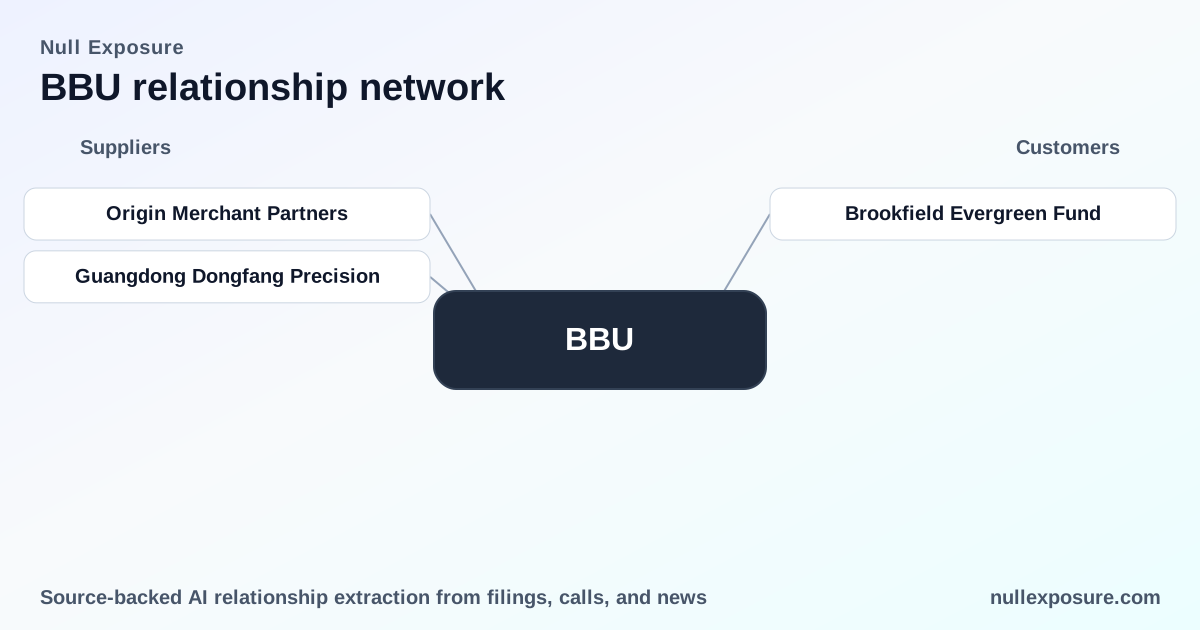
Supplier relationships uncovered in public coverage Below I summarize every supplier/relationship mentioned in the public results for BBU and give a concise, sourced read on each.
Origin Merchant Partners — fairness opinion on transaction consideration
Brookfield’s Special Committees used a fairness opinion prepared by Origin Merchant Partners that concluded the consideration to public holders of BBU units and BBUC exchangeable shares was financially fair, as of November 4, 2025. According to a Brookfield press release on GlobeNewswire, the Special Committees and Boards explicitly referenced Origin Merchant Partners’ opinion when recommending the transaction to holders (GlobeNewswire, Nov 6, 2025: https://www.globenewswire.com/news-release/2025/11/06/3182345/0/en/Brookfield-Business-Partners-Reports-Third-Quarter-2025-Results.html). Takeaway: use of an independent fairness opinion signals a governance process designed to mitigate perceived conflicts when BBU evaluates restructurings or exchange offers.
Guangdong Dongfang Precision — seller of Fosber carve-out
Brookfield agreed to acquire Fosber, a global designer and manufacturer of high-speed corrugating machinery, from Guangdong Dongfang Precision in a carve-out valued at approximately $900 million, according to coverage of the transaction (StockTitan reporting on FY2025 activity: https://www.stocktitan.net/news/BBU/brookfield-to-acquire-et44codzzg0h.html). Takeaway: this is a classic BBU move — buying an industrial equipment platform from a strategic seller and integrating it into a global manufacturing portfolio; supplier and counterparty relationships in the acquired business will become critical inputs to value creation.
Operational and supplier risk constraints — company-level signals There are no explicit supplier constraint excerpts in the scraped results for BBU. Treat this absence as a signal: public coverage for the supplier scope highlights transactions and advisory relationships rather than ongoing vendor disputes or binding supply constraints. From a company-level perspective, the following operating characteristics are evident and relevant to supplier analysis:
- Contracting posture: BBU’s transactions favor acquiring full control or majority stake, which creates long-duration supplier commitments and greater negotiating leverage post-close. This posture reduces the number of external counterparties whose contracts remain beyond BBU’s influence.
- Concentration: Risk concentrates around the acquired businesses. Suppliers to those businesses are potential single points of failure if they supply critical equipment or IP, particularly in carve-outs where supplier continuity must be managed through transition services.
- Criticality: Suppliers embedded in manufacturing or specialized engineering (for example, corrugating machinery for Fosber) become high criticality from an operational-risk perspective; continuity and spare-part flows are essential.
- Maturity and transition risk: Carve-outs often require transitional service agreements and rapid supplier due-diligence; these are operational execution items that influence the speed at which BBU can unlock synergies.
Financial and market signals that matter for supplier evaluation Use BBU’s financial profile to calibrate supplier exposure tolerance. Key public metrics: FY revenue ~ $27.46B, EBITDA ~ $7.18B, market cap around $2.71B (company figures in latest filings). Return metrics indicate positive operating margins but negative EPS on a per-share basis, reflecting high non-cash adjustments and capital-structure dynamics. High institutional ownership (83%) signals active coverage and access to financing for acquisitions, which reduces near-term liquidity-driven supplier disruption risk. Investors should interpret these financials as supportive of deal activity and post-acquisition supplier integration spending, but also as a reminder that leverage and distribution policy can influence working capital and payables behavior.
What investors and procurement leaders should watch next
- For operators integrating a carve-out such as Fosber, focus on supplier continuity plans, spare-parts inventory, and transfer-price terms negotiated during the transition period. These are tangible levers for preserving uptime and cash flow.
- For governance-focused investors, the use of independent advisors like Origin Merchant Partners in decisive transactions is a positive sign; confirm full disclosure of advisor engagement letters and assumptions in proxy materials.
- Monitor announcements for transition service agreements (TSAs) or supplier novations tied to newly acquired assets; these documents reveal where operational risk is concentrated.
Middle-of-report action item If you are evaluating counterparty risk, due diligence, or sourcing strategies across BBU-owned assets, start with transaction press releases and fairness-opinion disclosures for clear, actionable signals. For consolidated access to these documents and supplier-mapping tools, visit https://nullexposure.com/ to see how coverage aggregates governance and transaction-level signals.
Conclusions and recommended next steps Brookfield Business Partners is an active acquirer that monetizes through operational control and capital recycling. The supplier picture is transaction-driven: advisory engagements (Origin Merchant Partners) and strategic carve-outs (Guangdong Dongfang Precision → Fosber) are the dominant publicly visible supplier-related events. For investors, that structure implies supplier risk is most material at the asset level during and after acquisitions, when continuity, TSAs, and integration plans determine realized cash flows.
- Short-term diligence priority: supplier continuity and transition agreements for recent carve-outs.
- Governance priority: transparency of fairness opinions and advisor conflicts for large restructurings.
- Operational priority: inventory, spare-part sourcing, and critical supplier diversification for manufacturing assets.
Final call-to-action For practitioners building supplier risk frameworks around private-asset operators like BBU, see consolidated transaction and advisory coverage at https://nullexposure.com/ — the fastest way to scope counterparty exposure across deals and filings. For bespoke research or tracking of BBU’s next acquisitions and supplier integrations, visit https://nullexposure.com/ and subscribe for updates.