Brookfield Business Corp (BBUC): supplier relationships that matter to investors
Brookfield Business Corporation operates as an owner-operator of service businesses (healthcare, construction and wastewater services) and monetizes through operating cash flows from those portfolio companies, dividend distributions and fee arrangements with the Brookfield group. Value creation for shareholders is driven by the operating performance of underlying businesses and by corporate engineering — including management-fee formulas and structural simplification — that rebase the economics between BBUC and its Brookfield affiliates. This note reviews the supplier and advisor relationships disclosed around the recent simplification transaction and draws out the governance and commercial implications for investors and operators.
Explore deeper coverage and supplier mapping at https://nullexposure.com/.
What these supplier relationships reveal about BBUC’s operating posture
Brookfield Business Corp is executing a corporate-simplification transaction that reallocates how management fees are calculated and that relies on external financial and legal advisors to validate the process. The disclosed relationships are short-duration, deal-focused engagements rather than long-term operating vendors; they are transaction-critical and affect governance and fee economics during the conversion. Company-level signals relevant to counterparties and investors include:
- Contracting posture: The company is comfortable delegating advisory services to well-known boutiques and global law firms to support a structural transaction, signaling conservative governance for material corporate actions.
- Concentration and influence: Institutional ownership stands at ~93%, indicating a concentrated shareholder base that can rapidly influence transaction outcomes and governance votes.
- Economic profile and maturity: BBUC reported $7.168B revenue (TTM) and $1.096B EBITDA, but negative EPS (-12.76) and a Price-to-Sales of 0.299 signal meaningful capital-structure and accounting characteristics that investors must weigh alongside operating cash flow. Valuation multiples such as EV/EBITDA of 25.42 reflect market pricing that is sensitive to the success of corporatization and management-fee realignment.
- Transaction criticality: The vendor relationships disclosed are time-limited but material to the conversion, materially affecting governance and the base on which management fees are computed.
If you want supplier-level insights integrated with portfolio risk scoring, see https://nullexposure.com/.
The advisor and supplier roster — what was disclosed
-
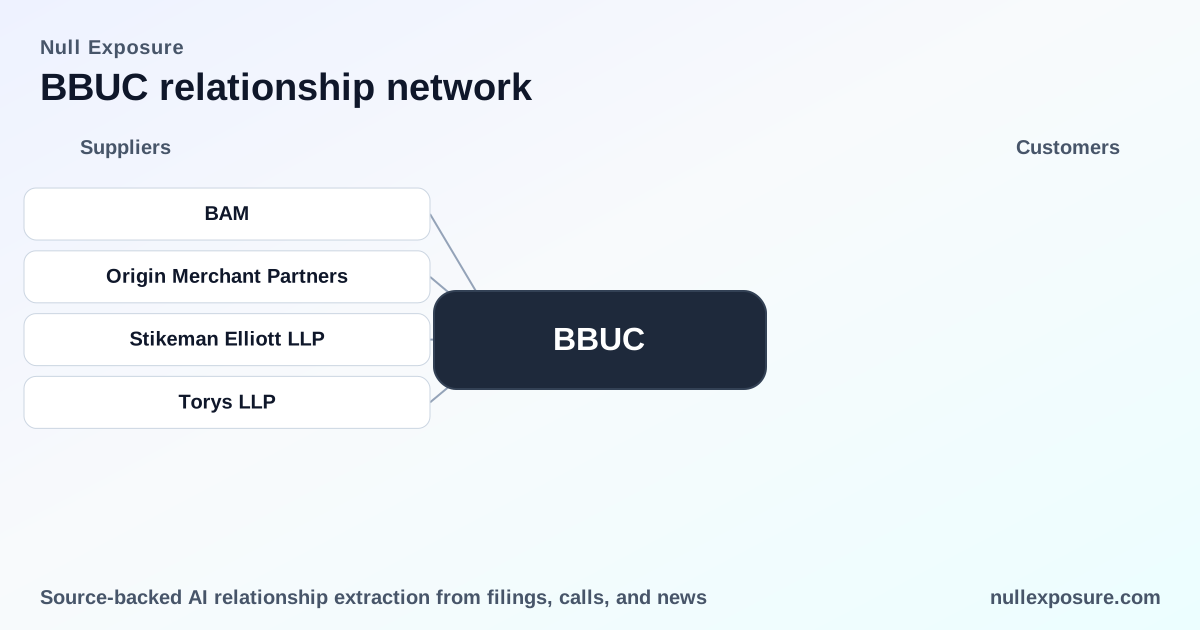
Brookfield Asset Management (BAM) — The management fee payable to Brookfield Asset Management will be calculated based on the market capitalization of BBU Inc. rather than the combined market capitalization of BBU and BBUC, changing the fee base used after simplification. This is disclosed in the company announcement distributed March 9, 2026. (Source: press release via The Globe and Mail, Mar 9, 2026.)
-
Origin Merchant Partners — An independent committee of each of BBU and BBUC has retained Origin Merchant Partners as the independent financial advisor to assist with review of the simplification transaction. Origin’s role is to provide valuation and fairness input to the independent directors. (Source: transaction notice carried on StockTitan and The Globe and Mail, Mar 9, 2026.)
-
Stikeman Elliott LLP — The independent committees retained Stikeman Elliott LLP as independent legal advisor in connection with their review of the conversion and simplification. Their mandate is the legal review and structuring advice for the independent directors. (Source: StockTitan and The Globe and Mail transaction notices, Mar 9, 2026.)
-
Torys LLP — Torys LLP is acting as legal advisor to Brookfield Business Partners for the same transaction, representing Brookfield Business Partners’ legal interests in the conversion mechanics. (Source: StockTitan and The Globe and Mail transaction notices, Mar 9, 2026.)
Each of these relationships is documented in the company’s March 9, 2026 public notices and reflects standard practice for a corporate reorganization of this scale.
How investors should interpret these engagements
- Advisors are transaction-focused, not vendor dependencies. The retained firms are high-quality advisors brought in for governance support; they are not long-term service vendors for operations. Their presence reduces legal and financial execution risk for the conversion, but they do not change operating cash flow dynamics.
- Management-fee rebasing is the headline operational lever. The change in fee basis to the market capitalization of BBU Inc. is an explicit commercial adjustment that reallocates fee receipts inside the Brookfield group and will influence how operating economics are reported post-conversion. Investors should treat this as a material policy change with P&L and governance implications.
- Governance cushion is strong but shareholder concentration is high. With institutional ownership near 93%, expect swift outcomes once institutional holders take a position; independent committees and independent advisors serve to protect minority governance interests but will operate under intense institutional scrutiny.
- Valuation and leverage lenses are essential. The company posts meaningful revenue and EBITDA, yet negative EPS and a high EV/EBITDA multiple indicate that investors are valuing future cash flows and corporate optionality — including the simplification outcome.
If you want to benchmark BBUC’s supplier and advisor exposures against peers, visit https://nullexposure.com/.
Investment implications and risk checklist
- Positive: The transaction reduces corporate complexity and clarifies the management-fee formula, which should improve transparency and remove a structural ambiguity that previously blended BBU and BBUC market caps.
- Watch: Any redefinition of the fee base can shift cash flows between affiliates and affect distributable cash to public shareholders versus parent entities; monitor subsequent filings for the explicit mechanics and projected fee quantum.
- Operational risk: Advisor appointments reduce legal and execution risk for the transaction but do not address operating execution across the underlying service businesses — that remains a core investor focus.
- Governance risk: High institutional concentration is a double-edged sword: faster decision-making and deal execution, but also potential for outcomes tightly aligned to large holders rather than retail or minority interests.
Bottom line and recommended next steps
Brookfield Business Corp is executing a simplification that materially changes how management fees are computed and has engaged leading financial and legal advisors to certify the process. These supplier relationships are transaction-critical and reduce execution risk, while the fee rebasing is the primary operational lever that investors should monitor for its impact on cash flow allocation.
For investors evaluating BBUC supplier exposure and governance alignment, the next actions are: (1) read the full conversion disclosure and future proxy materials for fee mechanics; (2) track institutional voting intentions; and (3) monitor post-conversion financials for changes in fee-related cash flows.
Continue the supplier mapping and get detailed counterparty analysis at https://nullexposure.com/.