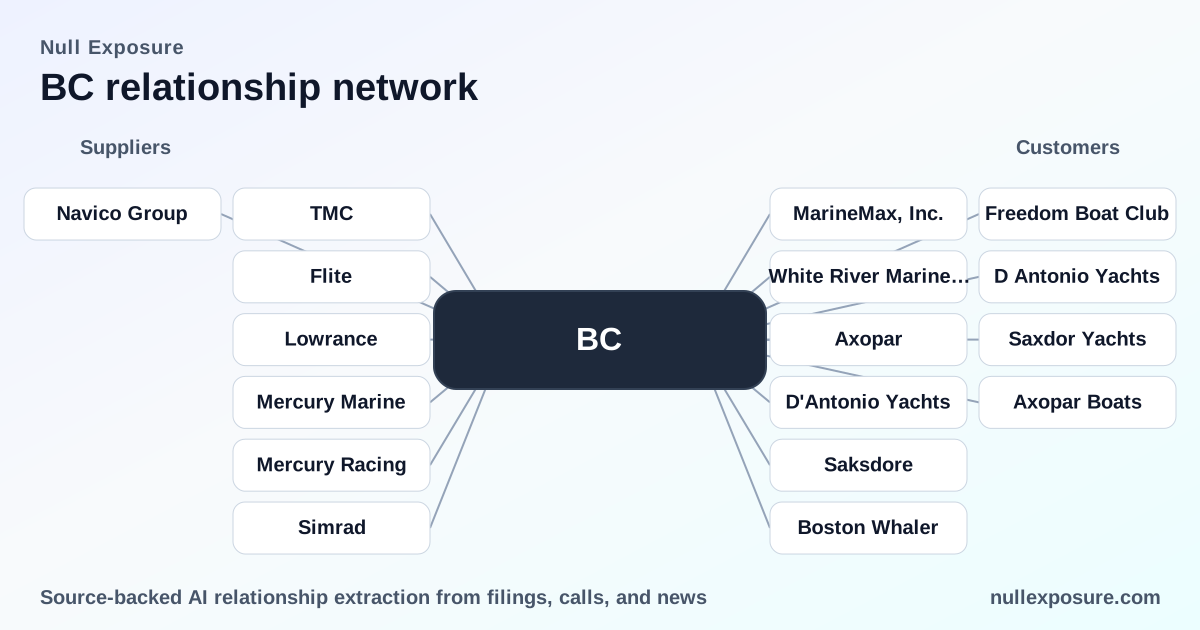
Brunswick Corporation (BC): supplier map and what it means for investors
Brunswick Corporation designs, manufactures and markets recreational marine products and propulsion systems and monetizes through a mix of new-vehicle hardware sales, propulsion and electronics sales, and recurring aftermarket parts and services. Its operating model blends vertical integration—Propulsion supplies engines to the Boat segment—with external supplier relationships for specialty components and co-developed innovations, creating both margin levers and concentrated counterparty exposures for investors. For further supplier signal coverage, visit https://nullexposure.com/.
Why supplier relationships matter for a hardware-led consumer cyclical company
Brunswick’s economics are driven by unit volumes, mix (high-margin aftermarket and propulsion services versus lower-margin boat builds), and the cadence of new product introductions that rely on strategic suppliers and internal manufacturing. The company both builds key components in-house and sources specialized systems from partners; that hybrid posture reduces some commoditized margin pressure while concentrating risk where single suppliers or tightly integrated partners supply critical systems. For investors, supplier disclosures are a direct window into procurement concentration, co-innovation bets, and the practical durability of gross margins.
For additional supplier analysis and tracking tools, see https://nullexposure.com/.
Company-level constraints and operating signals
The disclosures and excerpts produce several company-level signals about Brunswick’s contracting posture and supply risk:
- Manufacturer posture and vertical integration: Brunswick operates a Propulsion segment that manufactures engines and supplies substantially all engines for its Boat segment, indicating internal supply of a critical system and reduced external dependence for propulsion. This is a company-level fact sourced in corporate filings.
- Concentration at the supplier-purchase level: Specific purchase figures (see TMC below) show material single-supplier spend lines that can influence working capital and procurement leverage.
- Criticality of supplier systems: Electronic navigation, propulsion and high-performance motors are core to product differentiation—suppliers that provide those systems are operationally critical.
- Maturity and strategic partnership behavior: Multiple news items show co-developed products and CES showcases, suggesting long-term product partnerships and joint go-to-market activity rather than one-off spot buys.
These constraints indicate a mixed model: strong internal manufacturing where scale matters (propulsion) and strategic external partnerships where specialized capability or branding delivers differentiation.
Key supplier relationships investors should watch
TMC
Brunswick disclosed $99.6 million of purchases from TMC in FY2025 (up from $79.6 million in 2024), a clearly material procurement relationship that highlights single-supplier exposure for components or assemblies. According to Brunswick’s 2025 Form 10‑K, purchases from TMC totaled $99.6 million in 2025. (Brunswick 2025 10‑K)
Flite
Brunswick showcased a collaborative innovation with Flite on a high-performance eFoil called the FLITE RACE—an example of co‑development aimed at premium, adjacent water-sports markets. Boating Magazine’s CES 2026 coverage detailed the global launch of the FLITE RACE developed with Flite and Mercury Racing. (Boating Magazine, CES 2026)
Lowrance
Lowrance-provided navigation and sensor technology is featured across new Brunswick demonstrations, reflecting the role of specialized electronics in boat product offering and customer value. Boating Magazine’s CES 2026 piece noted that Brunswick will feature a Lund Crossover XS with the latest Lowrance technology. (Boating Magazine, CES 2026)
Mercury Marine
Mercury Marine is functionally core to Brunswick’s propulsion stack, powering all Boston Whaler and Sea Ray boats and appearing as the primary propulsion partner in new product showcases. SGB Online reported that “all Boston Whaler and Sea Ray boats feature Mercury Marine engines,” and Boating Magazine’s CES coverage emphasized deep connectivity between helm systems and Mercury propulsion. (SGB Online reporting on FY2023 show; Boating Magazine, CES 2026)
Mercury Racing
Mercury Racing supplies high-performance propulsion and is being integrated into co‑innovation projects and motor showcases—evidence of a partnership that targets performance-driven branding and premium customer segments. Boating Magazine’s CES 2026 coverage cited use of Mercury Racing 150R and other Mercury Racing hardware in new Lund demos. (Boating Magazine, CES 2026)
Simrad
Simrad’s autonomous boating technology (AutoCaptain) and display systems are being integrated into new Sea Ray and NAVAN models, underscoring the importance of autonomous and display software/hardware in product differentiation. Boating Magazine’s CES 2026 article described the global debut of Simrad AutoCaptain across two boats, including a new Sea Ray SLX and a NAVAN C30. (Boating Magazine, CES 2026)
Navico Group
Navico Group (owner of Simrad product lines) supplies radar, sonar and displays for Brunswick-branded models sold with electronics, signaling a longstanding electronics supplier relationship across multiple boat franchises. SGB Online’s show coverage noted that boat models sold with electronics feature Navico Group’s Simrad display, radar and sonar products. (SGB Online reporting on FY2023 show)
What these relationships mean for margins, risk and strategy
- Margin upside through differentiation: Co-developed products (Flite eFoil, Mercury Racing performance engines, Simrad AutoCaptain) support higher ASPs and aftermarket service opportunities, which are positive for operating margins if adoption scales.
- Concentration risk: The single-supplier spend noted for TMC is material in dollar terms and indicates procurement concentration that can compress margins or introduce operational disruption if supply is interrupted. TMC’s $99.6M of purchases in 2025 is a concrete example of concentrated spend.
- Vertical integration reduces some risks but introduces internal execution risk: Brunswick’s internal Propulsion manufacturing reduces dependence on external engine suppliers for core models, but it also makes Brunswick responsible for execution, capital intensity, and inventory management that can amplify operating leverage.
- Strategic partnerships are operationally critical: Electronics and autonomy suppliers (Lowrance/Simrad/Navico) and branding partners (Mercury, Mercury Racing) are integral to product desirability; losing or weakening these ties would be value‑destructive.
Actionable takeaways for investors and operators
- Monitor the evolution of single-supplier spend lines (TMC) and the cadence of large co‑developed product launches (Flite, Mercury Racing), since both influence near-term cash conversion and longer-term margin mix.
- Treat propulsion and electronics suppliers as strategic counterparties; contract terms, exclusivity, and integration timelines materially affect model-level profitability.
- For operators, prioritize supplier diversification or contractual protections in areas with demonstrated concentration and maintain rigorous quality and inventory controls in internally manufactured propulsion lines.
For ongoing supplier signal coverage and supplier‑risk dashboards, visit https://nullexposure.com/.
Bottom line
Brunswick balances vertical manufacturing strength in propulsion with targeted external partnerships for electronics and high-performance systems; this hybrid model supports product differentiation and aftermarket revenue but also concentrates spend and supplier dependency in discrete areas. Investors should weigh the margin benefits of co‑innovation and internal manufacturing against the operational and counterparty risks shown by material purchases and strategic supplier ties. For more supplier intelligence and monitoring, go to https://nullexposure.com/.