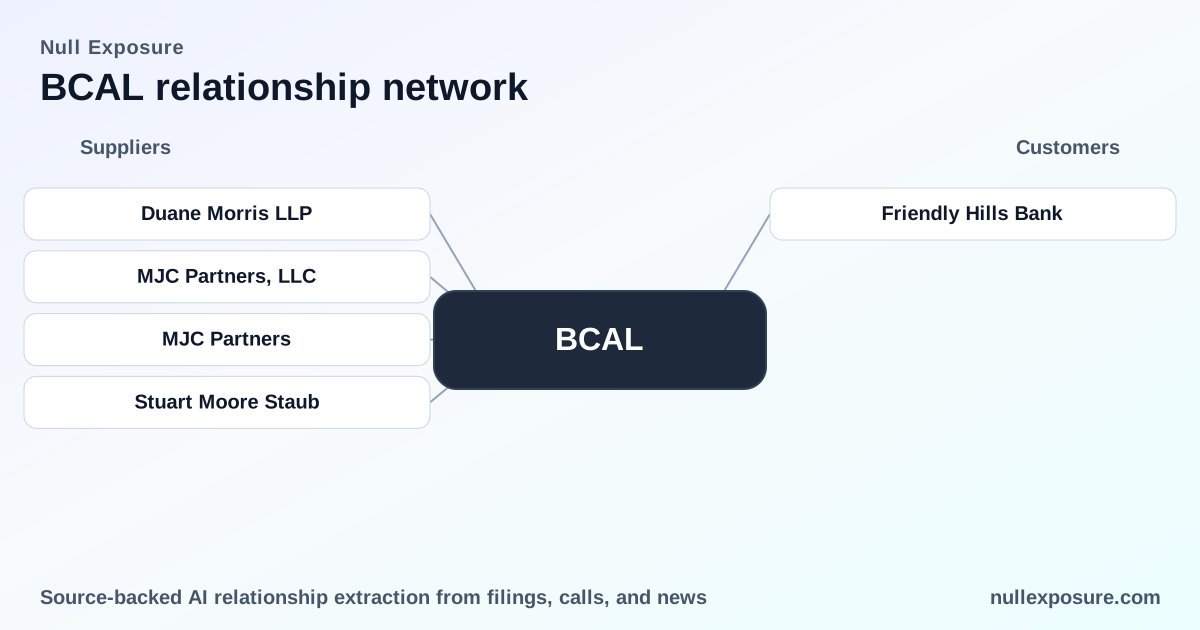
Southern California Bancorp (BCAL) — supplier relationships and what they mean for investors
Southern California Bancorp operates as the holding company for Bank of Southern California, N.A., monetizing through traditional regional-bank economics: net interest income from commercial and consumer lending, fee income from deposit and treasury services, and measured non-interest income from transaction and advisory activity. The bank’s recent transactions bring external legal and financial advisors onto its roster for discrete deals rather than running a broad outsourced vendor program; BCAL’s supplier footprint for strategic work is episodic and transaction-focused, while its balance-sheet economics (Revenue TTM $189M, Profit Margin 33.4%, Market Cap ~$569M) drive recurring profitability. Explore a succinct supplier review and implications below — or visit the Nillexposure homepage for broader counterparty intelligence: https://nullexposure.com/.
Quick read: what the vendor list reveals about operating posture
BCAL’s visible supplier engagements are concentrated in transaction advisory and legal counsel roles tied to merger activity. Those relationships are not core operational vendors (IT, payments, or deposit platforms) but instead reflect capacity to bring external expertise to M&A and regulatory work. The company’s publicly available financials show conservative leverage and a profitable regional banking franchise, and the supplier activity aligns with an institutional approach to deal execution.
- Contracting posture: Strategic and episodic — BCAL retains advisors for specific transactions rather than long-term outsourcing of critical operations.
- Concentration: Low vendor breadth for strategic work, but governance-linked leases introduce single-counterparty concentration risk at the property level (see constraints).
- Criticality: Legal and fairness-opinion providers are high-impact during deals but do not affect day-to-day banking operations.
- Maturity: Engagements span multiple years (documents reference FY2019 and FY2024), indicating repeated use of external M&A and legal advisors for corporate actions.
If you want granular relationship mapping and source-backed signals for counterparty diligence, see Nillexposure’s hub: https://nullexposure.com/.
Supplier roll call — each relationship in the record and why it matters
Below are the distinct supplier mentions identified in public filings and press reports. Each entry includes a plain-English summary and a concise source citation.
Duane Morris LLP
Duane Morris served as legal counsel to Bank of Southern California in connection with a transaction described in a 2019 press release about a merger agreement; the engagement indicates the bank uses established law firms for regulatory and transactional work. According to a Send2Press release dated FY2019, Duane Morris LLP acted as legal counsel to Bank of Southern California during that merger announcement (Send2Press, FY2019).
MJC Partners, LLC
MJC Partners, LLC acted as financial advisor to Bank of Southern California in the same FY2019 merger announcement, reflecting the bank’s practice of securing external financial advisers for deal structuring and negotiation. The Send2Press announcement from FY2019 identifies MJC Partners, LLC as the bank’s financial advisor (Send2Press, FY2019).
MJC Partners
In a later disclosure covering FY2024 activity, MJC Partners delivered a fairness opinion to Southern California Bancorp’s board and again functioned as the financial advisor — showing continuity of advisor selection across multiple corporate actions. A FY2024 news report on StockTitan describes MJC Partners providing a fairness opinion to the company’s Board of Directors (StockTitan, FY2024).
Stuart Moore Staub
Stuart Moore Staub acted as legal counsel to Southern California Bancorp in FY2024 transactions, indicating the bank engages different law firms across discrete deals rather than relying exclusively on a single legal provider. A FY2024 StockTitan item notes Stuart Moore Staub’s role as legal counsel for Southern California Bancorp (StockTitan, FY2024).
Constraints and company-level signals that investors should note
One explicit constraint in the public record pertains to property leasing and governance. BCAL leases its Ramona branch office from a beneficial owner who holds more than 5% of the company’s voting securities and is a former board member, under an operating lease that expires in 2027 on market terms. This is a company-level signal; it shows a governance entanglement that creates counterparty exposure at the property level rather than a supplier-of-record issue.
Operational and strategic implications:
- Governance-linked counterparty exposure: Leasing from a significant shareholder / former director increases the bank’s reliance on a single counterparty for physical branch access and raises related-party scrutiny.
- Contract maturity risk: The lease expiry in 2027 creates a discrete renegotiation point that investors should monitor for renewal terms or relocation costs.
- Supplier criticality profile: Legal and advisory suppliers are high-impact during deals but low on ongoing operational risk; the property lease is a sustained operational exposure.
For a full supplier and counterparty map that ties these signals to balance-sheet exposure, visit https://nullexposure.com/.
Strategic risk assessment and investor implications
BCAL’s external supplier list is compact and transaction-specific. That pattern supports two investor conclusions:
- Operational continuity is internally maintained. Core banking services and daily operations are not visibly dependent on the named legal and advisory firms; these suppliers are deployed for episodic corporate events.
- Counterparty concentration exists at the property and governance level. The lease to a >5% beneficial owner and former board member is a sustained exposure that warrants monitoring for conflict-of-interest governance and lease-renegotiation outcomes.
From a valuation standpoint, BCAL trades at a trailing P/E of 9.09 and a Price/Book near 0.99 — the market prices the bank as a profitable regional franchise with modest growth expectations. The supplier footprint reinforces that the company’s strategic execution relies more on its balance-sheet and dealmaking competence than on third-party operational dependencies.
Investor takeaways and practical next steps
- Supplier engagements are episodic and transaction-focused (financial advisor and legal counsel roles in FY2019 and FY2024), reducing day-to-day vendor risk but elevating event-driven counterparty importance.
- The lease to a significant shareholder is a material company-level constraint with a contract maturity date (2027) that investors should track for governance and continuity implications.
- Monitor advisor continuity and fairness opinions as signals of deal pipeline and board-level judgment; repeated use of MJC Partners suggests an established advisory relationship for fairness assessments.
If you want in-depth counterparty briefs, contract timelines, and board-level vendor disclosures, start your analysis at Nillexposure: https://nullexposure.com/.
Conservative governance checks (related-party disclosures, lease renewal terms) combined with deal-level diligence on counsel and advisor independence are the practical next steps for investors evaluating BCAL’s supplier and counterparty profile.