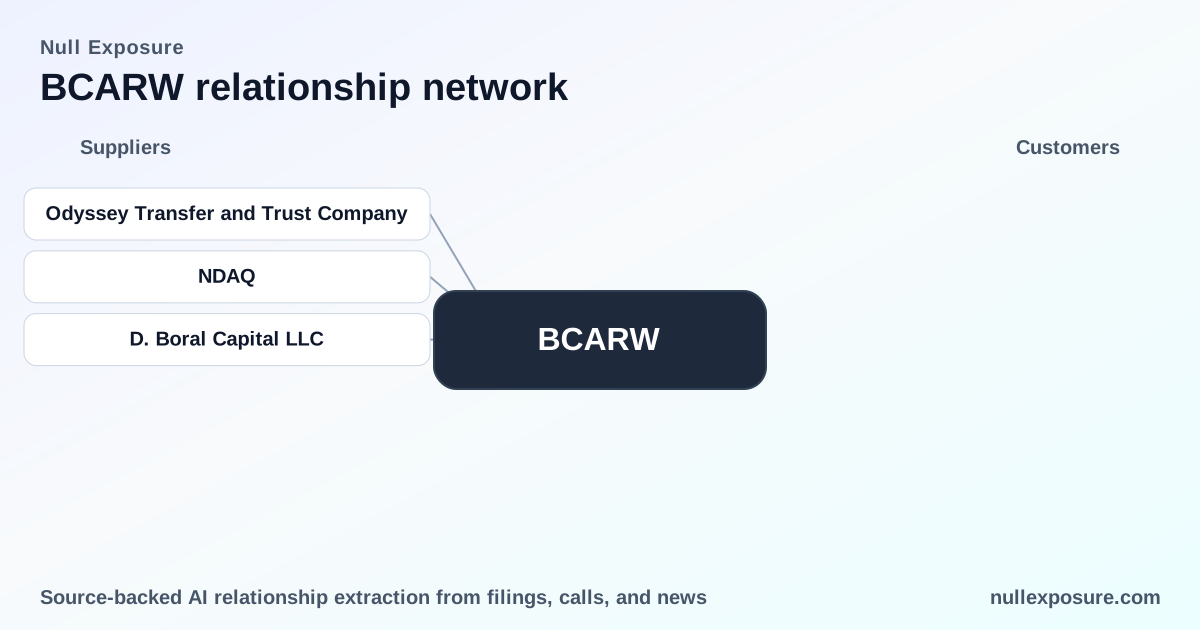
D. Boral ARC Acquisition I Corp. Warrant (BCARW): Supplier relationship briefing for investors
D. Boral ARC Acquisition I Corp. Warrant (BCARW) is a listed SPAC warrant that monetizes exclusively through secondary-market trading and potential exercise economics tied to the underlying Class A shares; it does not generate operating revenue or cash flow. BCARW is an equity derivative instrument issued as part of a SPAC unit structure—holders separate warrants from units via the transfer agent and trade the warrants on the Nasdaq Global Market under the symbol BCARW. For relationship diligence and counterparty risk, focus on transfer agent, listing venue, and the underwriters who brought the offering to market. For investors and operators assessing supplier exposure, the commercial profile is simple and concentrated: a thin set of counterparties perform discrete, high-impact functions for warrant holders. Read more at the NullExposure homepage: https://nullexposure.com/
What BCARW is and how it operates in the market
BCARW is a warrant instrument created when D. Boral ARC Acquisition I Corp. sold units composed of Class A ordinary shares and warrants. Warrants themselves are not operating companies; they are tradable financial instruments whose economic value depends on the share price, exercise terms, and market liquidity. The corporate profile shows no operating revenue, negligible operating metrics, and a book value point estimate reported at 0.019 per the company profile—consistent with a shell/SPAC vehicle that holds trust assets until a business combination is completed. The warrants trade on the Nasdaq Global Market, which provides execution, market surveillance, and listing compliance for holders and brokers.
Supplier network: the small set of counterparties that matter
BCARW’s supplier relationships are limited and functionally specific. Each supplier performs a necessary but narrowly scoped role in the lifecycle of the warrant instrument.
Odyssey Transfer and Trust Company — transfer agent
Holders separating units into Class A ordinary shares and warrants must contact the transfer agent, Odyssey Transfer and Trust Company, to effect the separation through their brokers. This operational step is necessary to convert a unit into freely tradable components and execute exercise or sale decisions. (Press release distributed via IndyStar, August 20, 2025; https://www.indystar.com/press-release/story/5755/d-boral-arc-acquisition-i-corp-announces-the-separate-trading-of-its-class-a-ordinary-shares-and-warrants-commencing-august-20-2025/)
The Nasdaq Global Market — listing and trading venue
The separated Class A ordinary shares and warrants trade on The Nasdaq Global Market under the symbols “BCAR” and “BCARW,” respectively; Nasdaq provides the primary market infrastructure, continuous trading, and the regulatory compliance framework for these securities. For liquidity and execution, Nasdaq’s role is central to any investor who intends to buy, sell, or hedge BCARW positions. (Company press release distributed via NorthJersey and IndyStar, August 2025; Nasdaq listing noted in the same releases.)
D. Boral Capital LLC — sole book-running manager
D. Boral Capital LLC acted as the sole book-running manager for the initial offering that created the units and their constituent warrants, which means it led distribution and underwriting activity for the IPO. The manager’s structuring and pricing choices set the initial float and supply of warrants on the market. (Newswire press release announcing pricing of the initial public offering, FY2025; https://www.newswire.com/news/d-boral-arc-acquisition-i-corp-announces-pricing-of-250-000-000-initial-public)
(These three counterparties capture every supplier relationship identified in company press coverage for BCARW.)
Contracting posture, concentration, criticality and maturity — company-level signals
There are no explicit contractual constraints disclosed in the relationship data provided. Absent detail, treat the following as company-level operational signals:
- Contracting posture: transactional and standardized. The relationships identified (transfer agent, exchange, book-runner) are governed by industry-standard engagements rather than bespoke, long-term service contracts; operational reliance is functional rather than strategic.
- Concentration: extremely high. A tiny set of counterparties performs all mission-critical functions for warrant holders; the transfer agent and Nasdaq provide services that cannot be easily substituted in the short term without administrative cost.
- Criticality: operationally critical but non-operational in economics. Transfer agent actions (unit separation) and Nasdaq trading status materially affect liquidity and investor ability to exercise or trade warrants, but these services do not change the underlying SPAC trust economics.
- Maturity: early-stage, event-driven. As a SPAC warrant, BCARW’s lifecycle is tied to the broader SPAC timeline—de-SPAC transaction, potential redemption mechanics, or expiry events—so counterparties support an inherently time-limited instrument.
These signals inform counterparty risk: operational breakdowns (e.g., transfer agent processing delays or listing disruptions) create execution risk for investors even though they do not change the fundamental absence of operating revenue.
Investment implications and risk considerations
- Liquidity and market risk are the primary drivers of investor outcomes. BCARW’s value derives from secondary trading; thin trading or wide spreads will dominate short-term P&L.
- Counterparty operational risk is concentrated. Because unit separation requires interaction with the transfer agent, any delay or miscommunication at Odyssey will translate directly into liquidity friction for holders; Nasdaq’s regulatory and market surveillance posture can materially affect access to continuous trading.
- Underwriter and initial float decisions influence supply. D. Boral Capital LLC set initial distribution parameters—those choices affect outstanding warrant supply and the post-IPO market depth.
- No operating cash flows or margins to underwrite downside. The corporate profile reports zero revenue and operating marginals consistent with a SPAC shell, so downside protection comes exclusively from market mechanics (e.g., trust holdings, redemptions), not from business performance.
What operators and procurement teams should do next
- For trading desks and operations teams: confirm transfer-agent procedures and cut-off timelines with Odyssey Transfer and Trust Company before attempting unit separation; operational readiness matters more than valuation nuance for execution.
- For counterparty risk teams: monitor Nasdaq notices and D. Boral Capital communications for changes in trading status, ticker designations, or distribution amendments that change liquidity.
- For investors evaluating position sizing: treat BCARW as a pure market-liquidity exposure rather than a credit or operating-income play.
Explore vendor and supplier profiles for similar warrant and SPAC instruments at the NullExposure home hub: https://nullexposure.com/
Bottom line
BCARW is a classic SPAC warrant: no operating revenue, a concentrated supplier base, and value fully determined by trading mechanics and underlying share performance. For relationship diligence, prioritize verifying transfer-agent mechanics with Odyssey, confirming continuous trading conditions on Nasdaq, and understanding how D. Boral Capital’s underwriting choices set initial supply. For immediate operational guidance and a comparative view of suppliers across listed warrants, visit NullExposure’s portal: https://nullexposure.com/ — it consolidates supplier relationships and operational signals for warrants and SPAC instruments.