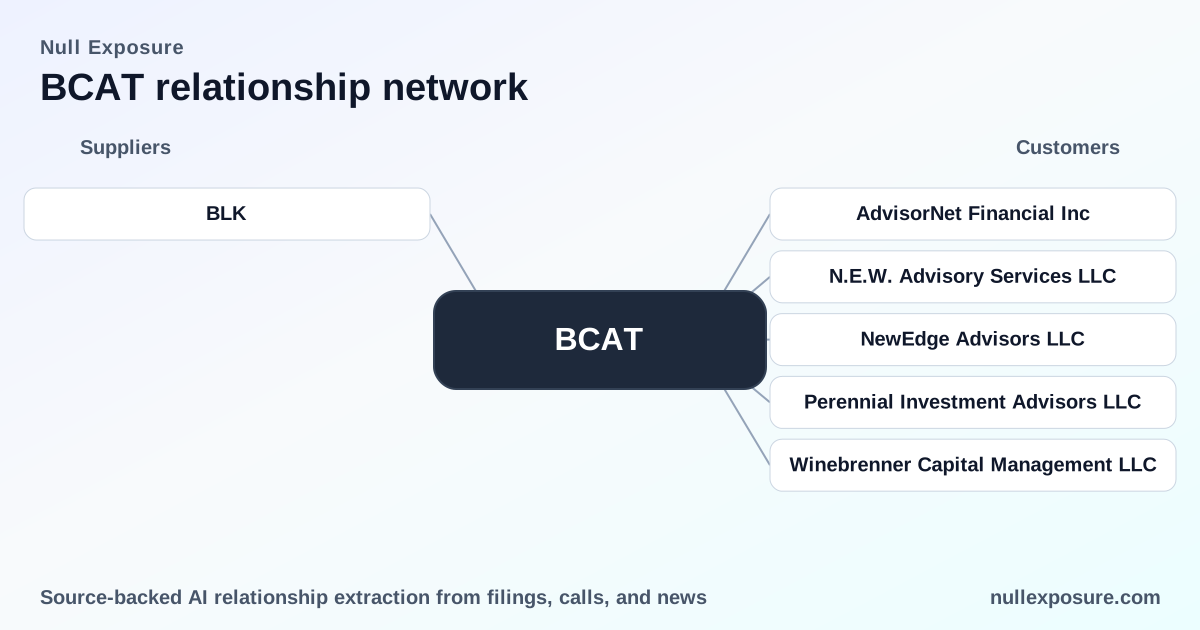
BCAT — Where a BlackRock‑managed closed‑end trust fits into a supplier map
BlackRock Capital Allocation Trust (BCAT) is a closed‑end investment trust that leverages BlackRock’s portfolio management to allocate capital between equities and fixed income and returns cash to shareholders through its distribution program; BCAT’s economic model is driven by asset performance and fee arrangements with BlackRock, while shareholders capture the net cash flows and market NAV premium/discount. For investors and operators evaluating supplier relationships, the critical supplier is the external manager — BlackRock — whose stewardship, distribution policy and shareholder dynamics determine performance delivery and operational risk. Explore deeper coverage at Null Exposure: https://nullexposure.com/
How BCAT operates and where the economics live
BCAT is structured as a closed‑end trust listed on the NYSE (ticker BCAT) that earns investor capital exposure through active allocation across global equities and fixed income under BlackRock’s management. The trust’s monetization is straightforward: investors buy shares on the exchange, the trust invests assets under a mandate run by BlackRock, and returns to shareholders are delivered via market price movement and periodic distributions. Key public metrics that shape commercial and counterparty assessments include market capitalization of roughly $1.54 billion, trailing P/E of 6.92, EPS of $2.12, and a price‑to‑book near 0.964, with institutional ownership around 20.3% and insiders holding roughly 0.006%. These figures frame how investors value management effectiveness, distribution sustainability, and governance outcomes.
The supplier relationships you need to evaluate
BCAT’s supplier footprint is concentrated and dominated by a single, high‑importance relationship: BlackRock as fund manager. The public record captured two distinct mentions that clarify that relationship and the shareholder context.
BlackRock — fund manager and key stakeholder (distribution communication)
A FinancialContent market report dated October 2, 2025 noted BlackRock’s direct managerial role and highlighted a robust monthly distribution declared by the trust, underscoring management’s active decision to return cash to shareholders and signaling confidence in cash management despite market volatility. See the FinancialContent market minute for the October 2025 distribution commentary: https://markets.financialcontent.com/wral/article/marketminute-2025-10-2-blackrock-capital-allocation-trust-declares-robust-monthly-distribution-signaling-confidence-amidst-market-volatility
BlackRock — ownership context and activist presence (investor dynamics)
An Observer report from July 2023 recorded that Saba Capital owned shares of BCAT, placing BCAT among several BlackRock closed‑end funds that attracted activist or concentrated holders; this underscores shareholder activism as an operational input that influences board engagement, distribution policy, and strategic choices. See the July 2023 Observer coverage on shareholder positions: https://observer.com/2023/07/boaz-weinstein-saba-fight-blackrock/
What those supplier signals mean for allocators and operators
BCAT’s supplier map is notably low in supplier breadth and high in supplier criticality: BlackRock is the single, dominant provider of investment management and operational protocols. That leads to a set of predictable model characteristics:
- Contracting posture: BCAT is manager‑centric — contractual terms between the trust and BlackRock determine fee levels, permissible leverage, and distribution mechanics; negotiating leverage at the trust level is limited relative to a broad open‑end platform.
- Concentration: Reliance on BlackRock compresses supplier diversification but increases predictability when the manager is large, capable, and resourced; the tradeoff is elevated single‑counterparty risk.
- Criticality: BlackRock’s operational role is mission‑critical — portfolio construction, risk management, trade execution and distribution decisions flow through the manager.
- Maturity and governance: BCAT is an established listed trust with observable market behavior (52‑week range, price‑to‑book near parity), and activist/institutional shareholders (including Saba historically) create governance pressure that can accelerate policy changes or fee renegotiations.
These are company‑level signals — they are intrinsic to BCAT’s operating model independent of any single news item.
Middle reading and portfolio diligence are recommended — see broader analysis at Null Exposure: https://nullexposure.com/
Investment and vendor risk considerations — concise takeaways
Operators and allocators should prioritize a short checklist when evaluating BCAT as a supplier‑partner exposure:
- Manager risk is primary: Evaluate BlackRock’s mandate execution, fee schedule, and any exclusivity or sideletter arrangements that could alter economics.
- Distribution and cashflow discipline drive market perception: Recent documented distributions in 2025 indicate management willingness to return cash; monitor frequency and size relative to NAV.
- Shareholder activism can be an accelerant: The presence of activist holders historically (e.g., Saba) increases the probability of governance actions that affect capital allocation or fee structures.
- Market pricing and valuation asymmetries matter: Price‑to‑book near 0.964 and a trailing P/E of 6.92 suggest that market valuation is close to book value but provides limited premium buffer; this compresses downside protection for holders relying on distribution income.
Practical next steps for investors and service operators
- For investors: stress test distribution sustainability against base case returns and downside scenarios, and assess how BlackRock’s management fee policies affect net yield.
- For operators and counterparties: document contract continuity risk in vendor playbooks; ensure operational SLAs account for the centralized role BlackRock plays in order execution and reporting.
- For governance teams: map activist investor footprints and prepare engagement protocols in anticipation of board or policy shifts.
Final assessment and action
BCAT is a closed‑end trust whose supplier profile is dominated by a singular, high‑criticality manager relationship with BlackRock; that concentration simplifies vendor analysis but raises single‑counterparty dependency risks that investors must price. Recent public signals — a robust distribution announced in 2025 and historical activist holdings — both reinforce the importance of active monitoring of manager decisions and shareholder composition.
To track updates on BCAT’s supplier relationships and governance signals, visit Null Exposure for continuous supplier intelligence: https://nullexposure.com/
For a tailored supplier‑risk briefing or to integrate BCAT relationship data into your operational due diligence, start at Null Exposure: https://nullexposure.com/