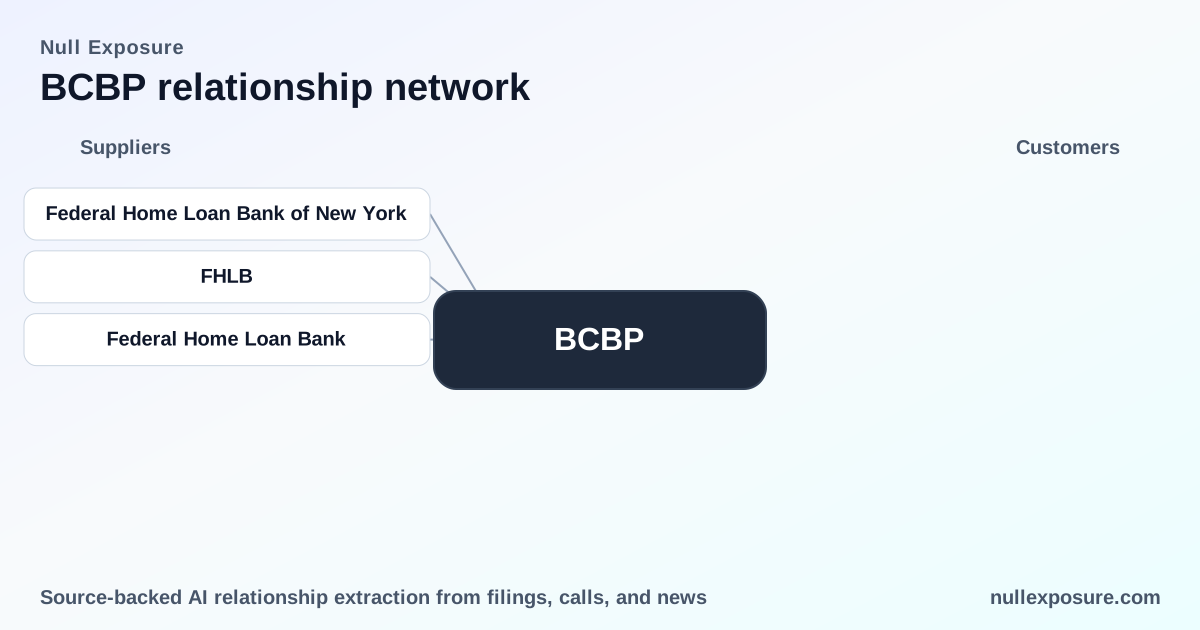
BCB Bancorp (BCBP): FHLB funding is the supplier relationship investors must watch
BCB Bancorp is a small regional bank holding company that monetizes through traditional banking spreads — earning net interest income from lending while funding that lending with deposits and wholesale borrowings — and modest fee income from commercial and retail services. The company's relationship with the Federal Home Loan Bank system and other wholesale funding channels is a direct lever on liquidity, capital mix, and margin management. For investor diligence on counterparties and supplier exposure, this relationship is the single most consequential external dependency to monitor. Read more at the NullExposure hub: https://nullexposure.com/.
Why BCBP's relationship with FHLB matters for valuation and risk
BCB Bancorp runs a classical regional bank model: loans + securities on the asset side, deposits + wholesale funding on the liability side. Wholesale funding decisions — particularly FHLB advances and brokered deposits — have driven recent balance-sheet moves, including material paydowns that reduced reported debt obligations and changed reported cash positions. That funding mix directly affects net interest margin, funding cost volatility, and the bank’s ability to respond to deposit pressure or capital needs.
Investors should treat FHLB access as both a strategic backstop and a potential source of funding-cost risk: reductions in FHLB borrowings improve leverage and interest expense today but can compress liquidity cushions if deposit attrition accelerates. For continued diligence, monitor disclosures and press releases for FHLB advance balances and maturity profiles. If you want a consolidated view of counterparty exposure, visit https://nullexposure.com/ to explore supplier relationships and signals.
What the public record says about the relationships (each reported item)
-
The bank reported that a decrease in cash was primarily attributable to paying down higher-cost brokered deposits and FHLB advances, a move disclosed in a March 2026 press release covered by Yahoo Finance. This note ties the cash reduction directly to wholesale funding paydowns. (Yahoo Finance, March 9, 2026)
-
A CityBiz write-up summarizing BCBP’s Q1 2025 results reported that debt obligations decreased by $49.8 million to $448.5 million at March 31, 2025 from $498.3 million at December 31, 2024, due to maturities and paydowns of FHLB advances, showing active balance-sheet deleveraging in early 2025. (CityBiz, April 2025 reporting of Q1 2025 results)
-
A fourth-quarter 2025 release summarized in The Manila Times / GlobeNewswire disclosed that debt obligations fell by $220.1 million to $278.2 million at December 31, 2025, from $498.3 million at December 31, 2024, driven by maturities and paydowns of FHLB advances, reflecting a significant year-end reduction in wholesale borrowings. (GlobeNewswire via The Manila Times, January 30, 2026)
-
A news item preserved on StockTitan quoting earlier commentary (FY2023 vintage) emphasized that the company retains ample capacity to borrow from wholesale markets, including the Federal Home Loan Bank, brokered deposits, and other third-party channels, indicating a longstanding contractual and operational access to FHLB liquidity. (StockTitan reporting on FY2023 remarks)
-
A Reuters item republished on TradingView covering Q1 2025 likewise noted that debt obligations decreased by $49.8 million to $448.5 million at March 31, 2025 from $498.3 million at December 31, 2024 as a result of maturities and paydowns of FHLB advances, corroborating the CityBiz summary and showing consistent messaging across outlets. (Reuters coverage republished on TradingView, April 22, 2025)
Each of the above items documents the same core relationship dynamic: BCBP has material borrowing capacity with the Federal Home Loan Bank system and has been actively reducing that exposure through maturities and paydowns during 2024–2025, with notable year-end reduction in 2025.
Collective read on concentration, criticality, and contracting posture
-
Concentration: The public disclosures confirm that the FHLB system has been a material wholesale lender to BCBP; historical balances approached the high hundreds of millions before the 2025–2026 paydown program. That level of reliance establishes concentration risk on a single wholesale channel for liquidity needs.
-
Criticality: FHLB access is operationally critical: it is a primary contingency source for liquidity and is used to manage interest-rate and deposit shocks. The bank’s active paydowns reduce leverage but do not eliminate the criticality of the FHLB channel given its role as standby liquidity.
-
Contracting posture and maturity: The bank demonstrates an active contracting posture, repaying advances as maturities arrive and reducing higher-cost liabilities. Public comments stretching back to FY2023 confirm a longstanding, mature relationship with the Federal Home Loan Bank system and other wholesale channels, not a short-lived experiment.
-
Company-level vendor signal: Separately, BCBP maintains a documented Third-Party/Vendor Risk Management program and leases 26 offices under operating leases, which indicates material third-party operational exposure and a significant real-estate lease footprint that drives vendor contracting and facilities cost structure. This is a firm-level operational constraint rather than a relationship-specific detail.
If you want a consolidated supplier-risk view and operational mapping to support diligence or model stress tests, see the supplier coverage on NullExposure: https://nullexposure.com/.
Risk implications for investors
-
Liquidity vs. margin tradeoff: The bank’s strategy to pay down FHLB advances and brokered deposits reduces funding costs and leverage, but it also trims immediate liquidity buffers. Investors should stress-test deposit stability against these paydowns.
-
Counterparty dependency: Continued access to the Federal Home Loan Bank system is a governance and counterparty risk. Any regulatory or operational change in that access would be highly consequential.
-
Operational complexity and vendor reliance: The vendor risk management program and multiple leased locations imply ongoing vendor-contract governance and fixed-cost obligations that affect operating leverage and branch rationalization options.
-
Capital and profitability backdrop: BCBP shows negative trailing EPS and compressed profitability metrics in recent reporting, which elevates the importance of preserving low-cost core deposits and stable wholesale lines while executing deleveraging without inducing funding stress.
Investment takeaway and next steps
BCBP has taken decisive steps to reduce higher-cost wholesale funding, materially shrinking its FHLB advance footprint through 2025. For investors the central question is whether reduced borrowings translate into sustainable margin improvement without sacrificing liquidity. Monitor quarter-to-quarter FHLB advance balances, maturity ladders, and deposit trends as leading indicators.
For a deeper supplier-risk profile and ongoing tracking of BCBP’s counterparty exposures, consult NullExposure’s supplier coverage: https://nullexposure.com/. If you are performing counterparty due diligence or building scenario analyses, use the public filings and press releases cited above as the primary verification sources, and then layer contractual and maturity detail from investor disclosures and FHLB statements.