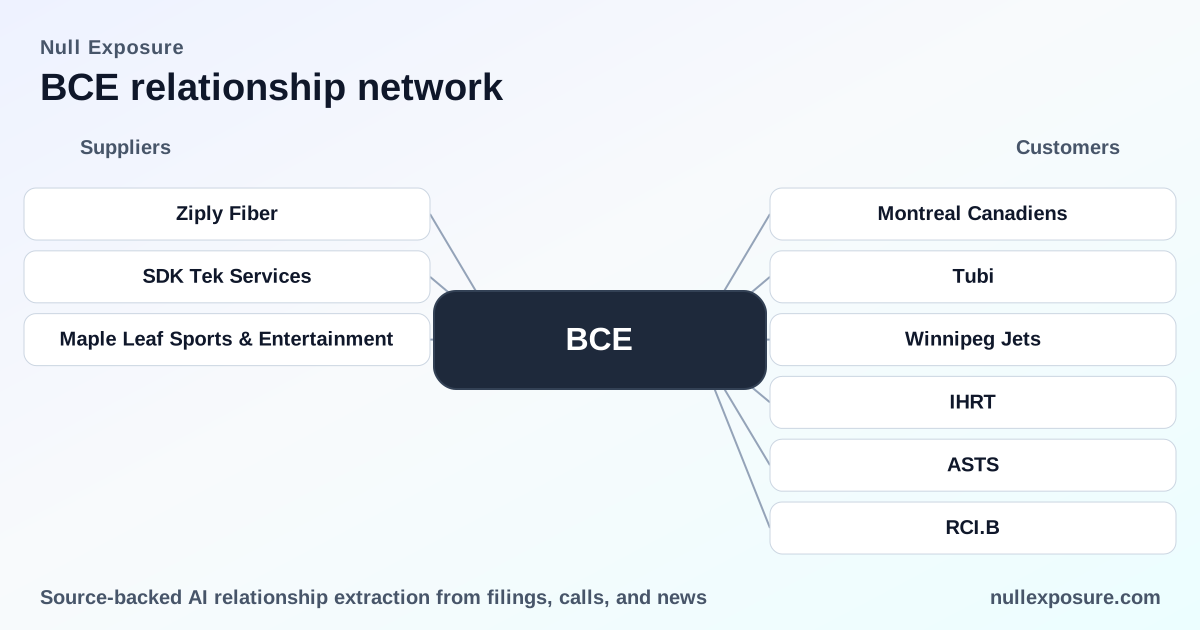
BCE Inc.: supplier relationships that reshape its network and content footprint
BCE operates as a vertically integrated Canadian telecommunications and media company that monetizes through subscription services (wireless, wireline, internet, TV), wholesale network access, and content rights and advertising. Its business model combines stable, cash-generating telecom operations with strategic content assets and targeted acquisitions to accelerate growth in key markets — most recently U.S. fiber — while preserving a high-yield income profile for investors.
For a focused supplier-risk profile and counterparty mapping for BCE, visit https://nullexposure.com/ to explore tailored research and signals.
How BCE’s contracting posture and financial profile shape supplier risk
BCE runs a mixed contracting posture: long-term, high-commitment deals where content and spectrum are involved, and more transactional vendor relationships for network build and equipment. Company filings show BCE generated approximately $24.47 billion in revenue TTM with a dividend yield of roughly 9.15%, reflecting a capital-return orientation that requires steady cash flow and constrains aggressive capital allocation to unproven suppliers. The firm’s EV/EBITDA (~5.2) and low P/E (~5.3) indicate a mature, cash-flow-oriented company able to finance acquisitions and network expansion but also sensitive to integration execution.
- Criticality: Network and content suppliers are high-criticality partners because downtime or rights gaps directly affect subscriber retention.
- Concentration: Revenue diversification across telecom services reduces single-supplier dependency, but content rights remain concentrated and strategically sensitive.
- Maturity: Financial metrics and institutional ownership (roughly 50% institutional holders) position BCE as a stable, income-focused counterparty that values long-term supplier reliability.
These company-level signals inform how operators and investors should view BCE’s supplier engagements: expect negotiated, long-tenor contracts for media/content and preferred-vendor dynamics for fiber/network rollouts.
Supplier relationships on the radar and what they mean for partners and investors
Ziply Fiber — a strategic U.S. growth platform
BCE’s acquisition of Ziply Fiber is positioned as a core growth engine for U.S. fiber expansion, providing scale and an operational platform to deploy fiber in high-demand markets. According to BCE’s Q4 2025 earnings call, the Ziply acquisition “marked a key milestone in our fiber growth strategy,” and management earlier described Ziply as “one of the best network growth engines in the U.S.” (Q4 2025 and Q3 2025 earnings calls).
Source: BCE Q4 2025 and Q3 2025 earnings calls (remarks referenced in March 2026 transcripts).
SDK Tek Services — ecosystem consolidation and platform strengthening
BCE referenced broader platform-strengthening activities that included third-party asset moves such as Ateko’s acquisition of SDK Tek Services in December 2025, noting these transactions as part of an effort to strengthen platforms on which BCE relies. This indicates BCE is monitoring and reacting to consolidation among specialized service providers that support its operations.
Source: BCE Q4 2025 earnings call (management commentary referencing Ateko and SDK Tek Services).
Maple Leaf Sports & Entertainment (MLSE) — asset sale with long-term content provisions
A separate market development saw Rogers agree to buy BCE’s 37.5% stake in MLSE for roughly $4.7 billion, while BCE’s Bell Media secured 20-year access to Maple Leafs and Raptors content on TSN, preserving downstream content supply despite the equity divestiture. This transaction reconfigures BCE’s direct ownership exposure to live sports venues while locking in long-term content rights that remain strategically important to Bell Media’s subscription offering.
Source: Canadian Lawyer Magazine report on Rogers’ acquisition of BCE’s MLSE stake (FY2026 news).
What these relationships imply for operators, procurement, and investors
- Integration risk is front-and-center with Ziply: acquiring and integrating a U.S. fiber operator creates supplier-onboarding and vendor-management complexities; expect BCE to standardize procurement and accelerate preferred-supplier agreements for fiber buildouts. This elevates the importance of delivering proven, scalable network solutions to secure long-term contracts.
- Platform consolidation raises supplier concentration risk in niche services: the movement of firms like SDK Tek into larger platforms suggests BCE’s suppliers are consolidating — suppliers that survive consolidation will have greater bargaining power or become more embedded. Monitor counterparty credit and integration roadmaps.
- Long-term content commitments reduce short-term ownership risk but lock in commercial dependencies: selling MLSE reduces BCE’s balance-sheet exposure to venue ownership, but the 20-year content access deal creates a long tail of commercial obligations and reliance on content monetization. Contract terms and escalation/litigation clauses should be core diligence priorities.
For supplier due diligence and counterparty heatmaps that align with these dynamics, see our research gateway at https://nullexposure.com/.
Quick action items for investors and operators evaluating BCE relationships
- Track Ziply integration KPIs: subscriber growth, churn in acquired footprints, and capex run-rate to assess whether U.S. fiber investment is converting to durable EBITDA.
- Review content-contract economics: understand revenue-share, renewal triggers, and exclusivity provisions in the 20-year TSN access agreement following the MLSE sale.
- Monitor supplier consolidation signals: prioritize credit and operational audits for critical vendors that have been acquired or are changing ownership (e.g., SDK Tek ecosystem).
Bottom line: where value and risk collide
BCE’s recent supplier- and asset-level moves underline a dual strategy: defensive monetization of core Canadian media assets through long-term content arrangements, and offensive expansion in U.S. fiber via Ziply. That combination produces stable cash flows and attractive yield for income investors, while creating execution and counterparty concentration risks tied to integration and long-term content commercialization. Investors and procurement teams should prioritize counterparties that can deliver scale, uptime, and predictable economics over the long contracts BCE prefers.
For customized supplier risk scoring and scenario-driven exposure analysis for BCE, start with a tailored report at https://nullexposure.com/.